


Legislators yesterday spent almost six-and-a-half hours at the Legislative Yuan debating a no-confidence motion against the Cabinet, but ended with no consensus.
Seventy-five of the 112 lawmakers were given five minutes each in the plenary session to opine on the Democratic Progressive Party’s (DPP) proposal before the motion is put to a vote this morning.
“The vote would be a monster detector for Chinese Nationalist Party (KMT) lawmakers — an indicator of whether they criticized President Ma Ying-jeou (馬英九) and Premier Jiang Yi-huah (江宜樺) on the one hand and voted to support them on the other,” DPP Legislator Gao Jyh-peng (高志鵬) said.
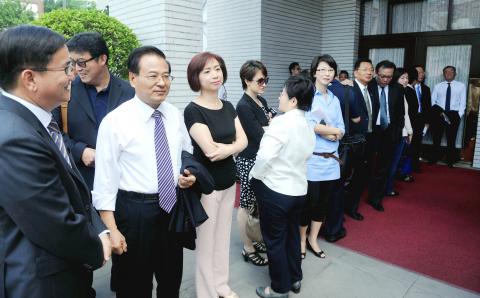
Photo: Wang Min-wei, Taipei Times
With the DPP controlling only 45 of the 112 votes — 40 of its own, three from the Taiwan Solidarity Union and two from the People First Party (PFP) —the chance of the motion passing the 50 percent threshold hinges on how many KMT lawmakers choose to vote against their own party, which has said that anyone who votes for the motion would face party discipline.
DPP lawmakers said that the rationale behind the motion was strong as Jiang had violated the due process of law and the Constitution in his “participation in a political conspiracy plotted by Ma, ignorance of the prosecutors’ abuse of wiretapping and lying to the public that he was unaware of the plan to remove Legislative Speaker Wang Jin-pyng (王金平).”
The premier has given conflicting statements when asked about Wang’s alleged involvement in an improper lobbying case, DPP Legislator Liu Chao-hao (劉櫂豪) said, first saying that he was not aware of the investigation prior to Sept. 4, but later admitting that he had met with Ma over the case on Aug. 31.
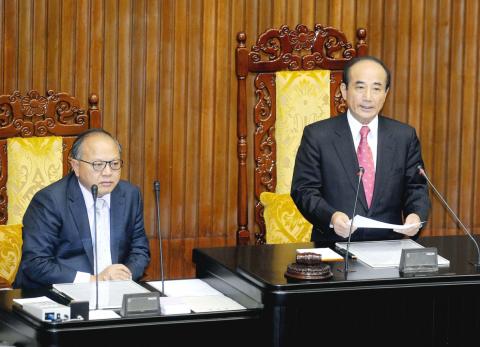
Photo: Wang Min-wei, Taipei Times
The motion of no confidence has become a “humble right” for the weak and “handicapped” legislature, which is not empowered with the right to investigate the powerful executive branch, DPP Legislator Tuan Yi-kang (段宜康) said.
Speaking in favor of the motion, PFP Legislator Thomas Lee (李桐豪) said that Jiang has accomplished almost nothing during his eight-month tenure and sparked controversy with every major policy, including the nuclear policy, the 12-year education plan, the capital gains tax and the cross-strait trade service agreement.
“The proposal is also on the table today because Ma has refused to communicate with the opposition. All he has done is to suppress the opposition by using the KMT majority,” Lee said.
KMT lawmakers countered the motion, criticizing DPP Chairman Su Tseng-chang (蘇貞昌) and the party’s “confrontational” style in the legislature.
“While other countries are working on fixing their economy, all the DPP thinks about is bringing down its political rivals,” KMT Legislator Huang Chao-hsun (黃昭順) said.
The DPP has initiated two no-confidence motions under Su’s leadership and the public is frustrated with the stalemated legislation in the Legislative Yuan because of the DPP’s relentless boycotts, KMT lawmakers said.
Apollo Chen (陳學聖) was one of the few KMT lawmakers who did not exclusively speak along the party line, saying that Ma and Jiang should “re-examine their attitude in handling political affairs” even if the motion failed to pass today.

NATIONAL SECURITY: Authorities are working to confirm the identities of the military personnel involved and investigating possible illegal conduct and regulatory violations Authorities are probing possible national security implications after Kinmen police and immigration officers on Sunday found a Chinese woman allegedly posing as a tourist while engaging in prostitution involving more than 10 military personnel. The woman, surnamed Chen (陳), has since been deported, authorities said, adding that investigators are still working to confirm the identities of those implicated, as the records only listed code names and aliases. The case stemmed from a report received by the Kinmen District Prosecutors’ Office on Friday last week from the Jinhu Precinct of the Kinmen County Police Bureau. On Sunday, police, along with the National Immigration

GLOBALGIVING: ‘ Caving to external pressure is not acceptable for an organization that has cultivated justice reform and human rights for 30 years,’ one NGO said A slew of non-government organizations (NGOs) have withdrawn from the GlobalGiving fundraising platform after it announced it would use “Chinese Taipei” instead of “Taiwan” from next month. The Taiwan Good Rice Association wrote on Facebook on Friday that it was informed on April 28 via a teleconference call of the change, which was made because the platform wanted to operate in China. Taiwan Good Rice is to terminate all cooperative relationships with GlobalGiving in response to the platform’s “unilateral and non-negotiable” decision to remove references to Taiwan, the NGO said. “Taiwan is in the official name of Taiwan Good Rice Association and the

HEAVY WEATHER: Typhoon Jangmi is due to crash straight into the Ryukyus as airlines look to shift flights to larger aircraft or cancel flights to Okinawa entirely Taiwan’s international air carriers announced flight adjustments over the weekend as Typhoon Jangmi is forecast to hit the Ryukyu Islands today and tomorrow. The Central Weather Administration (CWA) upgraded Jangmi from a tropical storm to a typhoon at 8am yesterday, with the eye located 580km south of Naha city. It was moving north at 19kph. Today, China Airlines’ CI-120, CI-121, CI-122 and CI-123 flights between Taoyuan and Naha, Okinawa, have been canceled as well as CI-132 and CI-133 between Kaohsiung and Naha. EVA Air’s BR-112, BR-113, BR-186 and BR-185 flights between Taoyuan and Naha are also canceled. Low-cost carrier Tigerair Taiwan canceled IT-230,

Chinese Nationalist Party (KMT) Chairwoman Cheng Li-wun (鄭麗文) yesterday briefed her party’s Central Standing Committee regarding her scheduled visit to the US between Monday next week and June 16, saying that her purpose would be to persuade the US that the Republic of China (ROC) Constitution was a “one China” constitution that would foster stable and peaceful cross-strait relations. The ROC Constitution is the most important defense for all Taiwanese citizens, as it upholds our democracy and has contributed to our robust economy, which aligns with international and US interests, she said. “We would not be troublemakers and drag the US under,”


 RSS
RSS