


US-Taiwan relations are now “fairly grim,” US-Taiwan Business Council president Rupert Hammond-Chambers said on Sunday.
Speaking at a press conference held on the eve of the 12th annual US-Taiwan Defense Industry Conference in Annapolis, Maryland, Hammond-Chambers said that he was “pessimistic” about the future of the relationship.
For the second year, both the US Department of State and the Department of Defense have failed to provide senior officials to speak at the conference although both have sent delegations.
While it is highly unlikely, there remains a slim chance that the Pentagon will send a last-minute speaker.
The two-day conference, closed to the press, has traditionally played an important role in promoting US-Taiwan relations.
The Taipei Economic and Cultural Representative Office has sent a 12-person team, including five senior military officials from Taipei led by Vice Minister of Armaments General Yen De-fa (嚴德發), who is giving a keynote speech.
However, while the Department of State has sent the Taiwan desk officer and other diplomats, senior officials are missing.
“While Taipei and Washington claim that the state of US-Taiwan relations has never been better, I would suggest that the reason there are no issues in the relationship is that neither side is pushing for anything of ambition,” Hammond-Chambers said.
He said Taipei had a policy of “no surprises” and that while the policy was extremely effective early in the administration of President Ma Ying-jeou (馬英九),“the utility of that policy ran its course after a couple of years.”
Taiwan is now in a situation where it asks for very little from the US and the US “is happy” to give very little, he said.
“And both sides declare it’s the best relationship for decades,” he said.
“When you look at this event, and there is no other conference of its kind in the US, this is the one opportunity every year [US President Barack] Obama[’s] administration has to get up there and say something about the relationship — and they pass,” Hammond-Chambers said.
“It speaks volumes about the state of US-Taiwan relations,” he said.
“If I was China, I would be thrilled by the state of US-Taiwan relations — there are no Cabinet-level visits, there are no arms sales, there are no significant demonstrations of US support for Taiwan and Taiwan’s sovereignty,” said Hammond-Chambers.
He said the US was making “very modest” efforts in the US-Taiwan relationship.
The Trade and Investment Framework Agreement is back up and running, but there is no discussion about Taiwan’s membership in the Trans Pacific Partnership and the visa waiver program was again just a modest step.
The Department of State was invited to provide a speaker six months ago, but waited until last week to turn down the invitation, giving no reason.
“I am pessimistic, I am very pessimistic, about the state of the relationship at the moment,” Hammond-Chambers said.
The US-Taiwan Business Council had always been wholly supportive of Ma’s policies for closer economic and cultural integration with China, he said.
“It was a significant risk that his administration took and over the initial period of time we believe it has reaped important rewards not just for Taiwan, but for China too and most significantly for the US,” Hammond-Chambers said.
However, Ma has run into difficulties with his policy, which was always going to be a challenge “as the low hanging fruit was picked” and more difficult issues started to arise, he said.
“Ma is having a difficult time in Taiwan at the moment,” Hammond-Chambers said, adding: “It is negatively impacting his ability to pass the most recent agreement between Taiwan and China, and the Chinese are frustrated that Taiwan does not seem to be prepared to move into political and military discussions.”
At the same time, the US has taken its “eye off the ball,” he said.
Hammond-Chambers said that the US was “hugely vested” in peace and security in the Taiwan Strait. However, if Washington was not focused on what was taking place between Taiwan and China — and the inherent difficulties that Ma now faces in continuing to move forward — “we run the risk that tensions will again start to rise in the Taiwan Strait.”
He said the US did not appear interested in investing significantly in the relationship with Taiwan and impressing upon China that it remained engaged.
“Actions speak louder than words,” he said.
Hammond-Chambers said that it had been years since a US assistant secretary of state had given a speech on the importance of Taiwan relations.
“This was an opportunity to do that, to talk about where they think the relationship is and where it is going — and they took a pass,” he said.
Only two Taiwan arms sales programs are still being considered by the US — the provision of F-16C/D aircraft and assistance to Taiwan in procuring submarines.
However, there was “no political will” to move forward with either of them, he said.
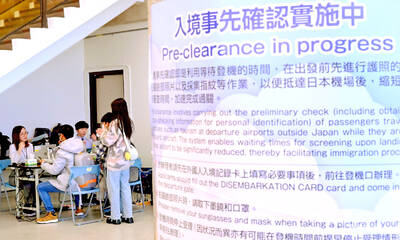
A preclearance service to facilitate entry for people traveling to select airports in Japan would be available from Thursday next week to Feb. 25 at Taiwan Taoyuan International Airport, Taoyuan International Airport Corp (TIAC) said on Tuesday. The service was first made available to Taiwanese travelers throughout the winter vacation of 2024 and during the Lunar New Year holiday. In addition to flights to the Japanese cities of Hakodate, Asahikawa, Akita, Sendai, Niigata, Okayama, Takamatsu, Kumamoto and Kagoshima, the service would be available to travelers to Kobe and Oita. The service can be accessed by passengers of 15 flight routes operated by
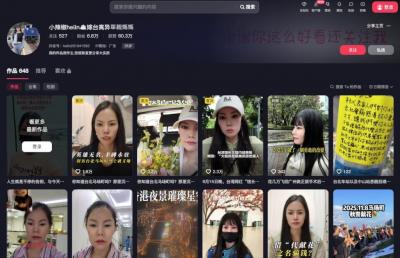
Chinese spouse and influencer Guan Guan’s (關關) residency permit has been revoked for repeatedly posting pro-China videos that threaten national security, the National Immigration Agency confirmed today. Guan Guan has said many controversial statements in her videos posted to Douyin (抖音), including “the red flag will soon be painted all over Taiwan” and “Taiwan is an inseparable part of China,” and expressing hope for expedited reunification. The agency last year received multiple reports alleging that Guan Guan had advocated for armed reunification. After verifying the reports, the agency last month issued a notice requiring her to appear and explain her actions. Guan

GIVE AND TAKE: Blood demand continues to rise each year, while fewer young donors are available due to the nation’s falling birthrate, a doctor said Blood donors can redeem points earned from donations to obtain limited edition Formosan black bear travel mugs, the Kaohsiung Blood Center said yesterday, as it announced a goal of stocking 20,000 units of blood prior to the Lunar New Year. The last month of the lunar year is National Blood Donation Month, when local centers seek to stockpile blood for use during the Lunar New Year holiday. The blood demand in southern Taiwan — including Tainan and Kaohsiung, as well as Chiayi, Pingtung, Penghu and Taitung counties — is about 2,000 units per day, the center said. The donation campaign aims to boost
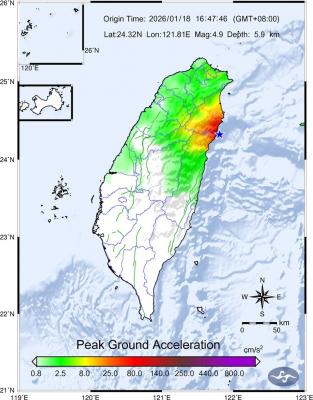
The Central Weather Administration (CWA) said a magnitude 4.9 earthquake that struck off the coast of eastern Taiwan yesterday was an independent event and part of a stress-adjustment process. The earthquake occurred at 4:47pm, with its epicenter at sea about 45.4km south of Yilan County Hall at a depth of 5.9km, the CWA said. The quake's intensity, which gauges the actual effects of a temblor, was highest in several townships in Yilan and neighboring Hualien County, where it measured 4 on Taiwan's seven-tier intensity scale, the CWA said. Lin Po-yu (林柏佑), a division chief at the CWA's Seismological Center, told a news conference


 RSS
RSS