


US Secretary of State John Kerry held a one-hour breakfast meeting with Chinese Minister of Foreign Affairs Wang Yi (王毅) on Thursday in New York, discussing issues that included the South China Sea and human rights.
During a briefing given later by a senior US Department of State official, Taiwan was not mentioned.
On the South China Sea, the official said that Kerry underscored the US view that it was very important for all claimants to be consistent with international law.
Kerry also reaffirmed the US’ position that conduct in disputed areas must be “careful and without intimidation.”
Kerry strongly urged that only “diplomatic and peaceful means” be used to address areas of difference, the official said.
“This was not a negotiating session, this was a strategy session,” the official said.
Both Wang and Kerry were in New York for the UN General Assembly.
Sources have told the Taipei Times that during private meetings over the last few days, Wang has discussed arms sales to Taiwan with Pentagon officials and with Kerry.
This follows a lengthy speech at the Brookings Institution in Washington last week when Wang said that the Asia-Pacific region was not only the world’s fastest-growing and most promising region, it was also home to “most of the hotspot issues.”
He also said that the US must respect China’s interests and concerns.
“The ‘Taiwan question’ concerns China’s sovereignty and territorial integrity,” Wang said. “Gradual integration of the two sides through two-way interactions and cooperation will lead to ultimate reunification. This is a historical trend that no one can stop.”
Wang said that for many years, the “Taiwan question” has been a liability in China-US relations that has undermined mutual trust as well as disrupting cooperation.
“However, if the United States can go along with the prevailing trend of peaceful development of cross-strait relations and genuinely appreciate and respect China’s efforts to oppose separation and achieve peaceful reunification, the issue — once a liability and negative factor in our relationship — will be turned into an asset and a positive factor, providing guarantee to the long-term, steady growth of China-US relations and opening [the] prospect for all-round cooperation,” the minister said.
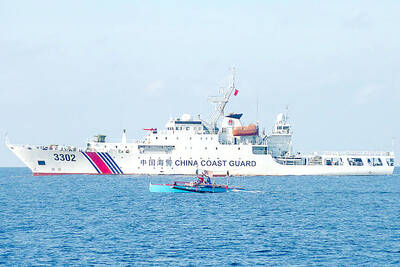
EXPANSIONIST: China deploys an average of 40 to 50 warships and coast guard vessels daily in the South China Sea, despite pledges not to militarize the region, an official said China is attempting to expand its influence across the First Island Chain and increase pressure on Japan by sending coast guard vessels into waters off of Taiwan under the pretext of maritime negotiations with Japan and the Philippines, a national security official said yesterday. China’s recent actions in the waters east of Taiwan and Japan and the Philippines’ exclusive economic zones (EEZ) are attempts to establish dominance in First Island Chain waters, said the official who declined to be named, adding that this is “expansion disguised as law enforcement.” Framing China’s actions solely as a cross-strait issue is a serious misjudgment that
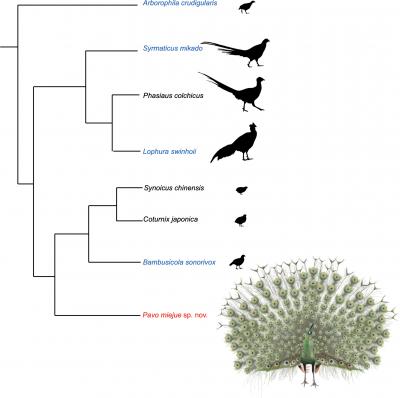
Through analyzing fossil evidence, a research team at National Taiwan University (NTU) discovered the largest endemic bird to have lived in Taiwan, naming it Pavo miejue, or extinct peafowl (滅絕孔雀). The Mikado pheasant, which is printed on the back of the NT$1,000 bank note, was previously believed to be the biggest endemic bird to Taiwan. The research team’s findings suggest that Pavo miejue lived during the Pleistocene epoch tens of thousands of years ago. It is the first endemic extinct bird species discovered and formally named in Taiwan. The study was coauthored by NTU Institute of Ecology and Evolutionary Biology professor Tsai Cheng-hsiu (蔡政修),
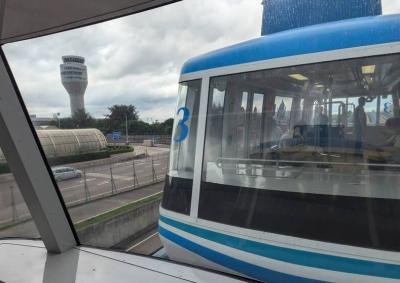
Taiwan Taoyuan International Airport is to suspend its automated Skytrain service connecting Terminal 1 and Terminal 2 starting on July 1 to facilitate connection works for the upcoming Terminal 3, the airport operator said today. Passengers and staff who need to travel between the two terminals after the suspension can instead use the Taoyuan MRT or the airport's 24-hour shuttle bus service, Taoyuan International Airport Corp said. The Taoyuan MRT Airport Line directly links the two terminals, while the shuttle buses are to operate around the clock, the company added. The Skytrain provides free transportation between the airport’s two terminals for travelers and
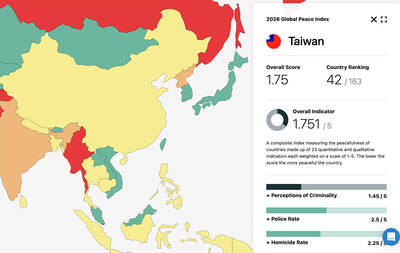
Taiwan ranked 42nd in terms of peacefulness among 163 countries, down five places from last year, according to this year’s Global Peace Index. With an overall score of 1.751, Taiwan dropped from 37th last year, the report published by the global Institute for Economics and Peace showed. The overall score measures a country’s level of peacefulness using 23 quantitative and qualitative indicators across three domains — ongoing domestic and international conflict, societal safety and security, and militarization. While Taiwan ranked 42nd worldwide, it was listed in ninth place among the 19 Asian-Pacific countries in the report, after New Zealand, Singapore, Japan, Malaysia,


 RSS
RSS