


Nearly a fifth of a government inspection of 127 samples of packaged rice failed to meet standards, the Agriculture and Food Agency said yesterday.
Following the discovery last month that Chyuan Shun Food Enterprise Co — one of the three largest rice mills and distributors in the nation that markets its products under the name Shanshui Rice — had been selling a type of packaged rice labeled as domestically grown, but which was actually mixed with cheaper imported rice, the agency said it had expanded its inspection of packaged rice.
It tested 127 products from 26 companies — 42 by Chyuan Shun, 21 by Yeedon Enterprise Co (Sanhao Rice), 21 by Union Rice Co (Zhongxin Rice) and 43 products from 23 other companies — that were sold in supermarkets and hypermarkets
The inspection again found that two products from Chyuan Shun were mislabeled, with the product origin described as 50 percent from Taiwan and 50 percent from Thailand, but test results showed that the bags did not contain any domestic rice.
The company was fined NT$200,000 (US$6,750) for each product in accordance with the Food Administration Act (糧食管理法).
Still another product by Chyuan Chun resulted in a NT$40,000 fine for mislabeling the type of rice variety. The agency ordered that all three products be pulled off the shelves immediately.
The 21 other products were found to have other labeling problems or were not up to standard, and the companies were given 30 days to make improvements.
The agency added that it had made some changes to penalties for violating the Food Administration Act to improve food monitoring and management. These include directly fining companies with serious false labeling problems and requiring them to withdraw their products immediately.
Companies found at fault and punished more than three times in a year would have their registration certificate invalidated, the agency said.
The agency said it had inspected 2,557 packaged rice products since June 2011, of which producers of 332 products were asked to improve within a certain period and 46 faced aggregate penalties of NT$2.02 million.


Kenting National Park service technician Yang Jien-fon (楊政峰) won a silver award in World Grand Prix Photography Awards Spring Season for his photograph of two male rat snakes intertwined in combat. Yang’s colleagues at Kenting National Park said he is a master of nature photography who has been held back by his job in civil service. The awards accept entries in all four seasons across six categories: architectural and urban photography, black-and-white and fine art photography, commercial and fashion photography, documentary and people photography, nature and experimental photography, and mobile photography. Awards are ranked according to scores and divided into platinum, gold and

More than half of the bamboo vipers captured in Tainan in the past few years were found in the city’s Sinhua District (新化), while other districts had smaller catches or none at all. Every year, Tainan captures about 6,000 snakes which have made their way into people’s homes. Of the six major venomous snakes in Taiwan, the cobra, the many-banded krait, the brown-spotted pit viper and the bamboo viper are the most frequently captured. The high concentration of bamboo vipers captured in Sinhua District is puzzling. Tainan Agriculture Bureau Forestry and Nature Conservation Division head Chu Chien-ming (朱健明) earlier this week said that the
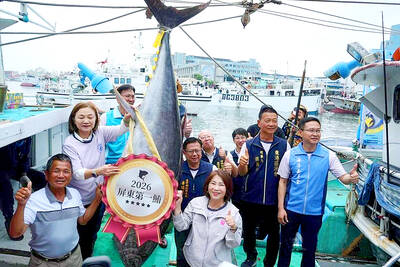
The first bluefin tuna of the season, brought to shore in Pingtung County and weighing 190kg, was yesterday auctioned for NT$10,600 (US$333.5) per kilogram, setting a record high for the local market. The auction was held at the fish market in Donggang Fishing Harbor, where the Siaoliouciou Island-registered fishing vessel Fu Yu Ching No. 2 delivered the “Pingtung First Tuna” it had caught for bidding. Bidding was intense, and the tuna was ultimately jointly purchased by a local restaurant and a local company for NT$10,600 per kilogram — NT$300 ,more than last year — for a total of NT$2.014 million. The 67-year-old skipper
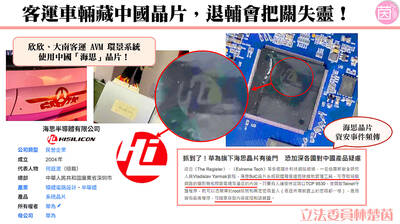
BREACH OF CONTRACT: The bus operators would seek compensation and have demanded that the manufacturer replace the chips with ones that meet regulations Two bus operators found to be using buses with China-made chips are to demand that the original manufacturers replace the systems and provide compensation for breach of contract, the Veterans Affairs Council said yesterday. Democratic Progressive Party Legislator Michelle Lin (林楚茵) yesterday said that Da Nan Bus Co and Shin-Shin Bus Co Ltd have fielded a total of 82 buses that are using Chinese chips. The bus models were made by Tron-E, while the systems provider was CYE Electronics, Lin said. Lin alleged that the buses were using chips manufactured by Huawei subsidiary HiSilicon Co, which presents a national security risk if the


 RSS
RSS