


President Ma Ying-jeou (馬英九) yesterday held a party-government policy meeting with four top officials from the legislative and administrative branches in place of the suspended weekly meeting of “the committee of five,” with Chinese Nationalist Party (KMT) caucus whip Lin Hung-chih (林鴻池) attending instead of Legislative Speaker Wang Jin-pyng (王金平).
“My duty [as whip] is to take charge of communications and negotiations between the government and the ruling party, serving as a bridge between the legislative and administrative branches and seeking to forge consensus within the party,” Lin said when approached by reporters before attending the meeting.
Lin said the party-government policy meeting was a platform through which he could further facilitate communication between the two branches and give constructive advice on major policy matters.
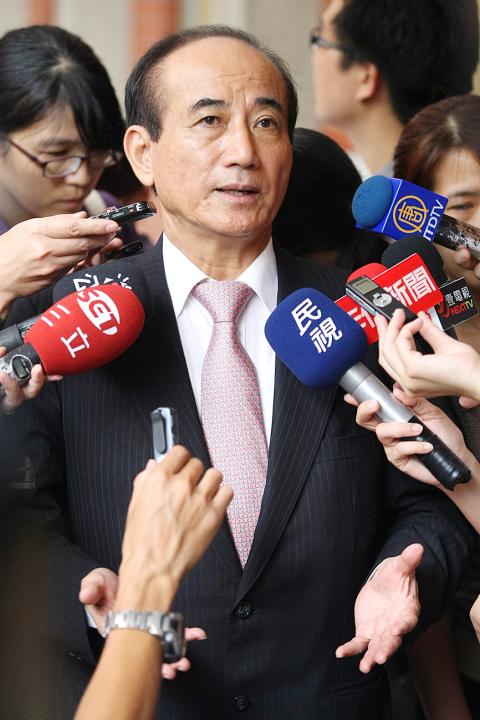
Photo: CNA
“There is absolutely no such thing as me replacing Speaker Wang,” Lin said.
Lin attended the meeting as representative of the legislative branch, a role originally served by Wang before Ma and the KMT, of which the president is chairman, made “necessary adjustments” to meetings in which Wang had been participating after his KMT membership was revoked on Sept. 11 for his alleged improper lobbying on behalf of Democratic Progressive Party caucus whip Ker Chien-ming (柯建銘) in a legal matter.
The adjustments include suspension of the weekly Monday meeting of the committee of five — which comprises Ma, Wang, Vice President Wu Den-yih (吳敦義), Premier Jiang Yi-huah (江宜樺) and KMT Secretary-General Tseng Yung-chuan (曾永權) — and the exclusion of Wang from tea gatherings including Ma and lawmakers held before the opening of the new legislative session last week.
Presidential Office officials have said that Ma would not change his zero-tolerance stance on Wang’s alleged improper lobbying, and would continue to make necessary changes to activities outside the constitutional structure that Wang had been taking part in.
Ma’s moves to exclude Wang from decisionmaking meetings have been seen by many as blatantly defying a Sept. 13 Taipei District Court ruling in favor of Wang’s provisional injunction seeking to retain his party membership and rights until the case is settled in court.
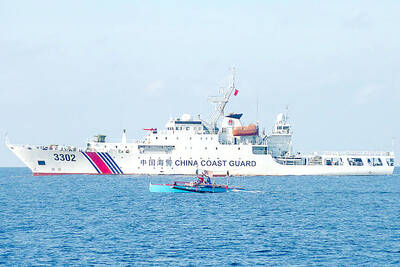
EXPANSIONIST: China deploys an average of 40 to 50 warships and coast guard vessels daily in the South China Sea, despite pledges not to militarize the region, an official said China is attempting to expand its influence across the First Island Chain and increase pressure on Japan by sending coast guard vessels into waters off of Taiwan under the pretext of maritime negotiations with Japan and the Philippines, a national security official said yesterday. China’s recent actions in the waters east of Taiwan and Japan and the Philippines’ exclusive economic zones (EEZ) are attempts to establish dominance in First Island Chain waters, said the official who declined to be named, adding that this is “expansion disguised as law enforcement.” Framing China’s actions solely as a cross-strait issue is a serious misjudgment that
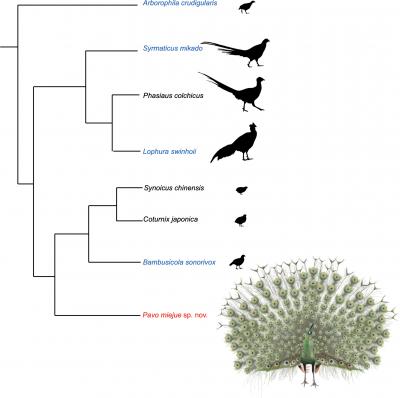
Through analyzing fossil evidence, a research team at National Taiwan University (NTU) discovered the largest endemic bird to have lived in Taiwan, naming it Pavo miejue, or extinct peafowl (滅絕孔雀). The Mikado pheasant, which is printed on the back of the NT$1,000 bank note, was previously believed to be the biggest endemic bird to Taiwan. The research team’s findings suggest that Pavo miejue lived during the Pleistocene epoch tens of thousands of years ago. It is the first endemic extinct bird species discovered and formally named in Taiwan. The study was coauthored by NTU Institute of Ecology and Evolutionary Biology professor Tsai Cheng-hsiu (蔡政修),
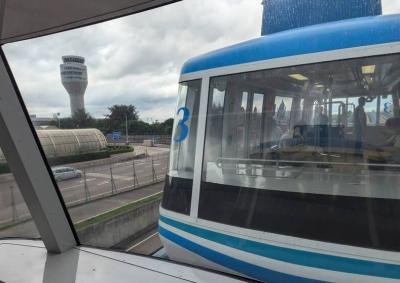
Taiwan Taoyuan International Airport is to suspend its automated Skytrain service connecting Terminal 1 and Terminal 2 starting on July 1 to facilitate connection works for the upcoming Terminal 3, the airport operator said today. Passengers and staff who need to travel between the two terminals after the suspension can instead use the Taoyuan MRT or the airport's 24-hour shuttle bus service, Taoyuan International Airport Corp said. The Taoyuan MRT Airport Line directly links the two terminals, while the shuttle buses are to operate around the clock, the company added. The Skytrain provides free transportation between the airport’s two terminals for travelers and
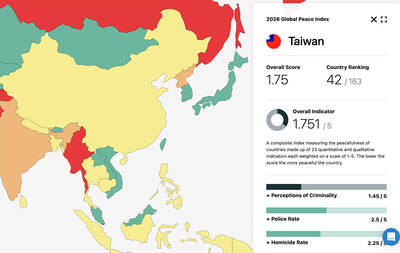
Taiwan ranked 42nd in terms of peacefulness among 163 countries, down five places from last year, according to this year’s Global Peace Index. With an overall score of 1.751, Taiwan dropped from 37th last year, the report published by the global Institute for Economics and Peace showed. The overall score measures a country’s level of peacefulness using 23 quantitative and qualitative indicators across three domains — ongoing domestic and international conflict, societal safety and security, and militarization. While Taiwan ranked 42nd worldwide, it was listed in ninth place among the 19 Asian-Pacific countries in the report, after New Zealand, Singapore, Japan, Malaysia,


 RSS
RSS