


With schools set to welcome pupils returning for the autumn semester later this month, a children’s welfare organization said a recent survey found that more than a third of children from underprivilieged families are unable to pay for lunch and other school fees.
According to the survey commissioned by the Child Welfare League Foundation (CWLF), one in three children from needy families do not eat breakfast every day, 30 percent of them have less than NT$30 (US$1) to spend on dinner and 60 percent go to sleep hungry.
The survey, carried out in December last year and January this year which questioned 853 children, also revealed that the parents of 38.6 percent of underprivileged children attending grade school are divorced or separated, while 12 percent of the children were being raised by their grandparents.
Of the underprivileged children, 44.7 percent said they worry about their personal belongings, such as school bags, books, sports equipment and swim wear, being damaged as their families do not have the money to buy new ones, while 67.8 percent admitted to often having to borrow coloring pencils, reference books and other items of stationery from their classmates.
Foundation chief executive Chen Li-ju (陳麗如) said that kids from underprivileged families have a lack of educational opportunities and resources, which negatively impacts their academic performance.
“For underprivileged students, 23.4 percent have average scores near the pass level in school tests, 16.4 percent get higher grades while being unable to write all 26 letters of the English alphabet and 46 percent said they have no one at home to help them with their homework,” she said.
Although 45.9 percent of underprivileged children want to attend cram school to improve their grades, 53 percent do not have the money to pay for it.
“Also, 93.3 percent of teachers of these students say they worry that the parents cannot pay for after-school care, with 34.3 percent of the children saying they participate in after-school care so that they get a meal for supper,” Chen said.
The foundation is cooperating with AIA Insurance to set up a support program for needy children, Chen said. People wishing to take part can call the CWLF on (02) 2550-5959 ext. 1.
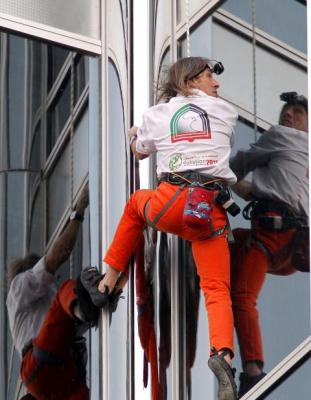
Alain Robert, known as the "French Spider-Man," praised Alex Honnold as exceptionally well-prepared after the US climber completed a free solo ascent of Taipei 101 yesterday. Robert said Honnold's ascent of the 508m-tall skyscraper in just more than one-and-a-half hours without using safety ropes or equipment was a remarkable achievement. "This is my life," he said in an interview conducted in French, adding that he liked the feeling of being "on the edge of danger." The 63-year-old Frenchman climbed Taipei 101 using ropes in December 2004, taking about four hours to reach the top. On a one-to-10 scale of difficulty, Robert said Taipei 101

Nipah virus infection is to be officially listed as a category 5 notifiable infectious disease in Taiwan in March, while clinical treatment guidelines are being formulated, the Centers for Disease Control (CDC) said yesterday. With Nipah infections being reported in other countries and considering its relatively high fatality rate, the centers on Jan. 16 announced that it would be listed as a notifiable infectious disease to bolster the nation’s systematic early warning system and increase public awareness, the CDC said. Bangladesh reported four fatal cases last year in separate districts, with three linked to raw date palm sap consumption, CDC Epidemic Intelligence
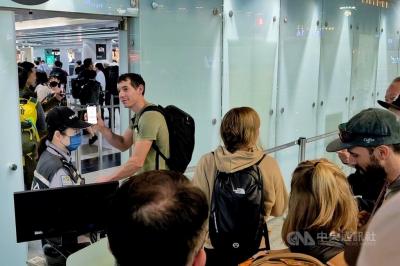
US climber Alex Honnold left Taiwan this morning a day after completing a free-solo ascent of Taipei 101, a feat that drew cheers from onlookers and gained widespread international attention. Honnold yesterday scaled the 101-story skyscraper without a rope or safety harness. The climb — the highest urban free-solo ascent ever attempted — took just more than 90 minutes and was streamed live on Netflix. It was covered by major international news outlets including CNN, the New York Times, the Guardian and the Wall Street Journal. As Honnold prepared to leave Taiwan today, he attracted a crowd when he and his wife, Sanni,

Taiwanese and US defense groups are collaborating to introduce deployable, semi-autonomous manufacturing systems for drones and components in a boost to the nation’s supply chain resilience. Taiwan’s G-Tech Optroelectronics Corp subsidiary GTOC and the US’ Aerkomm Inc on Friday announced an agreement with fellow US-based Firestorm Lab to adopt the latter’s xCell, a technology featuring 3D printers fitted in 6.1m container units. The systems enable aerial platforms and parts to be produced in high volumes from dispersed nodes capable of rapid redeployment, to minimize the risk of enemy strikes and to meet field requirements, they said. Firestorm chief technology officer Ian Muceus said


 RSS
RSS