


Taiwan is the front line in an emerging global battle for cyberspace, according to elite hackers in the country’s IT industry, who say it has become a rehearsal area for the Chinese cyberattacks that have strained ties with the US.
Taiwan has endured at least a decade of highly targeted data-theft attacks that are then directed towards larger countries, they say.
“We’ve seen everything,” said Jim Liu, the 28-year-old founder of Lucent Sky, a Taiwanese Internet security company specializing in resolving dangerous software vulnerabilities that hackers can exploit to gain access to a system. “We’ll see a specific attack signature here, and then six months later, see the same signature in an attack on the States.”
A Pentagon report in May accused China of trying to break into US defense computer networks. It followed another report in February by US computer security company Mandiant that said a secretive Chinese military unit was probably behind a series of hacking attacks that had stolen data from about 100 US companies.
Beijing dismissed both reports as without foundation. Taiwan experts say that hacking methods such as those outlined in the Mandiant report are the same kinds of security breaches that they had seen several years earlier.
It is easy to see why Taiwan might be an ideal target for Chinese hackers: It is close to China, Mandarin-speaking and boasts advanced Internet infrastructure.
This cyberwar playing out across the Taiwan Strait first came to public attention in 2003, when a Taiwanese police agency realized hackers had stolen personal data, including household registration information, from its computer system.
These attacks differed from traditional hacking attempts — where many casual hackers attempt to disrupt their targets’ systems, these hackers went in stealthily, with the intention to plunder, rather than destroy.
“Back then, it was very rare to see these kinds of social network attacks,” said hacking specialist Jeremy Chiu, a contract instructor in IT for Taiwan’s intelligence agencies. “They were very, very well-organized.”
Other indicators, including the ease with which the hackers penetrated an e-mail system written entirely in Chinese, painted a picture of the culprits as a large, coordinated group of hackers in China.
“One thing that indicates government support for these attacks is just the sheer volume — how many agencies are being attacked on a daily basis,” said Benson Wu, postdoctoral researcher in information technology at Academia Sinica and co-founder of Xecure Lab, which focuses on responding to advanced persistent threats.
The set-up of Wu’s Taipei office fits the classic hacker image: dimly lit, strewn with wires and humming with computers.
On a projector screen, he displayed a list of e-mails, written in Chinese, with subject headings like “meeting notes,” “dinner attendance” and “questionnaire.”
“These are all hacking attempts,” Wu said.
Once the documents have been opened, they plant a backdoor allowing the hacker virtually unfettered access to the network.
One such “spearphishing” attack was reportedly used on the White House in October last year. A Taiwanese expert in cyberespionage estimated that thousands of Taiwanese high-level government employees receive as many as between 20 and 30 of these e-mails a month.
“We’ve been following these Chinese hackers for so long, we can track their daily work schedule,” said the expert, who asked not to be identified. “People expect hackers to be night owls, but these guys work very normal hours — on Chinese national holidays, for example, we don’t see any hacking activity at all.”
However, tracking the exact source of the attacks remains a slippery game of Internet sleuth.
“We take the IP address culled from the attack as a springboard, then track it through the Internet — perhaps the same IP address was used in a forum registration, or to register a QQ handle,” he said, referring to a popular Chinese chat program. “It depends how good they are at covering their tracks.”
China denies being behind hacking attacks on other nations and insists it is a major victim of cyberattacks, including from the US — an argument that Beijing sees as strengthened by revelations last month from former National Security Agency contractor Edward Snowden about top-secret US electronic surveillance programs.
The US and China held talks focused on cyberissues last week.
According to Internet platform Akamai, 27 percent of worldwide hacking activity last year originated in China. However, the same report also placed Taiwan among the top five digital attack originating countries last year.
“Taiwan is one of the key countries where we see a lot of activity,” Singapore-based malware researcher Chong Rong Hwa of network security firm FireEye Inc said.
A report issued by SecureWorks, a network safety arm of PC maker Dell Inc, said the Taiwanese government’s ministries are swarming with a particularly malicious form of data-nabbing computer virus.
In one year, Taiwan’s National Security Bureau encountered more than 3 million hacking attempts from China, according to statements given by bureau director Tsai Der-sheng (蔡得勝) in March in response to questions from lawmakers.
Military and technology intelligence was included among the pilfered data.
“Taiwan will continue to be the battleground for lots of cyberattacks; it’s like we are on our own,” Wu said. “China has a huge pool of talent and technical resources.”

The manufacture of the remaining 28 M1A2T Abrams tanks Taiwan purchased from the US has recently been completed, and they are expected to be delivered within the next one to two months, a source said yesterday. The Ministry of National Defense is arranging cargo ships to transport the tanks to Taiwan as soon as possible, said the source, who is familiar with the matter. The estimated arrival time ranges from late this month to early next month, the source said. The 28 Abrams tanks make up the third and final batch of a total of 108 tanks, valued at about NT$40.5 billion

Two Taiwanese prosecutors were questioned by Chinese security personnel at their hotel during a trip to China’s Henan Province this month, the Mainland Affairs Council (MAC) said yesterday. The officers had personal information on the prosecutors, including “when they were assigned to their posts, their work locations and job titles,” MAC Deputy Minister and spokesman Liang Wen-chieh (梁文傑) said. On top of asking about their agencies and positions, the officers also questioned the prosecutors about the Cross-Strait Joint Crime-Fighting and Judicial Mutual Assistance Agreement, a pact that serves as the framework for Taiwan-China cooperation on combating crime and providing judicial assistance, Liang

A group from the Taiwanese Designers in Australia association yesterday represented Taiwan at the Midsumma Pride March in Melbourne. The march, held in the St. Kilda suburb, is the city’s largest LGBTQIA+ parade and the flagship event of the annual Midsumma Festival. It attracted more than 45,000 spectators who supported the 400 groups and 10,000 marchers that participated this year, the association said. Taiwanese Designers said they organized a team to march for Taiwan this year, joining politicians, government agencies, professionals and community organizations in showing support for LGBTQIA+ people and diverse communities. As the first country in Asia to legalize same-sex
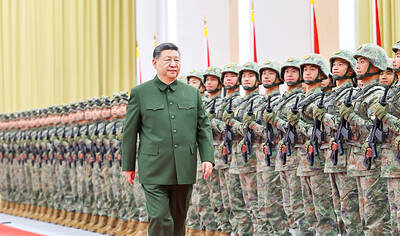
MOTIVES QUESTIONED The PLA considers Xi’s policies toward Taiwan to be driven by personal considerations rather than military assessment, the Epoch Times reports Chinese President Xi Jinping’s (習近平) latest purge of the Chinese People’s Liberation Army (PLA) leadership might have been prompted by the military’s opposition to plans of invading Taiwan, the Epoch Times said. The Chinese military opposes waging war against Taiwan by a large consensus, putting it at odds with Xi’s vision, the Falun Gong-affiliated daily said in a report on Thursday, citing anonymous sources with insight into the PLA’s inner workings. The opposition is not the opinion of a few generals, but a widely shared view among the PLA cadre, the Epoch Times cited them as saying. “Chinese forces know full well that


 RSS
RSS