


Minister of National Defense Kao Hua-chu (高華柱) yesterday again apologized for the death of army corporal Hung Chung-chiu (洪仲丘) and pledged to hold every responsible individual in the case accountable, and to carry out a comprehensive military reform.
It was the third time that Kao, who has offered to resign over the case, bowed in apology because details surrounding the death of the 23-year-old remain sketchy and suspicious more than two weeks after the unfortunate incident.
“We will uphold what we have promised at previous press conferences — to be honest about [what we have done wrong], to investigate and prosecute the case in accordance with the law, to reveal details, to discover the truth behind the matter and to conduct a thorough review of relevant systems [to prevent a similar case from happening],” Kao told a press conference organized by the Chinese Nationalist Party (KMT) caucus at the Legislative Yuan in Taipei.
Hung was found by a post-mortem examination to have died of heatstroke, which his family believes was brought on by excessive exercise forced upon him as punishment for taking a cellphone with a camera onto his army base without permission.
Kao still failed to explain what happened during the 80 minutes from 2pm and 3:20pm on July 1, when Hung was asked to perform a series of exercises in a field, and during the 30 minutes from 5:30pm and 6pm on July 3, before Hung fell down in the dining room of the disciplinary barracks and was sent to hospital.
Hung died in hospital in the early hours of the next day.
The ministry has provided surveillance video footage of events since Hung was punished with solitary confinement on June 28, but the situation in the two specific time slots remains unclear because the video footage filmed during those times is missing.
Kao did not answer why the ministry was unable to provide the two pieces of video footage recorded during those periods and referred the question to Senior Military Prosecutor Major-General Tsao Chin-sheng (曹金生), who was also present at the press conference.
Tsao said the video recording of Hung’s training session on July 1 was submitted to the Ministry of Justice’s Bureau of Investigation for examination in the hope that missing images of the 80-minute segment could be restored.
Given that the footage taken on July 1 was supposed to be hours of continuous video, “we were also eager to know why there were no images taken during the 80 minutes. Was it a result of mechanical failure or a deliberate man-made event? We will give an explanation soon, as the Ministry of Justice’s Bureau of Investigation is examining the video,” Tsao said.
Tsao said the 30 minutes Hung spent in the dining room were not captured on film because he was in a corner of the area, outside the surveillance camera’s range.
Kao told the press conference that the ministry would present proposals to improve conditions in disciplinary confinement by the end of this month, including one that surveillance cameras should be able to film every corner of the army’s confinement barracks.
The confinement barracks will remain closed until improvements are made, Kao said.
A total of 37 military officers, including Army Commander General Lee Hsiang-chou (李翔宙), have been reprimanded by the ministry over the case.
Separately yesterday, President Ma Ying-jeou (馬英九) reiterated his regret over the case and pledged efforts to have the Ministry of National Defense examine the military system and avoid abuse of power in the future.
“The military should learn a lesson from the incident and correct its mistakes immediately after a review of its system. We must restore the people’s faith in the military,” he said while speaking at a Republic of China Veterans Association meeting in Taipei.
In a last-minute decision to attend the event and use the occasion to address the incident, Ma added that he expected the ministry to facilitate the investigation of the case and prevent further damage of its reputation.
While pledging to uncover the truth behind the incident, Ma also defended the efforts of the military in disaster relief work, especially during typhoon seasons.
“We must get to the bottom of the case. However, we should also continue our support for hardworking soldiers,” he said.

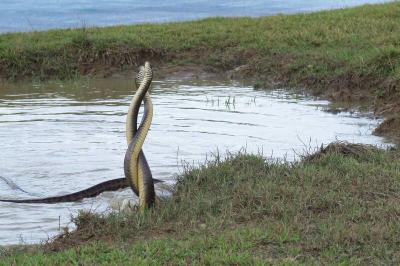
Kenting National Park service technician Yang Jien-fon (楊政峰) won a silver award in World Grand Prix Photography Awards Spring Season for his photograph of two male rat snakes intertwined in combat. Yang’s colleagues at Kenting National Park said he is a master of nature photography who has been held back by his job in civil service. The awards accept entries in all four seasons across six categories: architectural and urban photography, black-and-white and fine art photography, commercial and fashion photography, documentary and people photography, nature and experimental photography, and mobile photography. Awards are ranked according to scores and divided into platinum, gold and

More than half of the bamboo vipers captured in Tainan in the past few years were found in the city’s Sinhua District (新化), while other districts had smaller catches or none at all. Every year, Tainan captures about 6,000 snakes which have made their way into people’s homes. Of the six major venomous snakes in Taiwan, the cobra, the many-banded krait, the brown-spotted pit viper and the bamboo viper are the most frequently captured. The high concentration of bamboo vipers captured in Sinhua District is puzzling. Tainan Agriculture Bureau Forestry and Nature Conservation Division head Chu Chien-ming (朱健明) earlier this week said that the
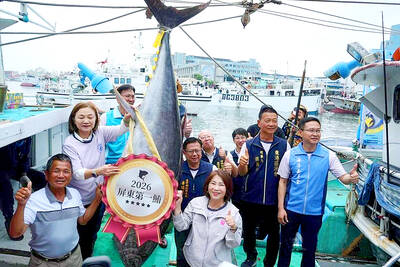
The first bluefin tuna of the season, brought to shore in Pingtung County and weighing 190kg, was yesterday auctioned for NT$10,600 (US$333.5) per kilogram, setting a record high for the local market. The auction was held at the fish market in Donggang Fishing Harbor, where the Siaoliouciou Island-registered fishing vessel Fu Yu Ching No. 2 delivered the “Pingtung First Tuna” it had caught for bidding. Bidding was intense, and the tuna was ultimately jointly purchased by a local restaurant and a local company for NT$10,600 per kilogram — NT$300 ,more than last year — for a total of NT$2.014 million. The 67-year-old skipper
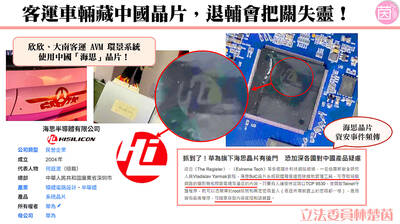
BREACH OF CONTRACT: The bus operators would seek compensation and have demanded that the manufacturer replace the chips with ones that meet regulations Two bus operators found to be using buses with China-made chips are to demand that the original manufacturers replace the systems and provide compensation for breach of contract, the Veterans Affairs Council said yesterday. Democratic Progressive Party Legislator Michelle Lin (林楚茵) yesterday said that Da Nan Bus Co and Shin-Shin Bus Co Ltd have fielded a total of 82 buses that are using Chinese chips. The bus models were made by Tron-E, while the systems provider was CYE Electronics, Lin said. Lin alleged that the buses were using chips manufactured by Huawei subsidiary HiSilicon Co, which presents a national security risk if the


 RSS
RSS