


Cross-strait relations should be dealt with under a multilateral or regional framework because Taiwan’s small yet advanced economy would very likely be absorbed and superseded by China’s larger economy, former Democratic Progressive Party (DPP) chairperson Tsai Ing-wen (蔡英文) said in an interview with Radio Television Hong Kong.
“If we dealt with the issues of free trade or free-trade agreements with a perspective based on the whole of Asia, things would be different. We would see the ‘balance effect’ we want to see in Taiwan’s engagement in regional economic integration,” Tsai said in the interview which aired in Hong Kong and southern China on Friday.
The video of the interview was not released by Tsai’s office until yesterday.
Tsai highlighted the dangers of Taiwan engaging Beijing bilaterally, adding that China is facing daunting challenges of social injustice and growing inequalities of wealth, the price it is paying for its strategy of developing certain parts of the country while leaving others behind, she said.
“Social instability also forced China to put political reform on hold, if it ever intended to implement it,” she said in the 20-minute interview conducted in May.
She would not visit China if the trip would not have a positive effect on bilateral relations and the political situation, she said.
One-and-a-half years after the presidential election, the former DPP presidential candidate also revisited her loss by 800,000 votes to President Ma Ying-jeou (馬英九) and reviewed Ma’s performance.
“Frankly, the results were not what I had expected. Exterior interference contributed [to the loss] and voters became conservative during the last two weeks of the campaign due to fears of change and uncertainty,” she said.
“However, I’m sure many people regret their decision now,” she said.
Ma has always been a conservative who cannot lead the charge and implement real change, she said, adding that Ma could make “bad changes” if forced to take action.
Asked about her plans for the next election, Tsai was low-key, saying that it is too early to say if she would run in 2016, adding that she would continue to make herself “one of people’s options.”
On Hong Kong, Tsai said she was concerned about backsliding on freedom of speech and judicial justice, which were once the pride of the former British colony and the entire Chinese-speaking world.
Regarding Beijing’s promise of “one country, two systems,” Tsai said that the concept has been intensively promoted and implemented by Beijing, while the people of Hong Kong found that they have had trouble safeguarding the “two systems” aspect of the ideology.
If Taiwan’s experience could provide a lesson, Tsai said she hoped the people of Hong Kong would understand that democracy “would not be given to you by the goodwill of those in power.”
“You have to fight for it. That’s how Taiwan was democratized,” she said.

The manufacture of the remaining 28 M1A2T Abrams tanks Taiwan purchased from the US has recently been completed, and they are expected to be delivered within the next one to two months, a source said yesterday. The Ministry of National Defense is arranging cargo ships to transport the tanks to Taiwan as soon as possible, said the source, who is familiar with the matter. The estimated arrival time ranges from late this month to early next month, the source said. The 28 Abrams tanks make up the third and final batch of a total of 108 tanks, valued at about NT$40.5 billion
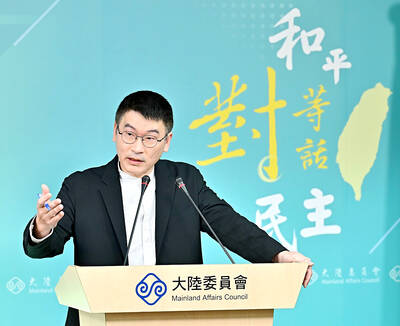
Two Taiwanese prosecutors were questioned by Chinese security personnel at their hotel during a trip to China’s Henan Province this month, the Mainland Affairs Council (MAC) said yesterday. The officers had personal information on the prosecutors, including “when they were assigned to their posts, their work locations and job titles,” MAC Deputy Minister and spokesman Liang Wen-chieh (梁文傑) said. On top of asking about their agencies and positions, the officers also questioned the prosecutors about the Cross-Strait Joint Crime-Fighting and Judicial Mutual Assistance Agreement, a pact that serves as the framework for Taiwan-China cooperation on combating crime and providing judicial assistance, Liang
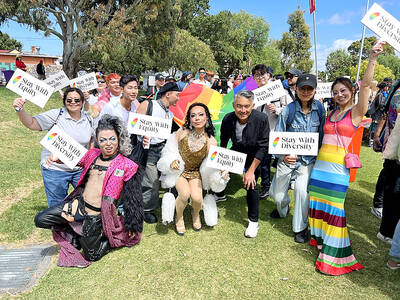
A group from the Taiwanese Designers in Australia association yesterday represented Taiwan at the Midsumma Pride March in Melbourne. The march, held in the St. Kilda suburb, is the city’s largest LGBTQIA+ parade and the flagship event of the annual Midsumma Festival. It attracted more than 45,000 spectators who supported the 400 groups and 10,000 marchers that participated this year, the association said. Taiwanese Designers said they organized a team to march for Taiwan this year, joining politicians, government agencies, professionals and community organizations in showing support for LGBTQIA+ people and diverse communities. As the first country in Asia to legalize same-sex
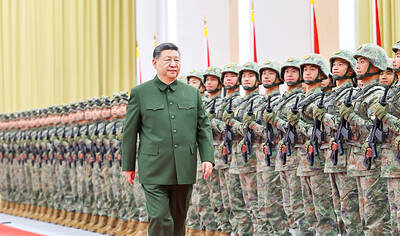
MOTIVES QUESTIONED The PLA considers Xi’s policies toward Taiwan to be driven by personal considerations rather than military assessment, the Epoch Times reports Chinese President Xi Jinping’s (習近平) latest purge of the Chinese People’s Liberation Army (PLA) leadership might have been prompted by the military’s opposition to plans of invading Taiwan, the Epoch Times said. The Chinese military opposes waging war against Taiwan by a large consensus, putting it at odds with Xi’s vision, the Falun Gong-affiliated daily said in a report on Thursday, citing anonymous sources with insight into the PLA’s inner workings. The opposition is not the opinion of a few generals, but a widely shared view among the PLA cadre, the Epoch Times cited them as saying. “Chinese forces know full well that


 RSS
RSS