


Tennis player Hsieh Su-wei (謝淑薇) yesterday repeated that she is a Taiwanese national and that the “glory” of winning the nation’s first Grand Slam title at Wimbledon belonged to everyone in Taiwan.
Hsieh returned to Taiwan on Wednesday night following her unprecedented victory in the women’s doubles at Wimbledon last week.
Yesterday morning, she first paid her respects to the deceased founder of Four Pillars Enterprises, Yang Pin-yen (楊斌彥), who was also the chairman of the Chinese Taipei Tennis Association (CTTA).
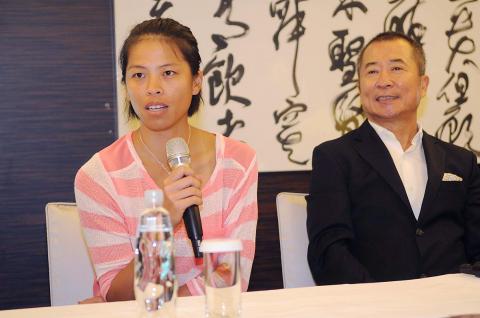
Photo: CNA
She met reporters following her visit to CTTA chairman Liao Yu-hui (廖裕輝).
The focus of the press conference was whether she would accept a NT$50 million (about US$1.7 million) per year sponsorship from a Chinese liquor company and switch allegiance to China.
Hsieh appeared to be rather irritated by the questions.
“I have never said anything about switching allegiance on my Facebook page, so I am a bit confused as to what happened here,” she said.
“Not just Qinghai [the Chinese liquor company], but other groups have approached me. I just never mentioned any of them in public,” she said.
“I think there’s no need to make a fuss about it. In other countries, people pay attention to tennis players who have potential. In Taiwan, nobody paid attention to tennis players before Wimbledon this year, but many people had in fact tried to talk to me about possible offers well before this time,” she said.
“My nationality is Republic of China [Taiwan], what more confirmation do you need?” Hsieh asked.
Hsieh said that she competed as a Taiwanese national at Wimbledon, and the glory of garnering the Grand Slam title belongs to everyone in Taiwan, whether or not she switches allegiance in the future.
She added that people should focus on how much effort she has made to make her what she is today.
Following her victory at Wimbledon, Liao and Hsieh each donated NT$1 million to establish a development fund for young tennis players. However, the funding is not enough for so many players, she said.
Asked about her plans in the next few months, Hsieh said that she wanted to rest for about a month before competing in the pre-US Open series. She would also start looking for training venues in other countries next week.
Asked who her partner would be in the doubles, she said: “It’s Peng Shuai (彭帥). It’s settled.”
Peng was her Chinese partner at Wimbledon.

SECURITY: Starlink owner Elon Musk has taken pro-Beijing positions, and allowing pro-China companies to control Taiwan’s critical infrastructure is risky, a legislator said Starlink was reluctant to offer services in Taiwan because of the nation’s extremely high penetration rates in 4G and 5G services, the Ministry of Digital Affairs said yesterday. The ministry made the comments at a meeting of the legislature’s Transportation Committee, which reviewed amendments to Article 36 of the Telecommunications Management Act (電信管理法). Article 36 bans foreigners from holding more than 49 percent of shares in public telecommunications networks, while shares foreigners directly and indirectly hold are also capped at 60 percent of the total, unless specified otherwise by law. The amendments, sponsored by Chinese Nationalist Party (KMT) Legislator Ko
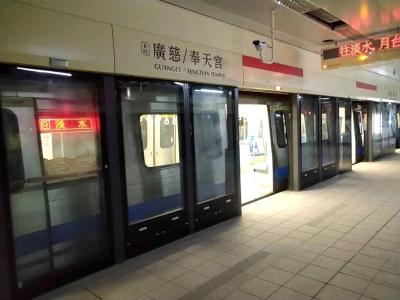
The eastern extension of the Taipei MRT Red Line could begin operations as early as late June, the Taipei Department of Rapid Transit Systems said yesterday. Taipei Rapid Transit Corp said it is considering offering one month of free rides on the new section to mark its opening. Construction progress on the 1.4km extension, which is to run from the current terminal Xiangshan Station to a new eastern terminal, Guangci/Fengtian Temple Station, was 90.6 percent complete by the end of last month, the department said in a report to the Taipei City Council's Transportation Committee. While construction began in October 2016 with an
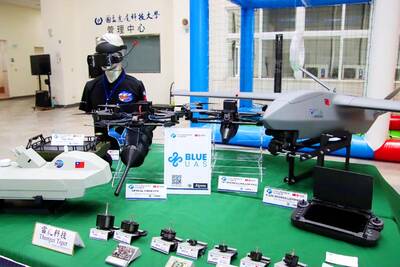
NON-RED SUPPLY: Boosting the nation’s drone industry is becoming increasingly urgent as China’s UAV dominance could become an issue in a crisis, an analyst said Taiwan’s drone exports to Europe grew 41.7-fold from 2024 to last year, with demand from Ukraine’s fight against Russian aggression the most likely driver of growth, a study showed. The Institute for Democracy, Society and Emerging Technology (DSET) in a statement on Wednesday said it found that many of Taiwan’s uncrewed aerial vehicle (UAV) sales were from Poland and the Czech Republic. These countries likely transferred the drones to Ukraine to aid it in its fight against the Russian invasion that started in 2022, it said. Despite the gains, Taiwan is not the dominant drone exporter to these markets, ranking second and fourth

Japanese Prime Minister Sanae Takaichi’s comment last year on Tokyo’s potential reaction to a Taiwan-China conflict has forced Beijing to rewrite its invasion plans, a retired Japanese general said. Takaichi told the Diet on Nov. 7 last year that a Chinese naval blockade or military attack on Taiwan could constitute a “survival-threatening situation” for Japan, potentially allowing Tokyo to exercise its right to collective self-defense. Former Japan Ground Self-Defense Force general Kiyofumi Ogawa said in a recent speech that the remark has been interpreted as meaning Japan could intervene in the early stages of a Taiwan Strait conflict, undermining China’s previous assumptions


 RSS
RSS