


Premier Jiang Yi-huah (江宜樺) promised to speed up review of a draft legislation in the Executive Yuan after being repeatedly urged to implement the autonomy of the indigenous peoples during his trip to Aboriginal tribes in Hualien County yesterday.
As part of a trip to boost tourism and the cultural industry in Hualien, and accompanied by Council of Indigenous Peoples Minister Sun Ta-chuan (孫大川), Jiang took part in a half-day rafting outing on the Siouguluan River (秀姑巒溪). He then visited a museum of the Kiwit people, Kakitaan, the Ancestral Shrine in Tafalong (太巴塱) and a tribal school of the Cilangasan people, all Amis Aborigines, as well as the Formosa Indigenous Dance Foundation of Culture and Art.
In talks with locals, Jiang was urged to allow indigenous people to organize autonomous communities, a promise that President Ma Ying-jeou (馬英九) has repeatedly made since 2008.
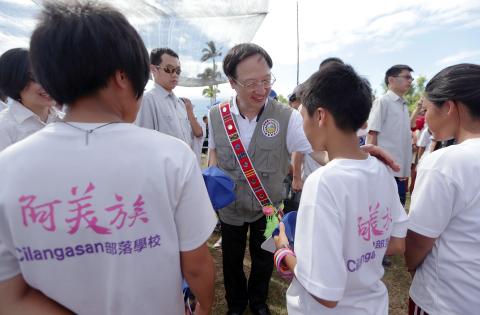
Photo: CNA
Yet the draft autonomy act has long been stalled in the legislature.
Wu Ming-chi (吳明季), who heads the Kiwit Indigenous Museum, said the Kiwit tribe could be designated as a pilot village of autonomy because rafting has made the tribe a good tourist attraction and brought in regular revenue.
Over the years, the tribe has seen the return of young people from big cities, which has kept the tribe’s culture alive and passed on traditions, but the lack of funds from Hualien County to maintain road infrastructure often leaves the roads, especially the main road to the tribe — County road No. 64 — broken, Wu said, calling on Jiang to address the issue.
Lin Huan-chih (林桓智), an Aboriginal cultural worker, explained to Jiang the efforts the tribe people have made since 1996 to rebuild the Tafalong’s Ancestral Shrine.
“What we are most concerned about is how traditional rituals can be understood by young people and be revived along the Ancestral Shrine to help revitalize the culture,” Lin said.
Sun, who is to leave the Cabinet to return to study Aboriginal literature at National Chengchi University, said his biggest regret during his four-year stint in the council was that an act to grant Aborigines right to autonomy was not enacted.
Sun said he wished the government could expand the establishment of tribe schools in Aboriginal villages to 30 schools in the next 10 years to help younger generations learn their mother tongue, culture and traditions.
There are currently three such schools nationwide that are recognized by the education system, but they are open only during the summer and winter vacations.

NATIONAL SECURITY: Authorities are working to confirm the identities of the military personnel involved and investigating possible illegal conduct and regulatory violations Authorities are probing possible national security implications after Kinmen police and immigration officers on Sunday found a Chinese woman allegedly posing as a tourist while engaging in prostitution involving more than 10 military personnel. The woman, surnamed Chen (陳), has since been deported, authorities said, adding that investigators are still working to confirm the identities of those implicated, as the records only listed code names and aliases. The case stemmed from a report received by the Kinmen District Prosecutors’ Office on Friday last week from the Jinhu Precinct of the Kinmen County Police Bureau. On Sunday, police, along with the National Immigration

GLOBALGIVING: ‘ Caving to external pressure is not acceptable for an organization that has cultivated justice reform and human rights for 30 years,’ one NGO said A slew of non-government organizations (NGOs) have withdrawn from the GlobalGiving fundraising platform after it announced it would use “Chinese Taipei” instead of “Taiwan” from next month. The Taiwan Good Rice Association wrote on Facebook on Friday that it was informed on April 28 via a teleconference call of the change, which was made because the platform wanted to operate in China. Taiwan Good Rice is to terminate all cooperative relationships with GlobalGiving in response to the platform’s “unilateral and non-negotiable” decision to remove references to Taiwan, the NGO said. “Taiwan is in the official name of Taiwan Good Rice Association and the

HEAVY WEATHER: Typhoon Jangmi is due to crash straight into the Ryukyus as airlines look to shift flights to larger aircraft or cancel flights to Okinawa entirely Taiwan’s international air carriers announced flight adjustments over the weekend as Typhoon Jangmi is forecast to hit the Ryukyu Islands today and tomorrow. The Central Weather Administration (CWA) upgraded Jangmi from a tropical storm to a typhoon at 8am yesterday, with the eye located 580km south of Naha city. It was moving north at 19kph. Today, China Airlines’ CI-120, CI-121, CI-122 and CI-123 flights between Taoyuan and Naha, Okinawa, have been canceled as well as CI-132 and CI-133 between Kaohsiung and Naha. EVA Air’s BR-112, BR-113, BR-186 and BR-185 flights between Taoyuan and Naha are also canceled. Low-cost carrier Tigerair Taiwan canceled IT-230,

Chinese Nationalist Party (KMT) Chairwoman Cheng Li-wun (鄭麗文) yesterday briefed her party’s Central Standing Committee regarding her scheduled visit to the US between Monday next week and June 16, saying that her purpose would be to persuade the US that the Republic of China (ROC) Constitution was a “one China” constitution that would foster stable and peaceful cross-strait relations. The ROC Constitution is the most important defense for all Taiwanese citizens, as it upholds our democracy and has contributed to our robust economy, which aligns with international and US interests, she said. “We would not be troublemakers and drag the US under,”


 RSS
RSS