


Both Vice President Wu Den-yih (吳敦義) and Premier Jiang Yi-huah (江宜樺) yesterday dismissed criticism of the government’s policy flip-flop on the dispute over the demolition of four houses in Miaoli County’s Dapu Borough (大埔), with Jiang also playing down concerns about the Presidential Office taking over the resolution of the dispute.
Wu, who in 2010 was premier and promised to preserve the four houses, on Tuesday discussed the issue with Jiang and asked him to negotiate with Miaoli County Commissioner Liu Cheng-hung (劉政鴻).
Seeking to dismiss accusations that he had failed to keep his promise, Wu stepped up his efforts and called a meeting with Jiang and Liu yesterday afternoon at the Presidential Office to resolve the dispute.
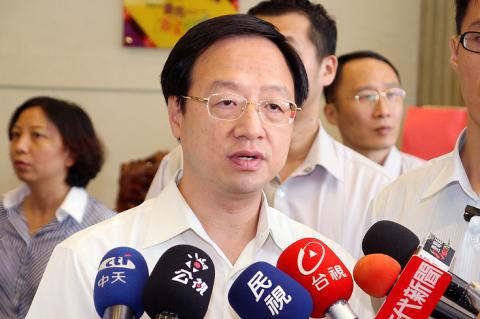
Photo: CNA
Presidential Office spokesperson Lee Chia-fei (李佳霏) said President Ma Ying-jeou (馬英九) has been paying close attention to the development of the Dapu incident and that he expects the relevant government agencies to find a solution to the case.
Wu yesterday said the government would demonstrate its sincerity in addressing the issue, while stressing that the meeting three years ago with Liu and Jiang, then the minister of the interior, had concluded that the four houses should not be demolished.
“We expect all parties to resolve the issue with sincerity. On the other hand, we will respect the county government’s authority in handling the incident,” the vice president said.
Wu’s comments came amid Liu’s insistence on the forceful demolition of the houses to make way for a science park project. Liu and the county government have largely ignored protesters’ demands that the houses be saved.
Jiang yesterday confirmed that he had talked with Ma and Wu by telephone on Thursday and said Ma authorized Wu to preside over the negotiation.
“The Executive Yuan is happy to have the vice president share his experience in handling the issue. We believe we can find a solution to the dispute,” Jiang said.
Jiang denied that he had been forced by Wu to change his position on the matter.
Since Thursday last week, Dapu residents and activists have brought attention to yesterday’s deadline set by the county government for the demolition of four houses in the borough.
After presenting an appeal demanding that Wu honor a promise he made in 2010 to save the four houses and failing to receive a positive response from the Executive Yuan and the Presidential Office, the protesters began a sit-in outside the front gates of the Executive Yuan on Tuesday and clashed with police on Thursday.
The Executive Yuan remained silent on the issue until Tuesday, when spokesperson Cheng Li-wun (鄭麗文) said the four houses were to be dismantled by the Miaoli County Government because they did not meet the four conditions for preservation — that they should not compromise the flow of traffic, public safety, equality or rationality in urban planning.
On Wednesday, Jiang reaffirmed what Cheng had said, adding that what had seemed to the Dapu residents to be a promise by Wu to preserve their houses was contingent on the four conditions, except that the four conditions were not listed in the minutes of the meeting in 2010.
Jiang said that the Executive Yuan told the Miaoli County Government that it should go ahead with the decision made at a meeting on April 24 last year by the Ministry of the Interior’s City Planning Commission that favored the county government’s plan to demolish the houses.
While denying the Executive Yuan flip-flopped on the issue, Jiang’s denial contrasted with what Cheng said on Tuesday and his own remarks on Wednesday.
Local media reports said that Jiang has been slapped in the face yet again by the Presidential Office.
About a month ago he also experienced a similar putdown when Ma demanded that the Executive Yuan invoke the right to reconsider a controversial amendment to Accounting Act (會計法) passed by the legislature.

Actor Darren Wang (王大陸) was sentenced to six months in prison, commutable to a fine, by the New Taipei District Court today for contravening the Personal Data Protection Act (個人資料保護法) in a case linked to an alleged draft-dodging scheme. Wang allegedly paid NT$3.6 million (US$114,380) to an illegal group to help him evade mandatory military service through falsified medical documents, prosecutors said. He transferred the funds to Chen Chih-ming (陳志明), the alleged mastermind of a draft-evasion ring, although he lost contact with him as he was already in detention on fraud charges, they said. Chen is accused of helping a

SECURITY: Starlink owner Elon Musk has taken pro-Beijing positions, and allowing pro-China companies to control Taiwan’s critical infrastructure is risky, a legislator said Starlink was reluctant to offer services in Taiwan because of the nation’s extremely high penetration rates in 4G and 5G services, the Ministry of Digital Affairs said yesterday. The ministry made the comments at a meeting of the legislature’s Transportation Committee, which reviewed amendments to Article 36 of the Telecommunications Management Act (電信管理法). Article 36 bans foreigners from holding more than 49 percent of shares in public telecommunications networks, while shares foreigners directly and indirectly hold are also capped at 60 percent of the total, unless specified otherwise by law. The amendments, sponsored by Chinese Nationalist Party (KMT) Legislator Ko

The eastern extension of the Taipei MRT Red Line could begin operations as early as late June, the Taipei Department of Rapid Transit Systems said yesterday. Taipei Rapid Transit Corp said it is considering offering one month of free rides on the new section to mark its opening. Construction progress on the 1.4km extension, which is to run from the current terminal Xiangshan Station to a new eastern terminal, Guangci/Fengtian Temple Station, was 90.6 percent complete by the end of last month, the department said in a report to the Taipei City Council's Transportation Committee. While construction began in October 2016 with an
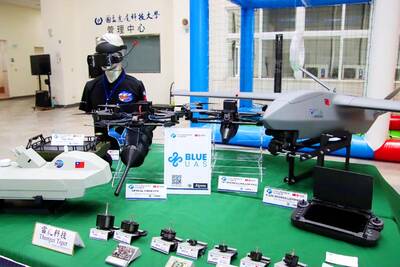
NON-RED SUPPLY: Boosting the nation’s drone industry is becoming increasingly urgent as China’s UAV dominance could become an issue in a crisis, an analyst said Taiwan’s drone exports to Europe grew 41.7-fold from 2024 to last year, with demand from Ukraine’s fight against Russian aggression the most likely driver of growth, a study showed. The Institute for Democracy, Society and Emerging Technology (DSET) in a statement on Wednesday said it found that many of Taiwan’s uncrewed aerial vehicle (UAV) sales were from Poland and the Czech Republic. These countries likely transferred the drones to Ukraine to aid it in its fight against the Russian invasion that started in 2022, it said. Despite the gains, Taiwan is not the dominant drone exporter to these markets, ranking second and fourth


 RSS
RSS