


Tonight’s 24th Golden Melody Awards ceremony is expected to see some fierce competition between Taiwanese and Hong Kong singers for some of the biggest awards.
Hong Kong singer Sandy Lam’s (林憶蓮) album Gaia, which leads with six nominations, will face off against Taiwanese pop idol Jay Chou’s (周杰倫) Opus 12, pop diva Jolin Tsai’s (蔡依林) MUSE, rapper MC Hotdog’s (熱狗) Ghetto Superstar: 2009-2012 Best Singles Collection and Hong Kong singer-songwriter Khalil Fong’s (方大同) Back to Wonderland.
Another hotly contested category is Best Mandarin Male Singer, where two-time winner Chou is up against Fong, as well as fellow Taiwanese competitors Yoga Lin (林宥嘉), Jam Hsiao (蕭敬騰) and Xiaoyu (小宇).
In the Best Mandarin Female Singer category, Lam, Tsai, Hong Kong singer G.E.M, Hong Kong Canadian singer-songwriter Ellen Loo (盧凱彤), Aboriginal singer Jia Jia (家家) and singer-songwriter Lala Hsu (徐佳瑩) are vying for the title.
Taiwan’s electronic band Lie Gramophone (謊言留聲機), rock band Monkey Pilot (猴子飛行員), indigenous reggae-rock band Matzka and garage rock band My Skin Against Your Skin (激膚樂團) are up against Chinese Canadian pop rock band io for the Best Band trophy.
In the running for the Best New Artist category are Taiwanese Aboriginal singers Jia Jia, Rachel Lu (呂薔), Sangpuy (桑布伊) and a capella group O-Kai Singers (歐開合唱團), along with Taiwanese American rapper Miss Ko (葛仲珊), Taiwanese singer-songwriter Ann Bai (白安) and singer Eve Ai (艾怡良).
A total of 115 musical works are competing in 24 categories, where the best Mandarin, Taiwanese, Hakka and Taiwanese Aboriginal music released over the past year will receive recognition.
Tsai and several Taiwanese bands, including last year’s biggest winner of the Golden Melody Awards, Mayday (五月天), will perform during the ceremony at the Taipei Arena, while Japanese singer-songwriter-actor Masaharu Fukuyama is scheduled to present one of the awards.
The event will be broadcasted by Sanlih E-Television, Asia Plus Broadcasting and MTV Networks Taiwan in rotation.
It will also be streamed live on YouTube.
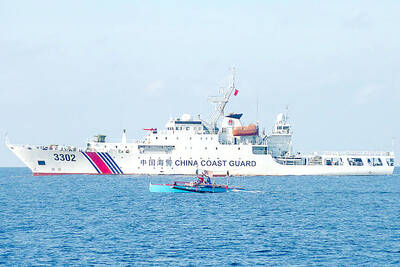
EXPANSIONIST: China deploys an average of 40 to 50 warships and coast guard vessels daily in the South China Sea, despite pledges not to militarize the region, an official said China is attempting to expand its influence across the First Island Chain and increase pressure on Japan by sending coast guard vessels into waters off of Taiwan under the pretext of maritime negotiations with Japan and the Philippines, a national security official said yesterday. China’s recent actions in the waters east of Taiwan and Japan and the Philippines’ exclusive economic zones (EEZ) are attempts to establish dominance in First Island Chain waters, said the official who declined to be named, adding that this is “expansion disguised as law enforcement.” Framing China’s actions solely as a cross-strait issue is a serious misjudgment that
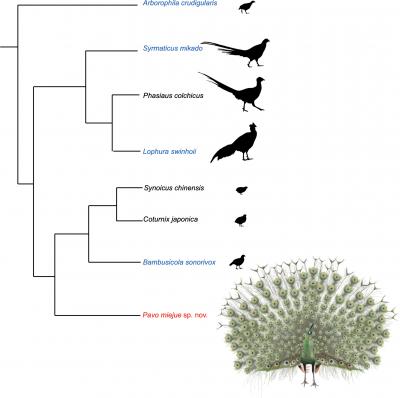
Through analyzing fossil evidence, a research team at National Taiwan University (NTU) discovered the largest endemic bird to have lived in Taiwan, naming it Pavo miejue, or extinct peafowl (滅絕孔雀). The Mikado pheasant, which is printed on the back of the NT$1,000 bank note, was previously believed to be the biggest endemic bird to Taiwan. The research team’s findings suggest that Pavo miejue lived during the Pleistocene epoch tens of thousands of years ago. It is the first endemic extinct bird species discovered and formally named in Taiwan. The study was coauthored by NTU Institute of Ecology and Evolutionary Biology professor Tsai Cheng-hsiu (蔡政修),
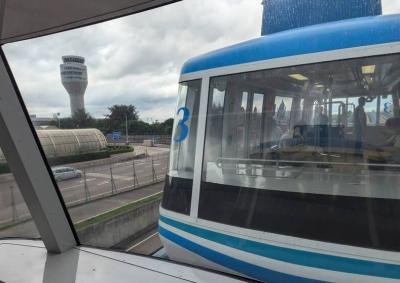
Taiwan Taoyuan International Airport is to suspend its automated Skytrain service connecting Terminal 1 and Terminal 2 starting on July 1 to facilitate connection works for the upcoming Terminal 3, the airport operator said today. Passengers and staff who need to travel between the two terminals after the suspension can instead use the Taoyuan MRT or the airport's 24-hour shuttle bus service, Taoyuan International Airport Corp said. The Taoyuan MRT Airport Line directly links the two terminals, while the shuttle buses are to operate around the clock, the company added. The Skytrain provides free transportation between the airport’s two terminals for travelers and
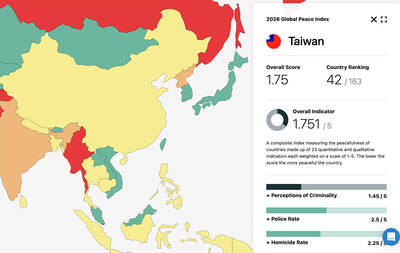
Taiwan ranked 42nd in terms of peacefulness among 163 countries, down five places from last year, according to this year’s Global Peace Index. With an overall score of 1.751, Taiwan dropped from 37th last year, the report published by the global Institute for Economics and Peace showed. The overall score measures a country’s level of peacefulness using 23 quantitative and qualitative indicators across three domains — ongoing domestic and international conflict, societal safety and security, and militarization. While Taiwan ranked 42nd worldwide, it was listed in ninth place among the 19 Asian-Pacific countries in the report, after New Zealand, Singapore, Japan, Malaysia,


 RSS
RSS