


Pharmacist associations yesterday argued against a move by five pharmacists to have the Pharmacist’s Act (藥師法) declared unconstitutional.
The five pharmacists have asked the Council of Grand Justices for a constitutional interpretation on whether the law violates the Constitution by restricting pharmacists to one business location.
The grand justices heard an oral argument on Thursday last week on whether Article 11 of the act, stating that pharmacists registered and issued a practice license shall be restricted to one business location, violates the right to work, and the equality promised and protected by the Constitution.
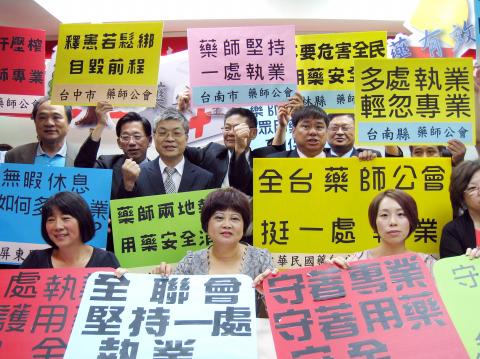
Photo: Wei Yi-chia, Taipei Times
The Taiwan Pharmacist Association, dozens of local pharmacist associations and supporters held a press conference in Taipei to voice their concerns about the consequences of relaxing the restrictions.
They urged the grand justices to take their concerns into consideration before delivering a decision.
The petitioners have asked that the location restriction be repealed and for pharmacists — who as physicians are also qualified primary healthcare providers — to be allowed to register parallel practices in multiple locations.
The associations warned that requests would not only result in pharmacists being overworked and exploited by hospital operators, but that it would put public safety at risk.
According to the associations, as of November last year there were 38,223 certified pharmacists nationwide, an average of 623 pharmacists join the workforce every year and more than 8,000 students are currently enrolled in pharmacy studies.
These numbers show there is no shortage of certified pharmacists, the groups said. Other types of healthcare providers who are legally allowed to work in multiple location practices have far fewer qualified professionals entering their fields, the associations said.
Using certified nurses as an example, the associations said there are 300,000 certified nurses nationwide, but only 130,000 are actually employed as nurses.
The willingness of healthcare practitioners to work in their fields depends on satisfactory working environments and fair treatment, and has nothing to do with whether multiple locations are sanctioned.
“What pharmacists provide is a kind of ‘irreversible service,’ meaning that once the prescribed drugs have been provided to patients, it’s hard to recall the medications. Having an overworked pharmacist at a pharmacy or a pharmacist not being present at the counter would be detrimental to safety and public health,” National Health Insurance Civic Surveillance Alliance convener Huang Sue-ying (黃淑英) said.
“The system of checks and balances between physicians and pharmacists, with the former prescribing and the latter checking for potential errors, would also be harmed by the lifting of the restriction,” said Eva Teng (滕西華), the alliance’s spokesperson.
Taiwan Pharmacist Association secretary-general Eric Tseng (曾中龍) said there can be more than 10,000 drug items in a community pharmacy.
“How could an overworked or dispatched pharmacist, unfamiliar with the surroundings, rapidly and accurately provide a good service?” he said.
The appeal to the grand justices is basically an attempt by hospitals and clinics to reduce their operating costs, Tseng said.

NATIONAL SECURITY: Authorities are working to confirm the identities of the military personnel involved and investigating possible illegal conduct and regulatory violations Authorities are probing possible national security implications after Kinmen police and immigration officers on Sunday found a Chinese woman allegedly posing as a tourist while engaging in prostitution involving more than 10 military personnel. The woman, surnamed Chen (陳), has since been deported, authorities said, adding that investigators are still working to confirm the identities of those implicated, as the records only listed code names and aliases. The case stemmed from a report received by the Kinmen District Prosecutors’ Office on Friday last week from the Jinhu Precinct of the Kinmen County Police Bureau. On Sunday, police, along with the National Immigration

GLOBALGIVING: ‘ Caving to external pressure is not acceptable for an organization that has cultivated justice reform and human rights for 30 years,’ one NGO said A slew of non-government organizations (NGOs) have withdrawn from the GlobalGiving fundraising platform after it announced it would use “Chinese Taipei” instead of “Taiwan” from next month. The Taiwan Good Rice Association wrote on Facebook on Friday that it was informed on April 28 via a teleconference call of the change, which was made because the platform wanted to operate in China. Taiwan Good Rice is to terminate all cooperative relationships with GlobalGiving in response to the platform’s “unilateral and non-negotiable” decision to remove references to Taiwan, the NGO said. “Taiwan is in the official name of Taiwan Good Rice Association and the

HEAVY WEATHER: Typhoon Jangmi is due to crash straight into the Ryukyus as airlines look to shift flights to larger aircraft or cancel flights to Okinawa entirely Taiwan’s international air carriers announced flight adjustments over the weekend as Typhoon Jangmi is forecast to hit the Ryukyu Islands today and tomorrow. The Central Weather Administration (CWA) upgraded Jangmi from a tropical storm to a typhoon at 8am yesterday, with the eye located 580km south of Naha city. It was moving north at 19kph. Today, China Airlines’ CI-120, CI-121, CI-122 and CI-123 flights between Taoyuan and Naha, Okinawa, have been canceled as well as CI-132 and CI-133 between Kaohsiung and Naha. EVA Air’s BR-112, BR-113, BR-186 and BR-185 flights between Taoyuan and Naha are also canceled. Low-cost carrier Tigerair Taiwan canceled IT-230,

Chinese Nationalist Party (KMT) Chairwoman Cheng Li-wun (鄭麗文) yesterday briefed her party’s Central Standing Committee regarding her scheduled visit to the US between Monday next week and June 16, saying that her purpose would be to persuade the US that the Republic of China (ROC) Constitution was a “one China” constitution that would foster stable and peaceful cross-strait relations. The ROC Constitution is the most important defense for all Taiwanese citizens, as it upholds our democracy and has contributed to our robust economy, which aligns with international and US interests, she said. “We would not be troublemakers and drag the US under,”


 RSS
RSS