


Straits Exchange Foundation (SEF) Chairman Lin Join-sane (林中森) yesterday said a planned cross-strait service trade agreement will contribute to the modernization of the service industry and create jobs on both sides of the Taiwan Strait.
Lin made the remarks at a welcoming ceremony held after his arrival at the Dongjiao State Guest Hotel in Shanghai ahead of a new round of high-level cross-strait talks today.
Lin was greeted at the hotel by Association for Relations Across the Taiwan Straits (ARATS) Chairman Chen Deming (陳德銘).
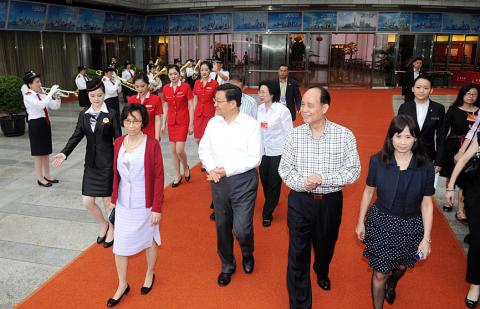
Photo: CNA
“It feels like an encounter between old friends even though we have never met before,” Lin said when he first set eyes on Chen.
Today’s meeting will be the ninth round of high-level talks between the foundation and ARATS since June 2008.
On the agenda is the signing of a service trade agreement to further expand cross-strait markets. The agreement will be a major follow-up to the Economic Cooperation Framework Agreement (ECFA) signed in 2010.
Lin said the service industry contributed more to China’s annual GDP than its manufacturing sector for the first time in the first quarter of this year, while the service sector already accounts for 72 percent of Taiwan’s GDP.
However, the service sector ratios of Taiwan and China are low in comparison with those of advanced countries, he said.
“Therefore, there is still ample room for the service sectors on both sides to grow,” Lin said, adding that he is convinced the new pact will help speed up service industry modernization and create more jobs and business opportunities in both Taiwan and China.
Chen said the new accord would be an important milestone in ECFA implementation.
In the face of mounting global financial and economic challenges and competition, the two sides of the Strait should cooperate closely to upgrade their competitiveness and avoid being marginalized, he said.
The two sides will also review how previous cross-strait agreements have been implemented and draw up an agenda for the next round of high-level talks, Lin said.
Topics include cooperation in tax and avoidance of double taxation, meteorological studies, seismic monitoring and natural disaster prevention.
Lin’s delegation includes foundation Vice Chairman and Secretary-General Kao Koong-lian (高孔廉), Mainland Affairs Council Vice Chairman Chang Hsien-yao (張顯耀) and Vice Minister of Economic Affairs Cho Shih-chao (卓士昭).
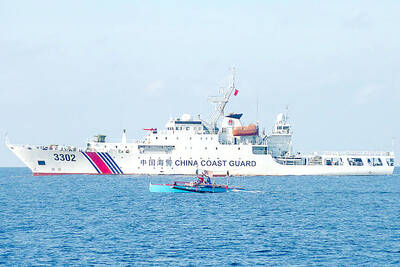
EXPANSIONIST: China deploys an average of 40 to 50 warships and coast guard vessels daily in the South China Sea, despite pledges not to militarize the region, an official said China is attempting to expand its influence across the First Island Chain and increase pressure on Japan by sending coast guard vessels into waters off of Taiwan under the pretext of maritime negotiations with Japan and the Philippines, a national security official said yesterday. China’s recent actions in the waters east of Taiwan and Japan and the Philippines’ exclusive economic zones (EEZ) are attempts to establish dominance in First Island Chain waters, said the official who declined to be named, adding that this is “expansion disguised as law enforcement.” Framing China’s actions solely as a cross-strait issue is a serious misjudgment that
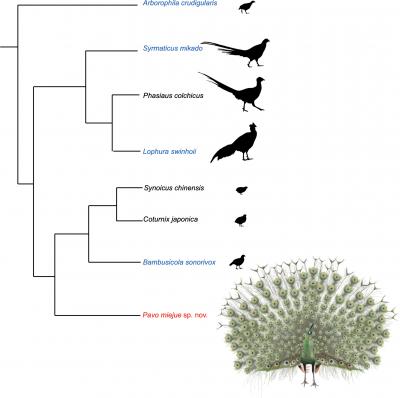
Through analyzing fossil evidence, a research team at National Taiwan University (NTU) discovered the largest endemic bird to have lived in Taiwan, naming it Pavo miejue, or extinct peafowl (滅絕孔雀). The Mikado pheasant, which is printed on the back of the NT$1,000 bank note, was previously believed to be the biggest endemic bird to Taiwan. The research team’s findings suggest that Pavo miejue lived during the Pleistocene epoch tens of thousands of years ago. It is the first endemic extinct bird species discovered and formally named in Taiwan. The study was coauthored by NTU Institute of Ecology and Evolutionary Biology professor Tsai Cheng-hsiu (蔡政修),
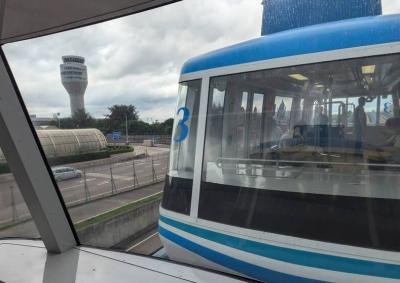
Taiwan Taoyuan International Airport is to suspend its automated Skytrain service connecting Terminal 1 and Terminal 2 starting on July 1 to facilitate connection works for the upcoming Terminal 3, the airport operator said today. Passengers and staff who need to travel between the two terminals after the suspension can instead use the Taoyuan MRT or the airport's 24-hour shuttle bus service, Taoyuan International Airport Corp said. The Taoyuan MRT Airport Line directly links the two terminals, while the shuttle buses are to operate around the clock, the company added. The Skytrain provides free transportation between the airport’s two terminals for travelers and
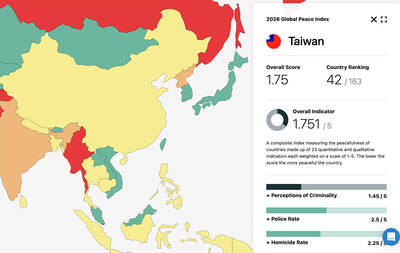
Taiwan ranked 42nd in terms of peacefulness among 163 countries, down five places from last year, according to this year’s Global Peace Index. With an overall score of 1.751, Taiwan dropped from 37th last year, the report published by the global Institute for Economics and Peace showed. The overall score measures a country’s level of peacefulness using 23 quantitative and qualitative indicators across three domains — ongoing domestic and international conflict, societal safety and security, and militarization. While Taiwan ranked 42nd worldwide, it was listed in ninth place among the 19 Asian-Pacific countries in the report, after New Zealand, Singapore, Japan, Malaysia,


 RSS
RSS