

Dozens of residents of Yuanli Township (苑裡), Miaoli County, yesterday rallied in front of the Environmental Protection Administration (EPA) against a wind turbine project they say is too close to their homes and violates the minimum distance required by the environmental impact assessment (EIA).
Some held piglets, others were accompanied by dogs on leashes and some held white banners with messages such as “the low-frequency electromagnetic radiation and noise from the wind turbines damages health.” The protesters shouted. “EPA, toughen up! Return the land to us.”
They said they were concerned that turbines built so close to their homes would even affect their pigs and dogs and that they would be hit if the turbines fell over.
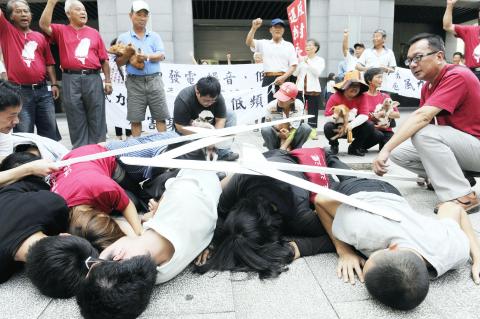
Photo: George Tsorng, Taipei Times
Chen Hui-ming (陳薈茗), a representative of the local self-help association against the turbines, said that the German wind-power firm InfraVest GmbH had violated the safety distance that it had guaranteed in the EIA report.
“The Environmental Protection Administration is neglecting its duty to monitor the project and make sure it is done properly,” Chen said.
There were many flaws in the EIA’s evaluation, such as the company neglecting its responsibility to communicate with nearby residents, but the EPA still allowed the project to win EIA approval, Chen said.
The residents also questioned whether the EPA’s equipment was able to accurately measure the distance between the turbines and their homes, Chen said.
Environmental Inspection Deputy Inspector-General Yang Su-er (楊素娥) said the EPA’s new equipment, purchased this year, was capable of precisely measuring the proper distances for this project.
The protesters later went to the Control Yuan to present a petition asking for an investigation into whether the EPA and the Bureau of Energy had ignored their duties to ensure that InfraVest builds the turbines according to safety principles.
The association staged a protest at the EPA two weeks ago, asking it to fine InfraVest for violating required safety distance requirement and to reconduct the EIA.
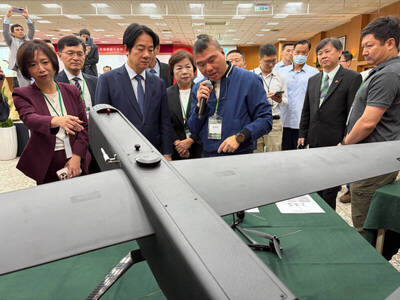
Two executives of drone supplier Jiin Ming Industry Co (錦明實業) have been detained and held incommunicado over the company's alleged use of prohibited China-made chips and camera lenses in drones supplied under recent military contracts, the Taoyuan District Prosecutors' Office said today. In a statement, prosecutors said they raided the offices of Jiin Ming — headquartered in Taoyuan — as well as those of its subsidiaries and its suppliers on Thursday last week. The raids followed a report that the company had breached its procurement contracts by putting the prohibited components into drones delivered to the military. During the raids, prosecutors summoned
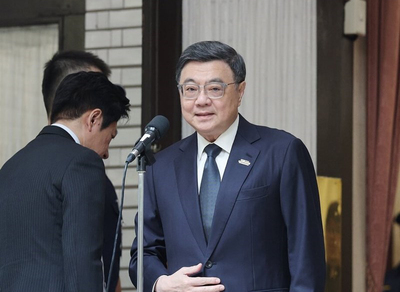
The government would continue monitoring online rumors that a pneumonic plague outbreak has spread from Russia into China and could enhance existing quarantine measures, Premier Cho Jung-tai (卓榮泰) said today. During a legislative meeting, Democratic Progressive Party Legislator Wang Ting-yu (王定宇) said rumors were circulating that the disease had spread across several Chinese provinces. He asked Cho whether the government was prepared to prevent the disease from spreading to Taiwan, given the frequent exchanges between Taiwan and China, and how concerned the government was about the alleged outbreak. The Ministry of Health and Welfare implemented border quarantine measures after briefing the Executive Yuan

South Korean boy band BigBang drew 120,000 fans to three concerts at Taipei Dome from Friday through yesterday, as the band thanked them for their support over their 20-year career. The Taipei Dome concerts were part of BigBang's "2026-2027 World Tour XX: Cosmos." Friday's concert was BigBang's first performance in Taiwan in 11 years. During the encore, group leader G-Dragon (GD) shouted "I love you" in Chinese and said he was especially happy to perform in Taiwan with bandmates Taeyang and Daesung. "Taipei, I'm very grateful to you all," GD said in Chinese, asking fans to wait for the band's return. Daesung thanked
A Chinese People's Liberation Army (PLA) Navy aircraft carrier group was being monitored after entering the western Pacific, the Ministry of National Defense said today, after Beijing yesterday criticized Taiwan for using a water cannon against a Chinese fishing boat near the Pratas Islands (Dongsha Islands, 東沙群島). A Chinese naval task group led by the aircraft carrier Liaoning (遼寧) yesterday sailed to the western Pacific for training, Chinese state-run Xinhua news agency quoted the PLA Navy as saying. “The drill is part of the annual routine training plan aimed at testing and improving the troops’ combat readiness and enhancing their ability to


 RSS
RSS