


The Ministry of National Defense and the Coast Guard Administration (CGA) will hold a joint military exercise in the overlapping waters of Taiwan and the Philippines this week, Deputy Minister of National Defense Andrew Yang (楊念祖) said yesterday.
Taiwan’s naval forces are more than a match for the Philippine Navy, Yang said, amid a dispute over the killing of a Taiwanese fisherman by personnel aboard a Philippine Coast Guard vessel on Thursday last week.
“We without a doubt have adequate forces [against the Philippines],” he said.
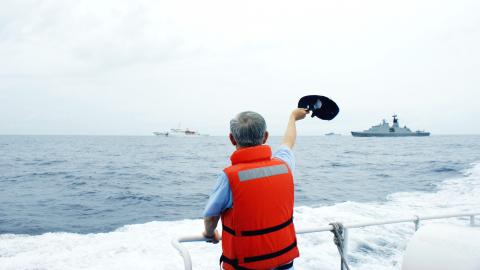
Photo: CNA, courtesy of the Coast Guard Administration
Yang told lawmakers at a meeting of the legislature’s Foreign Affairs and National Defense Committee that the ministry may hold a large-scale military exercise with the CGA this month. He did not elaborate.
Lawmakers threw their support behind the planned exercise as they adopted a resolution demanding that the drill utilize the coast guard’s 2,000-tonne Hsinbei vessel, the first CGA patrol boat equipped with a 40mm anti-aircraft cannon, as well as navy destroyers and frigates.
The combined exercise would be held in waters about 164 nautical miles (304km) southeast of the southernmost tip of Taiwan, where the 15-tonne Taiwanese fishing boat Kuang Ta Hsing No. 28 was attacked by a Philippine Coast Guard vessel, leading to the death of Taiwanese fisherman Hung Shih-cheng (洪石成).
If the Philippines fails to respond to the ultimatum by Taiwan regarding the incident, the ministry and the CGA should disperse fishing boats from the Philippines in waters within the 200-nautical mile (370km) exclusive economic zone claimed by Taiwan, carry out onboard checks or detain the boats, the resolution said.
Following the incident, the navy on Sunday dispatched a LaFayette-class frigate to join three coast guard ships to patrol the waters.
On Thursday, a Kidd-class destroyer and a Cheng Kung class frigate are to be dispatched to join two coast guard ships already patrolling the Bashi Channel for training operations, Yang said.
While the CGA will continue to serve as the frontline force to protect fishing boats, the military will offer full backup and support, Yang said.
Activities involving the use of firearms by national defense forces require authorization by the minister of defense.
“Yes, we are ready. The ministry will authorize the use of force” if coast guard ships are attacked by the Philippine Navy, Yang said, in response to a question by Chinese Nationalist Party (KMT) Legislator Lin Yu-fang (林郁方).
CGA Deputy Minister Cheng Chang-hsiung (鄭樟雄) said coast guard personnel have been authorized to use machine guns or rifles, but not 20mm cannons or other heavier weapons, which would require further authorization from the Coast Guard Administration minister.
Cheng said the CGA is also considering installing more 40mm cannons on coast guard vessels.
According to the CGA, the Kuang Ta Hsing No. 28 was operating 1.8 nautical miles (3.3km) beyond the temporary law enforcement line when it was confronted by the Philippine Coast Guard and left disabled within the enforcement line.
At a meeting of the legislature’s Internal Administration Committee, CGA Minister Wang Jinn-wang (王進旺) and Council of Agriculture Deputy Minister Hu Sing-hwa (胡興華) both agreed to consider expanding the line further southward.
Navy Chief of Staff Vice Admiral Hsu Pei-shan (許培山) said the navy’s first attack should be authorized by the minister of defense.
Lin asked the defense ministry to authorize naval ships to use certain weapons without giving the ministry prior notice.
According to CGA statistics, Philippine vessels intruded around Itu Aba Island (Taiping Island, 太平島) in the South China Sea 154 times between 2000 and last year, and 34 times around the Pratas Islands (Dongsha Islands, 東沙群島), but Taiwan’s coast guard did not expel, intercept or detain any of the vessels, Lin added.
Cheng said that according to coast guard regulations, its ships should expel intruding vessels.
Additional reporting by Rich Chang

REASONS FOR TRAVEL: An assistant professor said that proposed amendments to penalize drivers if they used drugs overseas would not deter people from traveling People who operate a motor vehicle under the influence of marijuana would have their driver’s license revoked, even if they used the substance while overseas, the Ministry of Transportation and Communications said yesterday, citing proposed amendments to the Road Traffic Management and Penalty Act (道路交通管理處罰條例). The amendments would also authorize the government to revoke the licenses of people determined to have used Category 1 or Category 2 narcotics, even if they were not operating a vehicle while under the influence of drugs, as well as ban them from taking the license test for three years, the ministry said. People aged 18 or

GLOBALGIVING: ‘ Caving to external pressure is not acceptable for an organization that has cultivated justice reform and human rights for 30 years,’ one NGO said A slew of non-government organizations (NGOs) have withdrawn from the GlobalGiving fundraising platform after it announced it would use “Chinese Taipei” instead of “Taiwan” from next month. The Taiwan Good Rice Association wrote on Facebook on Friday that it was informed on April 28 via a teleconference call of the change, which was made because the platform wanted to operate in China. Taiwan Good Rice is to terminate all cooperative relationships with GlobalGiving in response to the platform’s “unilateral and non-negotiable” decision to remove references to Taiwan, the NGO said. “Taiwan is in the official name of Taiwan Good Rice Association and the

HEAVY WEATHER: Typhoon Jangmi is due to crash straight into the Ryukyus as airlines look to shift flights to larger aircraft or cancel flights to Okinawa entirely Taiwan’s international air carriers announced flight adjustments over the weekend as Typhoon Jangmi is forecast to hit the Ryukyu Islands today and tomorrow. The Central Weather Administration (CWA) upgraded Jangmi from a tropical storm to a typhoon at 8am yesterday, with the eye located 580km south of Naha city. It was moving north at 19kph. Today, China Airlines’ CI-120, CI-121, CI-122 and CI-123 flights between Taoyuan and Naha, Okinawa, have been canceled as well as CI-132 and CI-133 between Kaohsiung and Naha. EVA Air’s BR-112, BR-113, BR-186 and BR-185 flights between Taoyuan and Naha are also canceled. Low-cost carrier Tigerair Taiwan canceled IT-230,
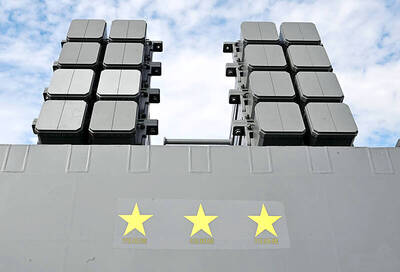
UPGRADE: The Kang Ding-class frigate is replacing its Chaparall missiles with Tien Chien II and Hua Yang VLS, which would provide it with long-range, 360° air defense Taiwan plans to produce 1,200 to 1,376 Hai Chien II missiles (海劍二, Sea Sword II) — also known as TC-2N — to serve as the standard air defense system of the navy’s surface combatant fleet, a source said yesterday. Last week, the Hai Chien II, the naval version of the Tien Kung II missile (天劍二, Sky Sword II), completed a live-fire test in waters off the National Chungshan Institute of Science and Technology’s Jiupeng facility (九鵬) in Pingtung County’s Manjhou Township (滿州). The MIM72 Chaparral and other dated air defense missiles that currently arm Taiwanese ships have inadequate range to combat Chinese


 RSS
RSS