


World Uyghur Congress (WUC) spokesman Dilshat Rexit yesterday protested National Security Bureau Director Tsai Der-sheng’s (蔡得勝) remarks hinting that Uighur activists are terrorists, urging that Taiwan, as a sovereign country, should have its own national security policies, instead of following those of Beijing.
“I didn’t really expect that I would be allowed into Taiwan, so before I departed, I contacted some human rights organizations such as Amnesty International and asked them to help once I was denied entry,” Dilshat, now a Swedish citizen, told a news conference held in Taipei after his arrival.
“Taiwan is a country on its own, you elect your own president, so I never understand why you always have to follow Beijing’s policies,” he said.
Dilshat was referring to a remark by Tsai during a legislative meeting that two terrorist suspects were denied entry in 2009 ahead of the World Games.
Although Tsai did not say who the two suspects were, one of the foreign nationals denied entry ahead of the games was WUC secretary-general Dulkun Isa.
“The accusation was baseless and politically motivated, because no other country in the world — except China — calls Uighurs terrorists,” Dilshat said. “The objectives of the Uighurs are very clear — politically, economically and culturally, we want to be on our own. Environmentally, we don’t want our homeland to be damaged.”
He said that China’s rule over Uighurs is effectively colonial rule and the struggle of the Uighurs is resistance against Chinese colonialism.
“Our struggle is not terrorism, not a single Uighur supports terrorism,” he said.
Yiong Cong-ziin (楊長鎮), one of the co-founders of Taiwan Friends of Uyghurs, agreed.
“Taiwan apparently does not have its own national security,” Yiong said. “As we can all see, [WUC President] Rebiya Kadeer and the Dalai Lama are welcome in most countries around the world, but President Ma Ying-jeou [馬英九] declined to allow them into Taiwan. In my opinion, Taiwan following China’s national security measures is the deepest security threat to this country.”
Dilshat called on the Taiwanese government to take action to support the democracy movement in China.
“China is causing threats to most of its neighbors, including Taiwan and Japan, and only when China becomes a democracy with rule of law can there be stability in the region and can Taiwan be secure,” he said.

FUKUOKA SITUATION: Japanese media reported that the pathogen is expected to be identified by the summer, while the CDC downplayed the idea that it was hMPV A “mysterious cold-like illness” reported in Japan’s Fukuoka Prefecture does not seem to be a new disease, but Japanese authorities have been asked about the situation, the Centers for Disease Control (CDC) said yesterday. The Fukuoka Prefectural Medical Association on Wednesday told a news conference that a “mystery cold” that has become a hot topic on social media is “highly likely to be caused by some kind of viral infection,” Japan’s KBC News reported. “Many people are experiencing symptoms starting with a sore throat, followed by a runny nose, phlegm and a severe cough,” KBC News reported, citing association officials. Health authorities are

Nvidia Corp CEO Jensen Huang (黃仁勳) arrived in Taiwan yesterday ahead of upcoming AI and technology events, saying he plans to meet with clients and Taiwan Semiconductor Manufacturing Co Chairman C.C. Wei (魏哲家) during his visit. After landing at Taipei Songshan Airport, Huang posed for photos with fans and handed out Yakult drinks to reporters and supporters waiting at the scene, saying he has “a lot to do” during the trip. Asked about reports that Nvidia’s planned headquarters site in Taipei’s Beitou Shilin Technology Park could break ground on May 27, Huang said that if the company holds an event, he would

The Ministry of Finance this afternoon announced the winning numbers for the March-April uniform invoice lottery. The winning number for the NT$10 million (US$318,060) special prize is 19531471, and the winning number for the NT$2 million grand prize is 85941329. Three numbers were drawn for the NT$200,000 first prize: 07225810, 20231230 and 83518781. Those with receipts matching the last seven digits of any of the first-prize numbers will win the NT$40,000 second prize, while those matching the last six digits will win the NT$10,000 third prize. Those whose receipts match the last five digits of the first-prize numbers can claim the NT$4,000 fourth prize,
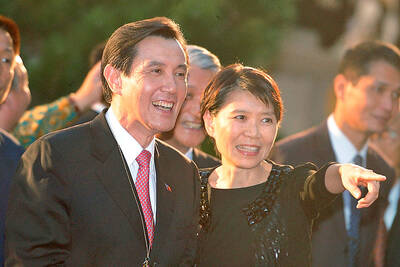
Former president Ma Ying-jeou (馬英九) yesterday expressed “shock and regret” over a statement issued by his wife without his consent, and rejected her assertion that his eldest sister, Ma Yi-nan (馬以南), would manage his medical care or act as his spokesperson amid an ongoing embezzlement probe into his foundation. Ma Ying-jeou in a statement said he was shocked by a statement by his wife, Chou Mei-ching (周美青), regarding his affairs. Ma Yi-nan “must not” be in charge of his healthcare and other personal affairs, nor can she be allowed to represent the Ma family, the former president said. He said he was also


 RSS
RSS