


Calls for a crackdown on corruption made by Chinese President Xi Jinping (習近平) and the “princelings” he represents are more a political show than an indication of intent, while the faction’s tendency toward nationalism does not mean they consider themselves part of the “proletariat,” Taiwan Tsing Hua University professor and former Tiananmen Square student leader Wang Dan (王丹) wrote yesterday.
The term “princeling” refers to the offspring of the Chinese Communist Party’s (CCP) founding members, such as generals Wang Zhen (王震) and Yeh Jianying (葉劍英); Yu Chiwei (俞啟威), also known by his pseudonym Huang Jing (黃敬); former Chinese premier Li Peng (李鵬) and Xi Zhongxun (習仲勛), Xi Jinping’s father.
In an article titled The Unfinished Transition of Power and posted on the New Society for Taiwan’s Web site, Wang Dan’s said that with Xi Jinping and the princelings in power, Chinese politics is headed for a period of instability.
The article said that the princelings had four characteristics that could lead to political instability: They are more emotional; not afraid to express themselves and show their strong personalities; they are politically divided and they are more likely to say that they understand the difficulties of the people, while not considering themselves part of the proletariat, but above them.
‘EMOTIONAL’
During the political upheaval that ensued in the People’s Republic of China (PRC) soon after its founding, many of the CCP’s founding members were sent to the countryside for “philosophical rehabilitation.” Xi Zhongxun, Bo Yibo (薄一波), father to Bo Xilai (薄熙來), and Deng Xiaoping (鄧小平) were such members.
On the characteristic of being more “emotional,” Wang Dan pointed to former Chongqing CCP secretary Bo Xilai’s public slapping of his chief of police, Wang Lijun (王立軍), over his handling of his wife’s, Gu Kailai (谷開來), case, causing Wang Lijun to visit the US consulate in Chengdu seeking asylum.
Bo Xilai was sacked from his position as Chongqing’s party chief “in light of the serious political repercussions of the Wang Lijun incident,” effectively removing him from the role of contender in the 18th Party Congress last year, Wang Dan said.
Gu became as suspect in the investigation into the mysterious death of British businessman Neil Heywood, as a prime suspect in his murder.
Gu has since been given a suspended death sentence.
Wang Dan also cited Xi Jinping as an example of a politician capable of emotional outbursts, pointing to how Xi during his tour of Latin America in 2009 had said: “There are some bored foreigners, with full stomachs, who have nothing better to do than point fingers at us [China]. First, China doesn’t export revolution. Second, China doesn’t export hunger and poverty. Third, China doesn’t come and cause you headaches, what more is there to be said?”
Wang Dan added that the current generation of Chinese political leaders was more emotional and less guarded in their behavior in part because of their family backgrounds, which served to sweep aside much of the opposition they encountered, adding that such behavior encouraged members of the faction to manifest their own personal characteristics.
Wang Dan said that the divisiveness of the princelings faction contrasted with the unity of the unofficial Youth League faction, of which former Chinese president Hu Jintao (胡錦濤) was a member, adding as an example how Xi Jinping and Bo had clashed before even coming to power.
This shows the severe difference of opinions within the faction, Wang Dan said, adding that much of the antagonism stemmed from their fathers’ generation.
GRUDGES
Aside from former Chinese leader Mao Zedong (毛澤東), most of the members of the CCP that founded the People’s Republic of China were more or less equal in station and power, and some of the political and war-time differences and grudges would of course pass over to their successors who are now fighting for positions of power, Wang Dan said.
Also saying that some of the princelings had been in the countryside for a time after their fathers lost power, Wang Dan said that the princelings tend to lean toward nationalism and use language that would draw people closer to them.
The princelings are more prone to acting out political drama to win the support of the people than the Youth League, Wang Dan said, adding that the repeated calls for anti-corruption since Xi Jinping had been sworn in as the official head of state were only a ploy to meet the public’s expectations.
“We will be seeing more of these events in the future, but we should keep in mind that such actions do not mean that the ruling elite consider themselves part of the proletariat,” Wang Dan said.
He added that the princeling would be at best adherents to populism, but certainly not democracy.
Wang concluded his analyses by saying that “personality dictates fate,” adding that the political personalities of the princelings would give Chinese politics “a stage filled with incessant plays” and that there could be no stable development of China under their rule.
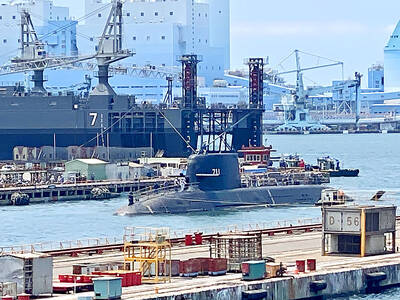
AGING: While Japan has 22 submarines, Taiwan only operates four, two of which were commissioned by the US in 1945 and 1946, and transferred to Taiwan in 1973 Taiwan would need at least 12 submarines to reach modern fleet capabilities, CSBC Corp, Taiwan chairman Chen Cheng-hung (陳政宏) said in an interview broadcast on Friday, citing a US assessment. CSBC is testing the nation’s first indigenous defense submarine, the Hai Kun (海鯤, Narwhal), which is scheduled to be delivered to the navy next month or in July. The Hai Kun has completed torpedo-firing tests and is scheduled to undergo overnight sea trials, Chen said on an SET TV military affairs program. Taiwan would require at least 12 submarines to establish a modern submarine force after assessing the nation’s operational environment and defense

A white king snake that frightened passengers and caused a stir on a Taipei MRT train on Friday evening has been claimed by its owner, who would be fined, Taipei Rapid Transit Corp (TRTC) said yesterday. A person on Threads posted that he thought he was lucky to find an empty row of seats on Friday after boarding a train on the Bannan (Blue) Line, only to spot a white snake with black stripes after sitting down. Startled, he jumped up, he wrote, describing the encounter as “terrifying.” “Taipei’s rat control plan: Release snakes on the metro,” one person wrote in reply, referring
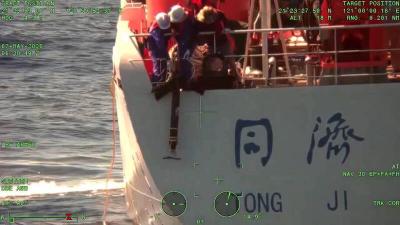
The coast guard today said that it had disrupted "illegal" operations by a Chinese research ship in waters close to the nation and driven it away, part of what Taipei sees a provocative pattern of China's stepped up maritime activities. The coast guard said that it on Thursday last week detected the Chinese ship Tongji (同濟號), which was commissioned only last year, 29 nautical miles (54km) southeast of the southern tip of Taiwan, although just outside restricted waters. The ship was observed lowering ropes into the water, suspected to be the deployment of scientific instruments for "illegal" survey operations, and the coast
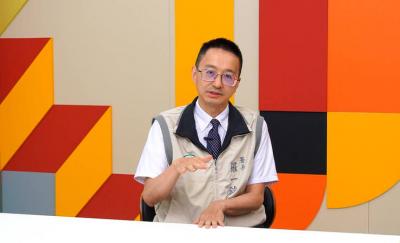
Taiwan’s two cases of hantavirus so far this year are on par with previous years’ case numbers, and the government is coordinating rat extermination work, so there should not be any outbreaks, Centers for Disease Control (CDC) Director-General Philip Lo (羅一鈞) said today in an interview with the Liberty Times (the Taipei Times’ sister newspaper). An increase in rat sightings in Taipei and New Taipei City has raised concerns about the spread of hantavirus, as rats can carry the disease. In January, a man in his 70s who lived in Taipei’s Daan District (大安) tested positive posthumously for hantavirus, Taiwan’s


 RSS
RSS