


The bribery allegations against Chinese Nationalist Party (KMT) Taipei City Councilor Lai Su-ju (賴素如) in the Taipei Twin Towers (台北雙子星) project have shaken the KMT and severely damaged the image of President Ma Ying-jeou’s (馬英九) administration.
Lai, a close aide of Ma who had run his KMT chairman’s office, was ordered back into detention yesterday for allegedly accepting NT$1 million (US$33,500) as a down payment bribe from a project developer in the bidding process for the project.
The bribery allegations are especially ironic as she acted as the defense lawyer for former Executive Yuan secretary-general Lin Yi-shih (林益世) in his corruption trial last year.
When the scandal surrounding Lin broke last year, Ma, who doubles as KMT chairman, expressed regret over his close aide’s lack of integrity and immediately held a corruption prevention forum with government officials to demonstrate his determination to tackle the problem.
In the wake of the allegations against Lai, Ma offered his apologies twice and repeated his pledge to fight corruption.
However, his anti-corruption slogans have ceased to be persuasive and his image as a politician of integrity has been further damaged. A poll released in the Chinese-language Apple Daily yesterday showed that 60.75 percent of respondents said they do not have confidence in the integrity of the Ma administration. Only 31 percent still professed faith in Ma’s integrity.
“President Ma’s integrity was the biggest asset in his political career, and he is losing that asset in these corruption cases. He must recognize that maintaining his personal integrity is not enough. Action must be taken to eliminate corruption in his party,” Ming Chuan University professor Chen Chao-chien (陳朝建) said.
Ma defeated the Democratic Progressive Party’s (DPP) Frank Hsieh (謝長廷) in the 2008 presidential election and led the KMT back to power when the DPP was experiencing a loss of public confidence amid the corruption scandals involving former president Chen Shui-bian (陳水扁) and his family.
Chen Chao-chien said the corruption accusations against Lin and Lai, as well as other KMT politicians including Nantou County Commissioner Lee Chao-ching (李朝卿), have left the Ma administration unable to shift the media spotlight from its poor performance to the DPP’s perceived shortcomings.
Ma’s political strength as the leader of the pan-blue camp would be further compromised, Chen Chao-chien said.
Amid the latest allegations, concerns about Ma’s bid for re-election as party chairman emerged again after several KMT legislators questioned the president’s capability, and suggested that he shoulder the responsibility for Lai’s corruption case and reconsider his plans to seek another term as party chairman.
On the other hand, a number of KMT political heavyweights voiced their support for Ma’s re-election bid. Legislative Speaker Wang Jin-pyng (王金平), Premier Jiang Yi-huah (江宜樺), Taipei Mayor Hau Lung-bin (郝龍斌) and New Taipei City Mayor Eric Chu (朱立倫) all said that Ma should continue to serve as KMT chairman to strengthen cooperation between the party and the government in implementing policies.
“Even with support from the party heavyweights, Ma would become a nominal chairman as he is in his second and final term as president. The KMT will face a power struggle among future leaders and local factions,” Chen Chao-chien said.
Shih Cheng-feng (施正鋒), a professor at National Dong Hwa University, said the bribery scandal behind the construction project, which was initiated by Ma during his term as Taipei mayor in 2004, also damaged the public’s confidence in the capabilities of both Ma and Hau, and Lai’s case was another wake-up call for Ma that he should put less trust in grassroots politicians.
National Sun Yat-sen University political science professor Liao Da-chi (廖達琪) said Ma should strengthen his communications with party members and develop a better understanding of the party’s structure especially at the grassroots level.
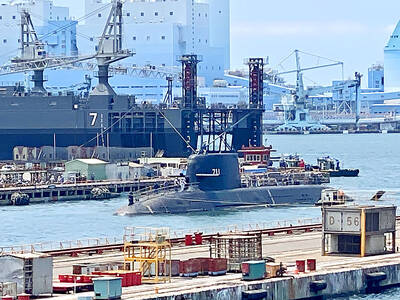
AGING: While Japan has 22 submarines, Taiwan only operates four, two of which were commissioned by the US in 1945 and 1946, and transferred to Taiwan in 1973 Taiwan would need at least 12 submarines to reach modern fleet capabilities, CSBC Corp, Taiwan chairman Chen Cheng-hung (陳政宏) said in an interview broadcast on Friday, citing a US assessment. CSBC is testing the nation’s first indigenous defense submarine, the Hai Kun (海鯤, Narwhal), which is scheduled to be delivered to the navy next month or in July. The Hai Kun has completed torpedo-firing tests and is scheduled to undergo overnight sea trials, Chen said on an SET TV military affairs program. Taiwan would require at least 12 submarines to establish a modern submarine force after assessing the nation’s operational environment and defense

Yangmingshan National Park authorities yesterday urged visitors to respect public spaces and obey the law after a couple was caught on a camera livestream having sex at the park’s Qingtiangang (擎天崗) earlier in the day. The Shilin Police Precinct in Taipei said it has identified a suspect and his vehicle registration number, and would summon him for questioning. The case would be handled in accordance with public indecency charges, it added. The couple entered the park at about 11pm on Thursday and began fooling around by 1am yesterday, the police said, adding that the two were unaware of the park’s all-day live
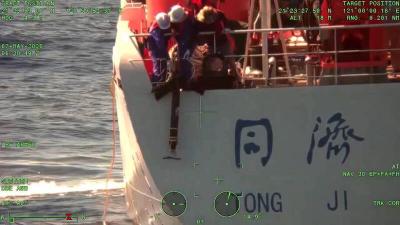
The coast guard today said that it had disrupted "illegal" operations by a Chinese research ship in waters close to the nation and driven it away, part of what Taipei sees a provocative pattern of China's stepped up maritime activities. The coast guard said that it on Thursday last week detected the Chinese ship Tongji (同濟號), which was commissioned only last year, 29 nautical miles (54km) southeast of the southern tip of Taiwan, although just outside restricted waters. The ship was observed lowering ropes into the water, suspected to be the deployment of scientific instruments for "illegal" survey operations, and the coast

A former soldier and an active-duty army officer were yesterday indicted for allegedly selling classified military training materials to a Chinese intelligence operative for a total of NT$79,440. The Taipei District Prosecutors’ Office indicted Chen Tai-yin (陳泰尹) and Lee Chun-ta (李俊達) for contravening the National Security Act (國家安全法) and the Anti-Corruption Act (貪污治罪條例). Chen left the military in September 2013 after serving alongside then-staff sergeant Lee, now an army lieutenant, at the 21st Artillery Command of the army’s Sixth Corps from 2011 to 2013, according to the indictment. Chen met a Chinese intelligence operative identified as “Wang” (王) through a friend in November


 RSS
RSS