


In a move to strengthen their anti-nuclear efforts, film directors Ko I-chen (柯一正) and Wu Yi-feng (吳乙峰) are considering inviting well-known people from the artistic and entertainment industries to endorse their petition against the construction of the nation’s controversy-plagued Fourth Nuclear Power Plant in Gongliao (貢寮), New Taipei City (新北市).
In a statement jointly authored by Ko and Wu, which they said would be published on their Facebook pages in the near future, the pair called on heavyweights from the artistic and cultural sectors to weigh in on their anti-nuclear bid.
“We will spare no effort in inviting Taiwanese ‘living national treasures’ to join our cause, such as globally acclaimed director Hou Hsiao-hsien (侯孝賢) and Cloud Gate founder Lin Hwai-min (林懷民),” Ko said.
The statement also urged the government to scrap a budget proposal to invest several billion NT dollars more in the contentious plant, “for the sake of offering peace of mind to the many parents in the country and their offspring.”
“Granting the additional budget to the nuclear power plant not only is tantamount to [throwing money into] a bottomless pit, but could also signal the onset of a major, irreversible catastrophe,” the pair said in the statement.
However, if President Ma Ying-jeou (馬英九) came forward and headed off the tragedy, it could become the “greatest contribution he has ever made to Taiwanese society,” they said, adding that now was the critical moment for Ma to create a historical legacy.
The statement came after a flash mob initiated by Ko and several other directors on May 28 last year on Ketagalan Boulevard in front of the Presidential Office, in which about 60 people formed the Chinese character ren (人, human being) for 30 seconds while shouting “I am a human being, I oppose nuclear power.”
“As using nuclear power would inevitably leave behind waste for future generations, the artistic and cultural industries are obliged to issue a warning against such an unjust action and prevent the Fourth Nuclear Power Plant from asking for more funding,” Ko said.
Ko said that since directors were not always good with words, voicing their opposition to nuclear power via creative approaches seemed more appropriate than using verbal tirades or acts of violence.
“We aspire to express our anti-nuclear stance in the simplest manner possible, one that every like-minded individual can easily emulate at home,” Ko said, as he took out a huge white umbrella that was covered by signatures and featured the slogan “stopping the Fourth Nuclear Power Plant for the next generation.”
If an adequate number of such anti-nuclear umbrellas are collected, they could also be used for a public art installation, Ko added.
Echoing Ko’s proposal, Wu said veteran television hostess Chang Hsiao-yen (張小燕) and comedian Chu Ko Liang (豬哥亮) were on his shortlist of big-name entertainers they would like to back their bid.
Describing the Fourth Nuclear Power Plant as a “terrifying assembled vehicle” that used Japanese-manufactured equipment, but was built based on the design concept of a US-based firm, Wu said a small and densely populated island such as Taiwan could not afford to take even the slightest risk of a nuclear disaster.
“How could anyone still be reluctant to end construction of the plant? If our failure to stop the project now is to result in a catastrophe 50 years later, we will be held accountable for the misery imposed on future generations,” Wu said.
Wu said that while the anti-nuclear issue had long been politicized, their bid carried no specific political affiliation and they hoped it would not become a maneuvering tool of the pan-blue and pan-green camps.
“After all, radiation leakage would occur regardless of which political party is in charge of the country,” Wu said, adding that Taiwanese must transcend politics on the issue of nuclear power, particularly in the wake of Japan’s Fukushima Dai-ichi nuclear disaster on March 11, 2011.
“Perhaps putting an end to the plant’s construction will become the first step toward conciliation between the pan-blue and pan-green camps,” Wu added.
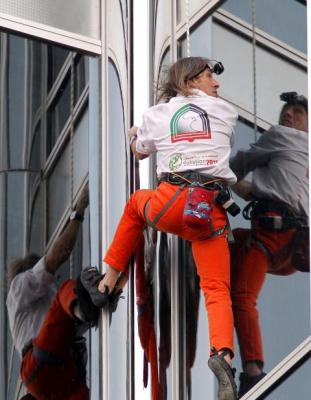
Alain Robert, known as the "French Spider-Man," praised Alex Honnold as exceptionally well-prepared after the US climber completed a free solo ascent of Taipei 101 yesterday. Robert said Honnold's ascent of the 508m-tall skyscraper in just more than one-and-a-half hours without using safety ropes or equipment was a remarkable achievement. "This is my life," he said in an interview conducted in French, adding that he liked the feeling of being "on the edge of danger." The 63-year-old Frenchman climbed Taipei 101 using ropes in December 2004, taking about four hours to reach the top. On a one-to-10 scale of difficulty, Robert said Taipei 101
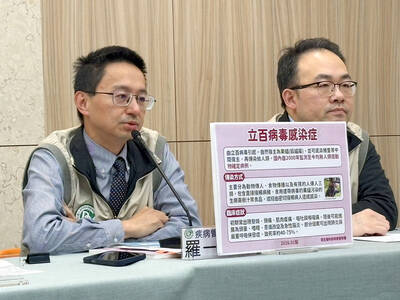
Nipah virus infection is to be officially listed as a category 5 notifiable infectious disease in Taiwan in March, while clinical treatment guidelines are being formulated, the Centers for Disease Control (CDC) said yesterday. With Nipah infections being reported in other countries and considering its relatively high fatality rate, the centers on Jan. 16 announced that it would be listed as a notifiable infectious disease to bolster the nation’s systematic early warning system and increase public awareness, the CDC said. Bangladesh reported four fatal cases last year in separate districts, with three linked to raw date palm sap consumption, CDC Epidemic Intelligence
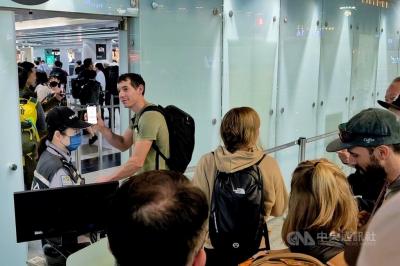
US climber Alex Honnold left Taiwan this morning a day after completing a free-solo ascent of Taipei 101, a feat that drew cheers from onlookers and gained widespread international attention. Honnold yesterday scaled the 101-story skyscraper without a rope or safety harness. The climb — the highest urban free-solo ascent ever attempted — took just more than 90 minutes and was streamed live on Netflix. It was covered by major international news outlets including CNN, the New York Times, the Guardian and the Wall Street Journal. As Honnold prepared to leave Taiwan today, he attracted a crowd when he and his wife, Sanni,
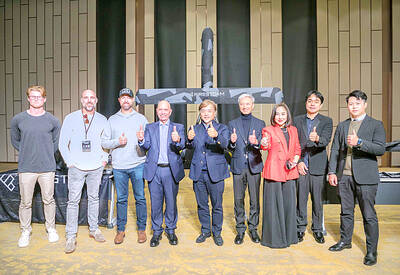
Taiwanese and US defense groups are collaborating to introduce deployable, semi-autonomous manufacturing systems for drones and components in a boost to the nation’s supply chain resilience. Taiwan’s G-Tech Optroelectronics Corp subsidiary GTOC and the US’ Aerkomm Inc on Friday announced an agreement with fellow US-based Firestorm Lab to adopt the latter’s xCell, a technology featuring 3D printers fitted in 6.1m container units. The systems enable aerial platforms and parts to be produced in high volumes from dispersed nodes capable of rapid redeployment, to minimize the risk of enemy strikes and to meet field requirements, they said. Firestorm chief technology officer Ian Muceus said


 RSS
RSS