


Representative to India James Tien (田中光) is to focus his efforts on building a platform to advance trade relations between Taiwan and India after he formally assumes his duties later this month.
In a recent interview in Taipei, Tien said that advancing bilateral trade relations would be one of his priorities in his new position, with the information technology sector one area targeted for expanded cooperation with the emerging economic power.
The platform is also to extend to discussion of an economic cooperation agreement between Taiwan and India.
A feasibility study on the pact is expected to be finalized early this year and the issue will become a main focus, said Tien, who is scheduled to depart for India in the middle of this month.
In an earlier interview, India’s envoy to Taiwan, Pradeep Kumar Rawat, said his country’s growing market for agricultural and processed food products represents a big opportunity for Taiwanese companies.
Rawat also suggested that Taiwan and India take advantage of their complementary strengths in hardware and software to launch information technology products, saying that India’s huge human resources could help Taiwanese companies design new products.
On the issue of visa-free privileges, Tien said that “both sides have exchanged views to understand each other’s needs.”
The Indian government has agreed to make it more convenient for people-to-people exchanges between the two countries, Tien said, but he indicated that further discussions on the issue of granting visa-free treatment or landing visas would be needed.
Noting that Taiwan’s government is committed to seeking visa-exemption privileges or landing visas from other countries to allow Taiwanese more convenient overseas travel, Tien said he would continue to pursue visa-waiver treatment from India.
Republic of China passport holders now enjoy visa-free treatment or landing visas in about 130 countries and territories, the Ministry of Foreign Affairs said.
Asked about cultural exchanges between Taiwan and India, Tien said this would also be an area where further cooperation is pursued.
“It will help both sides to understand each other better,” he said.
To promote bilateral cultural exchanges, Tien said cooperation should “start with things people like,” such as movies and music.
Mumbai-based Bollywood, for example, is one of the world’s leaders in the film industry, Tien said.
The 3D Hollywood blockbuster Life of Pi, directed by Taiwan-born director Ang Lee (李安), serves as an example of how Taiwan and India could increase cultural exchanges, he said.
Seventy percent of the film, which explores issues of faith through the tale of a shipwrecked Indian boy adrift on a lifeboat alone with a Bengal tiger, was shot in Taiwan.
Tien, the former director-general of the ministry’s Department of East Asian and Pacific Affairs, was appointed as representative to India in November to fill the post vacated by Ong Wen-chyi (翁文琪), who retired.

SECURITY: Starlink owner Elon Musk has taken pro-Beijing positions, and allowing pro-China companies to control Taiwan’s critical infrastructure is risky, a legislator said Starlink was reluctant to offer services in Taiwan because of the nation’s extremely high penetration rates in 4G and 5G services, the Ministry of Digital Affairs said yesterday. The ministry made the comments at a meeting of the legislature’s Transportation Committee, which reviewed amendments to Article 36 of the Telecommunications Management Act (電信管理法). Article 36 bans foreigners from holding more than 49 percent of shares in public telecommunications networks, while shares foreigners directly and indirectly hold are also capped at 60 percent of the total, unless specified otherwise by law. The amendments, sponsored by Chinese Nationalist Party (KMT) Legislator Ko

The eastern extension of the Taipei MRT Red Line could begin operations as early as late June, the Taipei Department of Rapid Transit Systems said yesterday. Taipei Rapid Transit Corp said it is considering offering one month of free rides on the new section to mark its opening. Construction progress on the 1.4km extension, which is to run from the current terminal Xiangshan Station to a new eastern terminal, Guangci/Fengtian Temple Station, was 90.6 percent complete by the end of last month, the department said in a report to the Taipei City Council's Transportation Committee. While construction began in October 2016 with an

NON-RED SUPPLY: Boosting the nation’s drone industry is becoming increasingly urgent as China’s UAV dominance could become an issue in a crisis, an analyst said Taiwan’s drone exports to Europe grew 41.7-fold from 2024 to last year, with demand from Ukraine’s fight against Russian aggression the most likely driver of growth, a study showed. The Institute for Democracy, Society and Emerging Technology (DSET) in a statement on Wednesday said it found that many of Taiwan’s uncrewed aerial vehicle (UAV) sales were from Poland and the Czech Republic. These countries likely transferred the drones to Ukraine to aid it in its fight against the Russian invasion that started in 2022, it said. Despite the gains, Taiwan is not the dominant drone exporter to these markets, ranking second and fourth
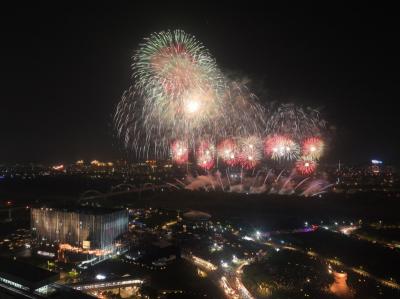
The New Taipei City Art Museum this weekend plans to celebrate its first anniversary with a two-day extravaganza featuring live concerts and a large-scale synchronized fireworks and drone display, the New Taipei City Cultural Affairs Department said. The two-day celebrations are to take place in the museum’s outdoor park, with markets and live performances by singers including Ann Bai (白安), Bii (畢書盡) and the Cosmos People (宇宙人), the department said. The highlight on both evenings would be the "Echoes of Light" show, an aerial spectacle combining fireworks and drone performances designed around the concept of "dual stages in the sky," it


 RSS
RSS