


The Supreme Court yesterday upheld a three-and-a-half-year jail sentence for Non-Partisan Solidarity Union Legislator Yen Ching-piao (顏清標) for spending millions of dollars of taxpayers’ money at hostess bars and KTV lounges.
Yen, who was sentenced for misusing public funds during his term as Taichung County Council speaker, is expected to start serving his prison sentence soon and will lose his seat in the legislature. His civil rights have been suspended for three years.
Independent Greater Taichung Council Speaker Chang Ching-tang (張清堂), who was Yen’s vice speaker in the Taichung County Council at the time, was sentenced to three-and-a-half years in prison and had his civil rights suspended for three years.
Tsai Wen-hsiung (蔡文雄), Yen’s former secretary, received six-and-a-half years and had his civil rights suspended for four years.
Although Yen and Chang are independent politicians, they are deemed close to the Chinese Nationalist Party (KMT) and their imprisonment could have an impact on Greater Taichung politics. Two by-elections are to be held to fill Yen’s legislative seat and Chang’s council speakership.
The Taiwan High Court ruled that the trio were guilty in September last year.
The Supreme Court said Yen and Chang had returned NT$20.55 million (US$687,000) in misused public funds to state coffers. As a result, the Taiwan High Court handed out reduced sentences.
The court found Yen, Chang and Tsai guilty of spending council funds between 1998 and 2000 to cover their expenditures at hostess bars and KTV lounges in then-Taichung City. According to the ruling, the trio used more than NT$20 million of council money and still owe various hostess bars about NT$10 million.
Yen, chairman of Chenlan Temple, spent three-and-a-half years in Green Island’s maximum-security prison after a crackdown on organized crime in 1986. His participation in local politics began soon after he was released.
Speaking of the decision, Deputy Minister of the Interior Chien Tai-lang (簡太郎) told a press conference that the sentence against Yen would take effect immediately and he would be stripped of his status as a lawmaker when the Ministry of the Interior receives the written sentence from the court.
“When we receive the written sentence, we will refer it to the Presidential Office, and the president, who would then officially announce the removal of Yen from the post of legislator,” Chien said. “At the same time, we will also inform the Central Election Commission to hold a by-election to fill the post that will be left open by Yen in three months.”
Chien said that while the deprivation of civil rights takes effect immediately, the three-year suspension period would start only after he finishes serving the jail term.
In a press statement, Yen said he had consulted Taipei County Council’s accounting director and chief secretary on how to handle the money and had no intention of committing corruption.
He said he respects the rule of law, but would continue to seek legal means to clear himself.

FUKUOKA SITUATION: Japanese media reported that the pathogen is expected to be identified by the summer, while the CDC downplayed the idea that it was hMPV A “mysterious cold-like illness” reported in Japan’s Fukuoka Prefecture does not seem to be a new disease, but Japanese authorities have been asked about the situation, the Centers for Disease Control (CDC) said yesterday. The Fukuoka Prefectural Medical Association on Wednesday told a news conference that a “mystery cold” that has become a hot topic on social media is “highly likely to be caused by some kind of viral infection,” Japan’s KBC News reported. “Many people are experiencing symptoms starting with a sore throat, followed by a runny nose, phlegm and a severe cough,” KBC News reported, citing association officials. Health authorities are

Nvidia Corp CEO Jensen Huang (黃仁勳) arrived in Taiwan yesterday ahead of upcoming AI and technology events, saying he plans to meet with clients and Taiwan Semiconductor Manufacturing Co Chairman C.C. Wei (魏哲家) during his visit. After landing at Taipei Songshan Airport, Huang posed for photos with fans and handed out Yakult drinks to reporters and supporters waiting at the scene, saying he has “a lot to do” during the trip. Asked about reports that Nvidia’s planned headquarters site in Taipei’s Beitou Shilin Technology Park could break ground on May 27, Huang said that if the company holds an event, he would

The Ministry of Finance this afternoon announced the winning numbers for the March-April uniform invoice lottery. The winning number for the NT$10 million (US$318,060) special prize is 19531471, and the winning number for the NT$2 million grand prize is 85941329. Three numbers were drawn for the NT$200,000 first prize: 07225810, 20231230 and 83518781. Those with receipts matching the last seven digits of any of the first-prize numbers will win the NT$40,000 second prize, while those matching the last six digits will win the NT$10,000 third prize. Those whose receipts match the last five digits of the first-prize numbers can claim the NT$4,000 fourth prize,
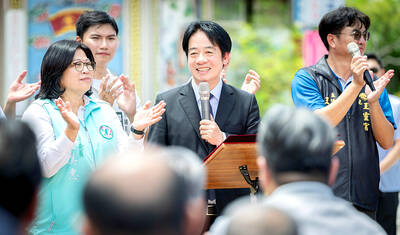
SIX SUBSIDIES: The monthly allowance for older farmers is to increase to NT$10,000, and NT$5,000 is to be given to homemakers under the national pension system, Lai said The government is to implement major welfare policies for disadvantaged groups, including raising the monthly allowance for older farmers to NT$10,000 and providing homemakers with NT$5,000 per month, President William Lai (賴清德) said yesterday. Lai made the remarks during a visit to Wangling Temple in Chiayi County, saying that the planned increases were being introduced amid economic growth and an increase in tax revenue. Touting a policy, in which the government plans to provide a monthly allowance of NT$5,000 for every child under the age of 18 in a bid to address Taiwan’s low birthrate, Lai said that if received for the


 RSS
RSS