


The Democratic Progressive Party (DPP) yesterday expressed its strong opposition to the proposed acquisition of Next Media Group by a consortium, saying the deal could be a “major catastrophe for Taiwan’s democracy” as it would allow China to influence Taiwanese media and jeopardize freedom of speech.
“As a political party that has always pursued democracy in Taiwan, we will not allow the situation to deteriorate and our determination to stop the deal should not be underestimated,” DPP Chairman Su Tseng-chang (蘇貞昌) told a press conference.
Formosa Plastics Group chairman William Wong (王文淵), Chinatrust Charity Foundation chairman Jeffrey Koo Jr (辜仲諒) and Want Want China Times Group chairman Tsai Eng-meng (蔡衍明) have launched a bid to buy the Next Media businesses for NT$17.5 billion (US$601.2 million).
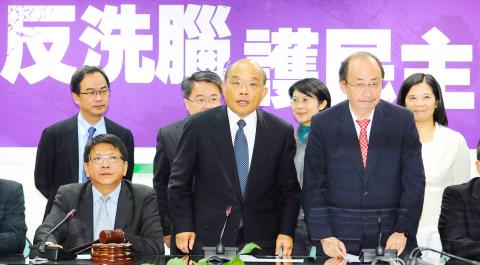
Photo: Chang Chia-ming, Taipei Times
Koo, Wong and Tsai were reportedly set to take stakes of 34 percent, 34 percent and 32 percent respectively in the media group, local media reports said on Sunday.
Taiwan-born Tsai, a business tycoon in working China, already controls various media businesses in Taiwan and is the most controversial investor in the deal.
In a four-point statement, Su demanded that President Ma Ying-jeou (馬英九) express his views and position on the controversial case, in which Chinese investment and influence were suspected to be involved, to reduce prevalent doubts on his position.
Second, government agencies, including the Fair Trade Commission, the Financial Supervisory Commission (FSC), the National Communications Commission, the Ministry of Economic Affairs and the Ministry of Justice, should all assume their responsibility, Su said.
Third, the DPP will collaborate with civic groups about possible measures to oppose the acquisition, Su said.
And fourth, the party urged the public and civic groups to safeguard Taiwan’s democracy through collective efforts and determination, he said.
Association of Taiwan Journalists (ATJ) president Chen Hsiao-yi (陳曉宜) said on the sidelines of the press conference that the ATJ had sent out letters of complaint to five agencies, warning the agencies that the deal may violate regulations concerning the separation of the financial sector and media, fair competition, freedom of speech and media monopoly.
Speaking at a separate press conference, Taiwan Solidarity Union (TSU) Legislator Hsu Chung-hsin (許忠信) called on government agencies to block the deal.
The involvement of the Chinatrust Group of financial companies could create a “contagion risk” which could jeopardize the financial stability of the member companies, while the involvement of Want Want China Times Group, which already owns several media outlets, could create a media monopoly, Hsu said.
Labor unions representing workers at Next Media Group’s businesses in Taiwan had requested that the acquisition of the media outlets be made transparent to ease growing anxiety among employees.
They were reportedly planning a strike against the deal and the group’s disregard of employees’ rights and interests.
Meanwhile, DPP Legislator Kuan Bi-ling (管碧玲) blasted the FSC’s “double standards” in its qualification review of Koo, who was asked to reduce his stake to 20 percent because of his position in Chinatrust Group, and Tsai.
Citing the Insurance Act (保險法). Kuan added that Tsai, the majority shareholder of Want Want Union Insurance Co, should also be prohibited from investing in other industries.

Taiwan must first strengthen its own national defense to deter a potential invasion by China as cross-strait tensions continue to rise, multiple European lawmakers said on Friday. In a media interview in Taipei marking the conclusion of an eight-member European parliamentary delegation’s six-day visit to Taiwan, the lawmakers urged Taipei to remain vigilant and increase defense spending. “All those who claim they want to protect you actually want to conquer you,” Ukrainian lawmaker Serhii Soboliev said when asked what lessons Taiwan could draw from Russia’s invasion of Ukraine. Soboliev described the Kremlin as a “new fascist Nazi regime” that justified
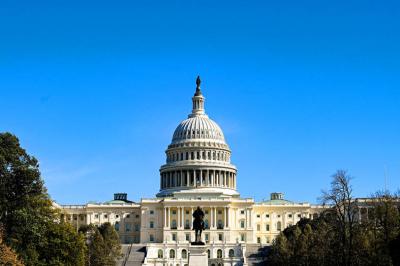
The US House of Representatives yesterday passed the PROTECT Taiwan Act, which stipulates that Washington would exclude China from participating in major global financial organizations if its actions directly threaten Taiwan’s security. The bill, proposed by Republican US Representative Frank Lucas, passed with 395 votes in favor and two against. It stipulates that if China’s actions pose any threat to Taiwan’s security, economic or social systems, the US would, “to the maximum extent practicable,” exclude China from international financial institutions, including the G20, the Bank for International Settlements and the Financial Stability Board. The bill makes it clear that China

‘T-DOME’: IBCS would increase Taiwan’s defense capabilities, enabling air defense units to use data from any sensor system and cut reaction time, a defense official said A defense official yesterday said that a purported new arms sale the US is assembling for Taiwan likely includes Integrated Battle Command Systems (IBCS). The anonymous official’s comments came hours after the Financial Times (FT) reported that Washington is preparing a US$20 billion arms sale encompassing “Patriot missiles and other weapons,” citing eight sources. The Taiwanese official said the IBCS is an advanced command and control system that would play a key role in President William Lai’s (賴清德) flagship defense program, the “T-Dome,” an integrated air defense network to counter ballistic missiles and other threats. The IBCS would increase Taiwan’s

NOMINAL NEWLYWEDS: A man’s family and his wife — his long-term caregiver — are engaged in a legal dogfight over the propriety and validity of the recent union A centenarian’s marriage to his caregiver unbeknownst to his children has prompted legal action, as the caregiver accuses the man’s children of violating her personal liberty and damaging her reputation, while the children have sought a legal option to have the marriage annulled. According to sources, the 102-year-old man surnamed Wang (王) lives in Taipei’s Zhongshan District (中山) and previously worked as a land registration agent. Wang reportedly owns multiple properties and parcels of land worth several hundred million New Taiwan dollars and has ten children. His caregiver, a 69-year-old surnamed Lai (賴), has been caring for him since about 1999,


 RSS
RSS