


A 31-year-old Taiwanese photographer who backpacked around Japan in July found that people in the two countries, despite their different languages, share the same desire for a nuclear-free and safer planet.
Carrying an anti-nuclear cardboard sign reading “No Nukes,” Lee Ping-hua (李秉樺), who only speaks broken Japanese, invited 25 groups of Japanese he encountered at random during his 14-day trip to pose for a photograph while holding copies of an anti-nuclear poster designed by celebrated Japanese illustrator Yoshitomo Nara.
Lee’s idea to shoot a set of anti-nuclear themed photographs to boost awareness was spurred by the lukewarm responses Taiwanese netizens gave to the worst nuclear disasters in Japanese history following the magnitude 9 earthquake and tsunami on March 11 last year.

Photo: Courtesy of Lee Ping-hua
“I was surprised to find that nuclear disasters could be so close to Taiwan,” Lee said.
The 31-year-old was able to put his idea into practice after he won return air tickets from Taiwan to Japan in a lucky draw contest.
To flesh out his campaign, Lee drew inspiration from a series of anti-nuclear events staged by Nara and Japanese animator Hayao Miyazaki.
He then made several copies of Yoshitomo’s “No Nukes” posters and requested his brother, an amateur painter, design a sign similar to an anti-nuclear one that Miyazaki had hung around his neck during a protest.
With four cameras in his backpack, Lee randomly stopped pedestrians and asked them to do a photo shoot with the poster using simple Japanese and body language.
Trudging from Osaka through Kanazawa to Hokkaido, Lee finished 25 sets of pictures and lost 6kg along the way.
“Before I set foot in Japan, I was already mentally prepared for rejections. While there were people who flatly turned down my request, there were also people who shared my beliefs, readily agreed to the photo shoot and even taught me how to pronounce ‘nuclear power’ in Japanese,” Lee said.
“It was a worthwhile and productive journey,” he added.
Lee’s advocacy efforts were not only welcomed by Japanese, but also people in Taiwan, as the photographs he shared on backpackers.com.tw have received fervent responses and triggered widespread online discussions.
“Changes to a society, or a country, almost always hail from a small change by an individual. [What Lee has done] is rather touching,” a Taiwanese netizen, identified as elisa1024, commented on the Web site.
While expressing gratitude to people who believe in him, Lee said he hoped his actions could draw more attention, as well as support, to the anti-nuclear issue.
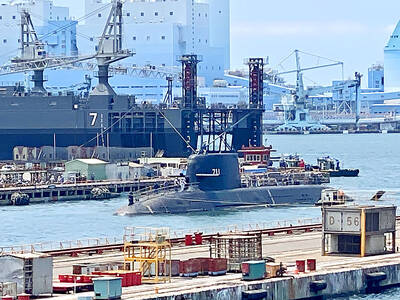
AGING: While Japan has 22 submarines, Taiwan only operates four, two of which were commissioned by the US in 1945 and 1946, and transferred to Taiwan in 1973 Taiwan would need at least 12 submarines to reach modern fleet capabilities, CSBC Corp, Taiwan chairman Chen Cheng-hung (陳政宏) said in an interview broadcast on Friday, citing a US assessment. CSBC is testing the nation’s first indigenous defense submarine, the Hai Kun (海鯤, Narwhal), which is scheduled to be delivered to the navy next month or in July. The Hai Kun has completed torpedo-firing tests and is scheduled to undergo overnight sea trials, Chen said on an SET TV military affairs program. Taiwan would require at least 12 submarines to establish a modern submarine force after assessing the nation’s operational environment and defense
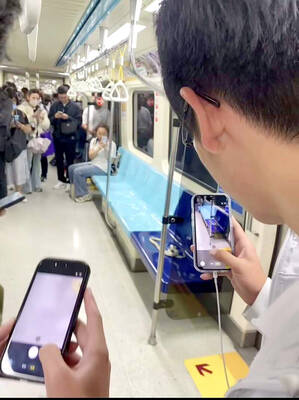
A white king snake that frightened passengers and caused a stir on a Taipei MRT train on Friday evening has been claimed by its owner, who would be fined, Taipei Rapid Transit Corp (TRTC) said yesterday. A person on Threads posted that he thought he was lucky to find an empty row of seats on Friday after boarding a train on the Bannan (Blue) Line, only to spot a white snake with black stripes after sitting down. Startled, he jumped up, he wrote, describing the encounter as “terrifying.” “Taipei’s rat control plan: Release snakes on the metro,” one person wrote in reply, referring
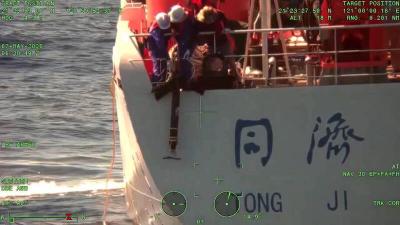
The coast guard today said that it had disrupted "illegal" operations by a Chinese research ship in waters close to the nation and driven it away, part of what Taipei sees a provocative pattern of China's stepped up maritime activities. The coast guard said that it on Thursday last week detected the Chinese ship Tongji (同濟號), which was commissioned only last year, 29 nautical miles (54km) southeast of the southern tip of Taiwan, although just outside restricted waters. The ship was observed lowering ropes into the water, suspected to be the deployment of scientific instruments for "illegal" survey operations, and the coast
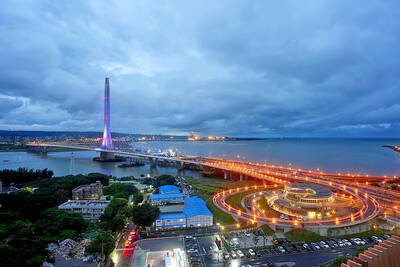
An inauguration ceremony was held yesterday for the Danjiang Bridge, the world’s longest single-mast asymmetric cable-stayed bridge, ahead of its official opening to traffic on Tuesday, marking a major milestone after nearly three decades of planning and construction. At the ceremony in New Taipei City attended by President William Lai (賴清德), Premier Cho Jung-tai (卓榮泰), Minister of Transportation and Communications Chen Shih-kai (陳世凱) and New Taipei City Mayor Hou Yu-ih (侯友宜), the bridge was hailed as both an engineering landmark and a long-awaited regional transport link connecting Tamsui (淡水) and Bali (八里)


 RSS
RSS