


Environmentalists yesterday said soil samples near the controversial Miramar Resort Village in Taitung County’s Shanyuan Beach (杉原沙灘) were found to contain exceedingly high levels of chromium, but the company said its test reports showed the levels were within safe limits.
After the Supreme Administrative Court ruled last month that the construction permit to build the resort was invalid, many environmentalists have urged the government to tear down the building.
However, the Taitung County Government, which gave permission for the build-operate-transfer development project, told the Ministry of Interior on Monday that the court had found the first construction permit in 2005 invalid, adding that since another permit was granted in 2008 for a larger area and an environmental impact assessment was underway, the hotel was not an illegal construction.
At Citizen of the Earth, Taiwan’s office in Taipei yesterday, Tainan Community University researcher Wu Jen-pang (吳仁邦) said heavy metal contamination tests on soil samples collected from seven sites near the hotel on Oct. 4 showed that three of the samples contained chromium concentrations exceeding the soil quality standard of 250 parts per million (ppm).
Wu said he suspects the chromium comes from the hotel construction and may have been the result of the illegal mixing of bottom ashes or industrial waste with cement. Wu added he is “concerned that the heavy metal contaminated soil will negatively affect visitors’ health.”
“Since 2009, our investigations have shown that many coral reefs have been contaminated with dirt and sand. We are now even more concerned that they may be contaminated by the heavy metal substances found in the soil samples,” said the director of Taiwan Environmental Info Association’s Environmental Trust Center, Sun Hsiu-ju (孫秀如).
Tsai Chung-yueh (蔡中岳), director of Citizen’s Hualien and Taitung offices, said the hotel had violated the law many times during its construction and damaged the surrounding environment so the government should tear it down.
In response, Miramar’s Development Department section head Lin Hong-che (林弘哲) provided a test report as evidence that the soil was not contaminated and said the company had commissioned Cheng Shiu University — whose lab is approved by the Environmental Protection Administration (EPA) — to conduct soil quality examinations in June.
During the press conference, Wu said the test results provided by Miramar were derived using the elution method, in which the soil samples are dissolved in an acidic solution before testing, often resulting in inaccurate readings. Wu added that Miramar should instead use total concentration analysis to provide more accurate test results.
Miramar then issued a press release in the evening saying that their test results had indeed been derived using total concentration analysis.
The EPA has also sent an inspection team to collect samples.
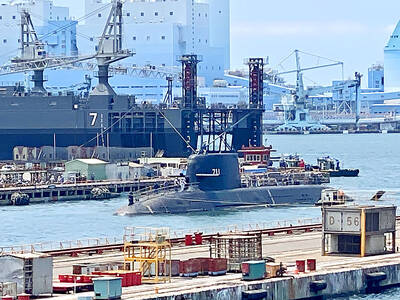
AGING: While Japan has 22 submarines, Taiwan only operates four, two of which were commissioned by the US in 1945 and 1946, and transferred to Taiwan in 1973 Taiwan would need at least 12 submarines to reach modern fleet capabilities, CSBC Corp, Taiwan chairman Chen Cheng-hung (陳政宏) said in an interview broadcast on Friday, citing a US assessment. CSBC is testing the nation’s first indigenous defense submarine, the Hai Kun (海鯤, Narwhal), which is scheduled to be delivered to the navy next month or in July. The Hai Kun has completed torpedo-firing tests and is scheduled to undergo overnight sea trials, Chen said on an SET TV military affairs program. Taiwan would require at least 12 submarines to establish a modern submarine force after assessing the nation’s operational environment and defense

A white king snake that frightened passengers and caused a stir on a Taipei MRT train on Friday evening has been claimed by its owner, who would be fined, Taipei Rapid Transit Corp (TRTC) said yesterday. A person on Threads posted that he thought he was lucky to find an empty row of seats on Friday after boarding a train on the Bannan (Blue) Line, only to spot a white snake with black stripes after sitting down. Startled, he jumped up, he wrote, describing the encounter as “terrifying.” “Taipei’s rat control plan: Release snakes on the metro,” one person wrote in reply, referring
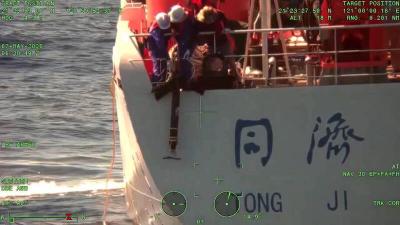
The coast guard today said that it had disrupted "illegal" operations by a Chinese research ship in waters close to the nation and driven it away, part of what Taipei sees a provocative pattern of China's stepped up maritime activities. The coast guard said that it on Thursday last week detected the Chinese ship Tongji (同濟號), which was commissioned only last year, 29 nautical miles (54km) southeast of the southern tip of Taiwan, although just outside restricted waters. The ship was observed lowering ropes into the water, suspected to be the deployment of scientific instruments for "illegal" survey operations, and the coast

Taiwan’s two cases of hantavirus so far this year are on par with previous years’ case numbers, and the government is coordinating rat extermination work, so there should not be any outbreaks, Centers for Disease Control (CDC) Director-General Philip Lo (羅一鈞) said today in an interview with the Liberty Times (the Taipei Times’ sister newspaper). An increase in rat sightings in Taipei and New Taipei City has raised concerns about the spread of hantavirus, as rats can carry the disease. In January, a man in his 70s who lived in Taipei’s Daan District (大安) tested positive posthumously for hantavirus, Taiwan’s


 RSS
RSS