


President Ma Ying-jeou (馬英九) yesterday dismissed concerns about the possible negative repercussions on US-Taiwan relations that recent confrontations with Japan over the Diaoyutai Islands (釣魚台) may have had, insisting that bilateral relations were proceeding under a “zero-accident” policy.
In an interview with TVBS, Ma denied that the absence of senior US defense and diplomatic officials from the Taiwan-US Defense Industry Conference on Sunday was the result of Washington’s displeasure with the Ma administration’s policy on the Diaoyutais and said that Taiwan was defending national sovereignty over the islands — three of which were nationalized by Japan last week — in a “rational way.”
“The meeting has nothing to do with the Diaoyutais sovereignty issue. We learned about [the absence of senior US officials] beforehand ... The US maintains a neutral stance on the issue,” he said.
Speculation about the US’ dissatisfaction with the Ma administration’s handling of the issue emerged after a high-seas conflict erupted between Taiwanese vessels and Japanese patrol boats last month. The spat was sparked by 75 Taiwanese boats setting sail for the Diaoyutais in a bid to assert Taiwanese sovereignty over the islands and to defend fishery rights.
Ma said that Taiwanese vessels did not initiate any confrontation during the sortie and insisted that the waters around the island chain had been the fishing grounds of Taiwanese fishermen for decades and that the government fully supports their moves to protect their rights.
With the US government expected to announce Taiwan’s membership of its US Visa-Waiver Program, Ma said the government was waiting for the US to complete all the associated procedures and said that the immigration policy should be reached within the foreseeable future.
The Taipei Economic and Cultural Representative Office in the US said on Monday that members of the US Congress have issued 382 letters and statements in recognition of Taiwan’s democratic achievements, ahead of National Day on Oct. 10.
In their letters, the US congressmen said Taiwan needs to strengthen its military capabilities and that they will ensure that the US continues to safeguard Taiwan’s security based on the Taiwan Relations Act.
In addition, they expressed support for the country’s participation in the International Civil Aviation Organization and other UN-affiliated agencies, the office said.
About 28 senators and congressmen released individual statements in praise of Taiwan as a role model of democratic development in Asia and as an important trade partner for the US, the office said.
While touting the government’s achievements in foreign affairs and in defending sovereignty, Ma acknowledged public dissatisfaction with the implementation of domestic policies and said he would instruct the Cabinet to present concrete achievements within one month.
“It is difficult for us to make all the people feel satisfied with our policies, but we will work hard to make it happen,” he said.
Amid growing complaints about the Cabinet, Ma insisted that the government has implemented policies that will boost the economy.
“We accept public criticism with humility, but if anyone describes our good policies as empty slogans then that is not true,” he said.
Additional reporting by CNA
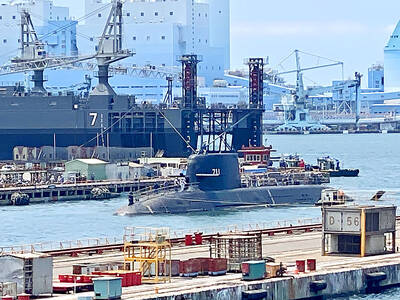
AGING: While Japan has 22 submarines, Taiwan only operates four, two of which were commissioned by the US in 1945 and 1946, and transferred to Taiwan in 1973 Taiwan would need at least 12 submarines to reach modern fleet capabilities, CSBC Corp, Taiwan chairman Chen Cheng-hung (陳政宏) said in an interview broadcast on Friday, citing a US assessment. CSBC is testing the nation’s first indigenous defense submarine, the Hai Kun (海鯤, Narwhal), which is scheduled to be delivered to the navy next month or in July. The Hai Kun has completed torpedo-firing tests and is scheduled to undergo overnight sea trials, Chen said on an SET TV military affairs program. Taiwan would require at least 12 submarines to establish a modern submarine force after assessing the nation’s operational environment and defense
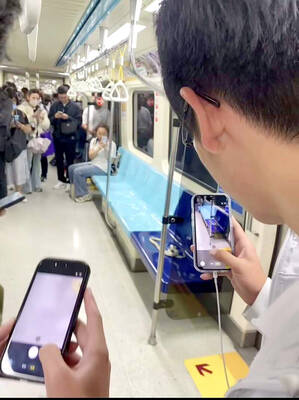
A white king snake that frightened passengers and caused a stir on a Taipei MRT train on Friday evening has been claimed by its owner, who would be fined, Taipei Rapid Transit Corp (TRTC) said yesterday. A person on Threads posted that he thought he was lucky to find an empty row of seats on Friday after boarding a train on the Bannan (Blue) Line, only to spot a white snake with black stripes after sitting down. Startled, he jumped up, he wrote, describing the encounter as “terrifying.” “Taipei’s rat control plan: Release snakes on the metro,” one person wrote in reply, referring
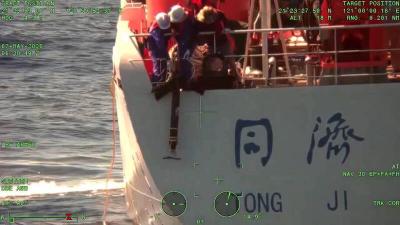
The coast guard today said that it had disrupted "illegal" operations by a Chinese research ship in waters close to the nation and driven it away, part of what Taipei sees a provocative pattern of China's stepped up maritime activities. The coast guard said that it on Thursday last week detected the Chinese ship Tongji (同濟號), which was commissioned only last year, 29 nautical miles (54km) southeast of the southern tip of Taiwan, although just outside restricted waters. The ship was observed lowering ropes into the water, suspected to be the deployment of scientific instruments for "illegal" survey operations, and the coast
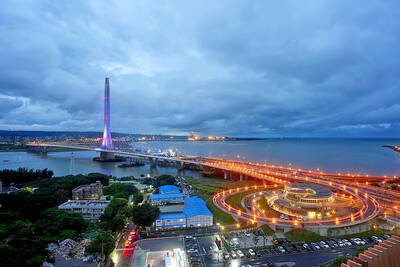
An inauguration ceremony was held yesterday for the Danjiang Bridge, the world’s longest single-mast asymmetric cable-stayed bridge, ahead of its official opening to traffic on Tuesday, marking a major milestone after nearly three decades of planning and construction. At the ceremony in New Taipei City attended by President William Lai (賴清德), Premier Cho Jung-tai (卓榮泰), Minister of Transportation and Communications Chen Shih-kai (陳世凱) and New Taipei City Mayor Hou Yu-ih (侯友宜), the bridge was hailed as both an engineering landmark and a long-awaited regional transport link connecting Tamsui (淡水) and Bali (八里)


 RSS
RSS