


Environmentalists yesterday called on the Atomic Energy Council (AEC) to conduct a thorough survey around Lanyu (蘭嶼, also known as Orchid Island) as a report released by Japanese academics shows that an unusual amount of radiation has been found on the island and that the nuclear waste storage facility on the island may be leaking.
“Two Japanese academics have found unusual levels of radiation at more than 10 locations around Lanyu, with the level at one location as high as 500 times more than the environment background value — this shows that the issue of radioactive pollution is very serious on the island,” Peter Chang (張武修), a professor at Taipei Medical University’s School of Public Health, and the chairman of the National Association for Radiation Protection, told a news conference yesterday.
“We hereby call on the AEC to conduct a throughout survey on radiation levels on the island,” he added. “This is not only for the safety and health of residents, but also for protection of tens of thousands of visitors to the island.”
He said that exposure to such levels of radiation may increase the risk of residents and visitors getting cardiovascular diseases, cancers, or giving birth to deformed babies.
Chang was referring to a report released by Tokyo-based J.F. Oberlin University professor Katsumi Nakao and associate professor You Kato from Tokyo Metropolitan University’s Division of Radiological Science.
The two Japanese academics conducted a three-day survey of the island from late last month to early this month and formally released their results in Tokyo on Thursday.
Tao Foundation executive director Sutej Hugu urged the AEC to mark polluted areas, inform residents about the risks, discover the source of the radiation, inspect the nuclear waste storage facility, find out those who should be held responsible for the leak, remove the storage facility and thoroughly clean the site.
In response, AEC Minister Tsai Chuen-horng (蔡春鴻) said at a separate setting that the council did not find unusual levels of radiation during its latest survey, which was carried out earlier this month.
He added, however, that to allay worries from the public, the council would conduct another survey next month and will invite lawmakers to travel along.

SECURITY: Starlink owner Elon Musk has taken pro-Beijing positions, and allowing pro-China companies to control Taiwan’s critical infrastructure is risky, a legislator said Starlink was reluctant to offer services in Taiwan because of the nation’s extremely high penetration rates in 4G and 5G services, the Ministry of Digital Affairs said yesterday. The ministry made the comments at a meeting of the legislature’s Transportation Committee, which reviewed amendments to Article 36 of the Telecommunications Management Act (電信管理法). Article 36 bans foreigners from holding more than 49 percent of shares in public telecommunications networks, while shares foreigners directly and indirectly hold are also capped at 60 percent of the total, unless specified otherwise by law. The amendments, sponsored by Chinese Nationalist Party (KMT) Legislator Ko

The military has spotted two Chinese warships operating in waters near Penghu County in the Taiwan Strait and sent its own naval and air forces to monitor the vessels, the Ministry of National Defense (MND) said. Beijing sends warships and warplanes into the waters and skies around Taiwan on an almost daily basis, drawing condemnation from Taipei. While the ministry offers daily updates on the locations of Chinese military aircraft, it only rarely gives details of where Chinese warships are operating, generally only when it detects aircraft carriers, as happened last week. A Chinese destroyer and a frigate entered waters to the southwest
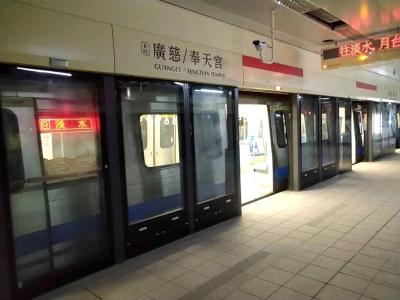
The eastern extension of the Taipei MRT Red Line could begin operations as early as late June, the Taipei Department of Rapid Transit Systems said yesterday. Taipei Rapid Transit Corp said it is considering offering one month of free rides on the new section to mark its opening. Construction progress on the 1.4km extension, which is to run from the current terminal Xiangshan Station to a new eastern terminal, Guangci/Fengtian Temple Station, was 90.6 percent complete by the end of last month, the department said in a report to the Taipei City Council's Transportation Committee. While construction began in October 2016 with an
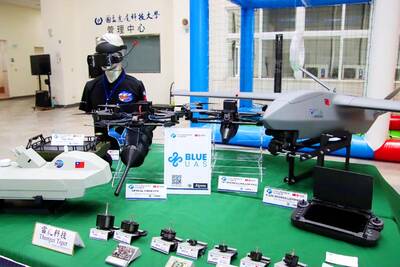
NON-RED SUPPLY: Boosting the nation’s drone industry is becoming increasingly urgent as China’s UAV dominance could become an issue in a crisis, an analyst said Taiwan’s drone exports to Europe grew 41.7-fold from 2024 to last year, with demand from Ukraine’s fight against Russian aggression the most likely driver of growth, a study showed. The Institute for Democracy, Society and Emerging Technology (DSET) in a statement on Wednesday said it found that many of Taiwan’s uncrewed aerial vehicle (UAV) sales were from Poland and the Czech Republic. These countries likely transferred the drones to Ukraine to aid it in its fight against the Russian invasion that started in 2022, it said. Despite the gains, Taiwan is not the dominant drone exporter to these markets, ranking second and fourth


 RSS
RSS