

The National Police Agency special police second headquarters has taken the lead in countering anti-nuclear activities and become a thug for Taiwan Power Co (Taipower), Democratic Progressive Party (DPP) Legislator Cheng Li-chun (鄭麗君) said yesterday.
Cheng said the headquarters’ Web site included an articled titled “The anti-nuclear trend is no longer fashionable”, which claims that anti-nuclear activists are irrational, use false data and base their views on the slim chance that a nuclear disaster might happen.
It cites the German Green party — a main proponent of anti-nuclear policy in Germany — as an example of the waning popularity of anti-nuclear views as it has often been defeated in elections.
“The economy is the lifeline of a nation and electricity is the lifeline of the economy. When our primary [economic] competitors are all fully committed to nuclear power, are we supposed to be led by the nose by the anti-nuclear activists who uses false data and threats of nuclear disasters?” the article says.
The article also mentions that due to the electoral failure of the German Green Party and the pressure of signatory countries to adhere to the Kyoto Protocol — an addendum to the UN Framework Convention on Climate Change calling for the “stabilization of greenhouse gas concentrations in the atmosphere at a level that would prevent dangerous anthropogenic interference with the climate system” — that many advanced countries are reconsidering their anti-nuclear policies.
Cheng said she wondered if the police force was using funding from Taipower to cover its personnel and administrative fees, effectively turning the national police into a “security force for Taipower” or its “political warfare department.”
The special police second headquarters is a professional police task force founded in accordance to the Nuclear Power Law (原子能法) and Taipower has commissioned it to send some of its men to stand guard around its three operational nuclear power plants, as well as the one still under construction, for NT$850 million (US$28.6 million).
The article on the headquarters’ Web site goes against the majority consensus of anti-nuclear policies and ignores the aftermath of the nuclear disaster at Fukushima Dai-ichi nuclear plant in Japan in March last year, and uses outdated concepts and cites government Web sites to advocate keeping nuclear power on Taipower Co’s behalf, Cheng said.
Cheng added that Article 23 of the Basic Environment Act (基本環境法) stipulates: “The government must establish plans to gradually achieve the goal of becoming a nuclear-free country,” adding that the headquarters’ Web site article has already violated the act and that the police agency should apologize for this and discipline those responsible for it.
Cheng also said that she would be inspecting the headquarters’ budget estimate to see if it contains evidence of a hidden agenda, adding that if there was such evidence she “would not let them get off without consequences.”
Meanwhile, Taiwan Green Party spokesman Pan Han-shen (潘翰聲) said police should be neutral and not endorse “brainwashing” efforts.
Pan added that the German Green Party’s defeat in the elections was because it had not been anti-nuclear enough to gain the support of the German people, adding that after the party made an amendment to its guidelines, it has regained popular support.
Green parties in Europe have been “receiving great amount of support” over the past few years, and even the pro-nuclear party Christian Democratic Union of Germany has also begun to show signs of leaning toward ab anti-nuclear stance, Pan said.
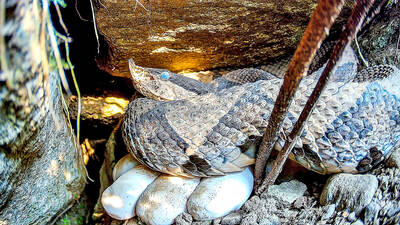
NATURE TAKES ITS COURSE: The agency’s head said he felt a sense of loss watching red-banded snakes eat the babies, as they had decided on non-intervention The Forestry and Nature Conservation Agency yesterday released a documentary on a hundred-pace viper that had incubated 16 eggs, all of which hatched, but only a baby viper escaped after they were attacked by red-banded snakes. The agency’s Taichung branch last year launched the viper reproduction monitoring project soon after forest rangers Lin Chun-yu (林俊佑) and Chou Chia-cheng (周家成) spotted a pregnant hundred-pace viper in a grass-covered burrow near a parking lot in Tbulan Village (松鶴部落). The Atayal village, in Taichung’s Heping District (和平), is headed by Ecyang Yapu, who was positive about the project and assisted in access control and power

The Coast Guard Administration (CGA) yesterday said that it had deployed vessels to “monitor” Chinese ships operating in waters off the east coast. The CGA said it dispatched vessels in response to a China Coast Guard announcement that it had carried out another “routine law-enforcement patrol” in waters off the east coast. “The CGA firmly rejects China’s cognitive warfare campaign of ‘law enforcement in name, jurisdictional expansion in practice,’” it said on X. As of 11am yesterday, two China Coast Guard ships were “loitering and drifting” about 105 nautical miles (195km) and 74 nautical miles east of Green Island (綠島) respectively, it said. It

The first two F-16V Block 70 jets Taiwan purchased from the US were spotted unexpectedly turning back after departing from Hawaii yesterday, potentially further delaying delivery of the aircraft. Taiwan has purchased 66 of the F-16 C/D Block 70 jets to be deployed at Chihhang Air Base (志航基地) in Taitung County and operated by the air force's 7th Tactical Fighter Wing to defend Taiwan’s eastern region. Two single-seat jets, bearing serial No. 6727 and 6728, were spotted taking off from Hickam Field in Hawaii yesterday, observers said. Based on the precedent set during the delivery of Taiwan's older F-16 Block 20s, the new

A sharp rise in compensation to be paid by air force officers who leave before completing their required service could indicate an increase in pilots leaving the military early, an analyst said on Friday, warning that the trend could worsen a shortage of experienced personnel. Chieh Chung (揭仲), a researcher at the Association for Strategic Foresight, issued the warning even though the number of volunteer military personnel is expected to increase next year. The planned headcount for volunteer military personnel, covering officers, noncommissioned officers (NCO) and enlisted soldiers, is 158,223 for next year, up 4,258 from 153,965 this year, Chieh said. The increase


 RSS
RSS