


Officials said yesterday at a forum that more creativity and a new mindset would have to be introduced in all plans for urban development in the future as academics expressed disappointment over the government’s performance in this area during the past decade.
“New legislation, ideas and approaches are required for metropolises such as Taipei City and the New Taipei City to improve their urban environment,” said Hung Chia-hung (洪嘉宏), director-general of the Construction and Planning Agency’s Urban and Rural Development Branch.
Hung was among a group of officials and academics in the Taipei Next Forum, organized by Democratic Progressive Party (DPP) Legislator Pasuya Yao (姚文智), which focused on urban development, in particular on issues of social housing, urban regeneration and the proposed development of a waterfront, in the greater Taipei area.
With housing prices in Taiwan skyrocketing, social housing has been mentioned by experts as a way to ease housing demand for the young and the poor, but Taiwan’s government has always distributed social apartments through selling, rather than leasing.
“Perhaps it’s time for us to introduce the concept of superficies by allowing residents to live in apartments without owning them, so they would not have to endure the high housing price,” Hung said.
Volunteer participation in urban regeneration projects could be tax deductible and legislation should be relaxed to allow changes in the use of land to bring in industries and rejuvenate certain areas, he added.
Ting Yu-chun (丁育群), Commissioner of Taipei City’s Department of Urban Development, said the city government has learned lessons in a number of urban regeneration projects which had stirred up controversies and public anger this year.
Taipei City plans to build 45,000 social apartments, around 5 percent of the total of 970,000 households in the city, in 25 years for people in need, he said.
Huang Jui-mao (黃瑞茂), a professor of Architecture at Tamkang University, described the government’s performance on urban development in the past decade as “out of control.”
Development projects have become politicians’ blank checks in election campaigns, he said, adding that the underprivileged people and urban reservations were among the issues that the government had totally ignored in Tamsui (淡水), a town of 100,000 residents in New Taipei City (新北市), has been the perfect example of how things went wrong in Taiwan’s urban planning, Huang said.
The town was “overloaded” with careless development of its waterfront and its culturally rich urban texture, he said.


Kenting National Park service technician Yang Jien-fon (楊政峰) won a silver award in World Grand Prix Photography Awards Spring Season for his photograph of two male rat snakes intertwined in combat. Yang’s colleagues at Kenting National Park said he is a master of nature photography who has been held back by his job in civil service. The awards accept entries in all four seasons across six categories: architectural and urban photography, black-and-white and fine art photography, commercial and fashion photography, documentary and people photography, nature and experimental photography, and mobile photography. Awards are ranked according to scores and divided into platinum, gold and
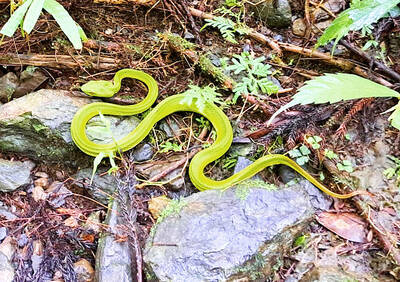
More than half of the bamboo vipers captured in Tainan in the past few years were found in the city’s Sinhua District (新化), while other districts had smaller catches or none at all. Every year, Tainan captures about 6,000 snakes which have made their way into people’s homes. Of the six major venomous snakes in Taiwan, the cobra, the many-banded krait, the brown-spotted pit viper and the bamboo viper are the most frequently captured. The high concentration of bamboo vipers captured in Sinhua District is puzzling. Tainan Agriculture Bureau Forestry and Nature Conservation Division head Chu Chien-ming (朱健明) earlier this week said that the
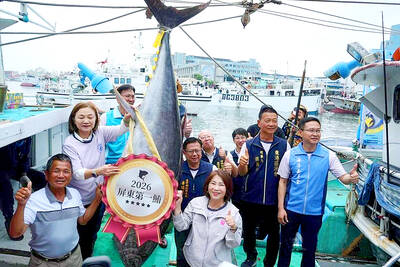
The first bluefin tuna of the season, brought to shore in Pingtung County and weighing 190kg, was yesterday auctioned for NT$10,600 (US$333.5) per kilogram, setting a record high for the local market. The auction was held at the fish market in Donggang Fishing Harbor, where the Siaoliouciou Island-registered fishing vessel Fu Yu Ching No. 2 delivered the “Pingtung First Tuna” it had caught for bidding. Bidding was intense, and the tuna was ultimately jointly purchased by a local restaurant and a local company for NT$10,600 per kilogram — NT$300 ,more than last year — for a total of NT$2.014 million. The 67-year-old skipper
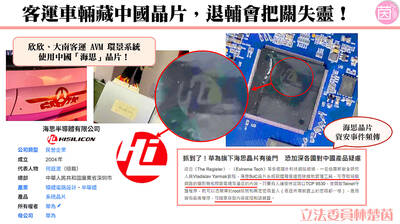
BREACH OF CONTRACT: The bus operators would seek compensation and have demanded that the manufacturer replace the chips with ones that meet regulations Two bus operators found to be using buses with China-made chips are to demand that the original manufacturers replace the systems and provide compensation for breach of contract, the Veterans Affairs Council said yesterday. Democratic Progressive Party Legislator Michelle Lin (林楚茵) yesterday said that Da Nan Bus Co and Shin-Shin Bus Co Ltd have fielded a total of 82 buses that are using Chinese chips. The bus models were made by Tron-E, while the systems provider was CYE Electronics, Lin said. Lin alleged that the buses were using chips manufactured by Huawei subsidiary HiSilicon Co, which presents a national security risk if the


 RSS
RSS