


A US military expert has written that if Chinese and Japanese forces met in battle over the Diaoyutai Islands (釣魚台), the outcome would be difficult to predict.
“Such a fight appeared farfetched before 2010, when Japan’s Coast Guard apprehended Chinese fishermen who rammed one of its vessels off the disputed islands, but it appears more likely now,” James Holmes, an associate professor of strategy at the US Naval War College, wrote in Foreign Policy magazine this week.
Holmes said that China’s leaders are “clearly thinking about the unthinkable.”
However, Japan would not be a pushover, he wrote.
He said the Japan Maritime Self-Defense Force (JMSDF) has accumulated several pockets of material excellence, such as undersea warfare, and their sailors were renowned for their professionalism.
“If commanders manage their human, material and geographic advantages artfully, Tokyo could make a maritime war with China a close-run thing — and perhaps even prevail,” Holmes wrote.
He said a straightforward China-on-Japan war was doubtful unless Beijing managed to isolate Tokyo diplomatically or Tokyo isolated itself through “foolish diplomacy.”
Barring that, Holmes said a conflict would probably ensnare the US as an active combatant on the Japanese side.
However, discounting politics, a contest between Chinese and Japanese sea power would be no contest in purely numerical terms.
Japan has 48 major surface combatant ships, including light aircraft carriers, guided-missile destroyers, frigates and corvettes and 16 diesel-electric submarines.
The People’s Liberation Army Navy (PLAN) boasts 73 major surface combatants, 84 missile-firing patrol craft and 63 submarines.
“China’s navy is far superior in sheer weight of steel,” Holmes wrote.
However, the PLAN is untested and its quality unsure.
The quality of the JMSDF’s Navy and its human capabilities “could partially or wholly offset the PLA’s advantage of numbers.”
“JMSDF flotillas ply Asian waters continually, operating solo or with other navies. The PLA Navy is inert by comparison,” he wrote.
He said that in general, Chinese fleets emerge only for brief cruises or exercises, leaving crews little time to develop an operating rhythm or learn their profession.
The human edge goes to Japan.
Because China and Japan are close to each other, both countries’ land-based firepower needs to be factored in, Holmes said.
PLA conventional ballistic missiles could strike land sites throughout Asia, putting Japanese assets at risk before they ever left port or took to the sky.
China’s Second Artillery Corps, or missile force, has reportedly fielded anti-ship ballistic missiles able to strike moving ships at sea from China.
However, if Japan forward-deployed Type 88 ASCMs — mobile, easily transportable anti-ship weapons — and missile crews to the islets and to neighboring islands in the Ryukyu chain, its ground troops could generate overlapping fields of fire that would “convert nearby seas into no-go zones for Chinese shipping.”
Holmes concluded that whoever best combined sea, land and air forces stood a good chance of winning a conflict.
“That could be Japan if its political and military leaders think creatively, procure the right hardware and arrange it on the map for maximum effect,” he wrote.
Holmes said Japan would not need to defeat China’s military to win a showdown at sea because it already holds the “contested real estate.”
“If Northeast Asian seas became a no-man’s land, but Japanese forces hung on, the political victory would be Tokyo’s,” he says.
Finally, Holmes said that if China lost much of its fleet in a Sino-Japanese clash — even in a winning effort — Beijing could see its momentum toward world-power status “reversed in an afternoon.”
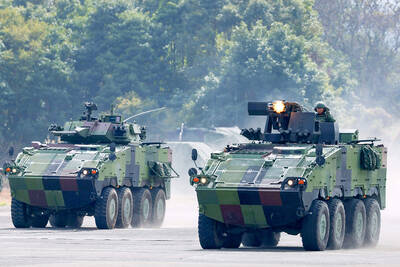
Taiwan must first strengthen its own national defense to deter a potential invasion by China as cross-strait tensions continue to rise, multiple European lawmakers said on Friday. In a media interview in Taipei marking the conclusion of an eight-member European parliamentary delegation’s six-day visit to Taiwan, the lawmakers urged Taipei to remain vigilant and increase defense spending. “All those who claim they want to protect you actually want to conquer you,” Ukrainian lawmaker Serhii Soboliev said when asked what lessons Taiwan could draw from Russia’s invasion of Ukraine. Soboliev described the Kremlin as a “new fascist Nazi regime” that justified
The US House of Representatives yesterday passed the PROTECT Taiwan Act, which stipulates that Washington would exclude China from participating in major global financial organizations if its actions directly threaten Taiwan’s security. The bill, proposed by Republican US Representative Frank Lucas, passed with 395 votes in favor and two against. It stipulates that if China’s actions pose any threat to Taiwan’s security, economic or social systems, the US would, “to the maximum extent practicable,” exclude China from international financial institutions, including the G20, the Bank for International Settlements and the Financial Stability Board. The bill makes it clear that China
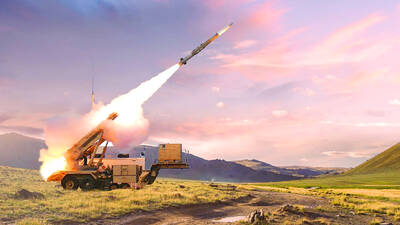
‘T-DOME’: IBCS would increase Taiwan’s defense capabilities, enabling air defense units to use data from any sensor system and cut reaction time, a defense official said A defense official yesterday said that a purported new arms sale the US is assembling for Taiwan likely includes Integrated Battle Command Systems (IBCS). The anonymous official’s comments came hours after the Financial Times (FT) reported that Washington is preparing a US$20 billion arms sale encompassing “Patriot missiles and other weapons,” citing eight sources. The Taiwanese official said the IBCS is an advanced command and control system that would play a key role in President William Lai’s (賴清德) flagship defense program, the “T-Dome,” an integrated air defense network to counter ballistic missiles and other threats. The IBCS would increase Taiwan’s

NOMINAL NEWLYWEDS: A man’s family and his wife — his long-term caregiver — are engaged in a legal dogfight over the propriety and validity of the recent union A centenarian’s marriage to his caregiver unbeknownst to his children has prompted legal action, as the caregiver accuses the man’s children of violating her personal liberty and damaging her reputation, while the children have sought a legal option to have the marriage annulled. According to sources, the 102-year-old man surnamed Wang (王) lives in Taipei’s Zhongshan District (中山) and previously worked as a land registration agent. Wang reportedly owns multiple properties and parcels of land worth several hundred million New Taiwan dollars and has ten children. His caregiver, a 69-year-old surnamed Lai (賴), has been caring for him since about 1999,


 RSS
RSS