


The top 10 imported Chinese medicines will require safety certification from Aug. 1, as well as improved labeling, according to the Department of Health (DOH).
Importers of these herbs and medicines will be required to provide certification, said Huang Lin-huang (黃林煌), chairman of the DOH’s Committee on Chinese Medicine and Pharmacy.
Chinese dates, astragalus root, dong quai (當歸) and Chinese liquorice will also be subjected to customs’ sample inspections because these four items often fail pesticide safety standards as well as showing traces of heavy metals and aflatoxins, Huang said.
The moves are part of a three-phase plan by the department to control the safety of Chinese herbs and to regulate medication sourcing.
The first phase includes requiring clearly labeled packaging for 324 of the approximately 600 kinds of Chinese herbs and medicinal products on the local market.
Phase two includes establishing inspection standards to check for abnormal levels of residues of things like heavy metals and aflatoxins in 91 types of herbs, while the final phase is to establish import source control mechanisms.
Huang also said that potentially harmful substances should carry a barcode so that their source can be verified and the public can be informed about the toxic properties of the medication.
Toxic substances are sometimes added to traditional Chinese medicines to give the recipient the feeling that the medicine is working.
Huang said the barcoding of poisonous substances, including arsenic, toad venom extract and realgar will be completed by next year.
Taiwan imports more than 600 Chinese medicinal products, more than 90 percent of which come from China. DOH statistics show that in 2009, Taiwan imported 3,086 tonnes of Chinese red dates, 2,935 tonnes of astralagus root, 2,041 tonnes of dong quai and 1,455 tonnes of Chinese liquorice.

Taiwan must first strengthen its own national defense to deter a potential invasion by China as cross-strait tensions continue to rise, multiple European lawmakers said on Friday. In a media interview in Taipei marking the conclusion of an eight-member European parliamentary delegation’s six-day visit to Taiwan, the lawmakers urged Taipei to remain vigilant and increase defense spending. “All those who claim they want to protect you actually want to conquer you,” Ukrainian lawmaker Serhii Soboliev said when asked what lessons Taiwan could draw from Russia’s invasion of Ukraine. Soboliev described the Kremlin as a “new fascist Nazi regime” that justified
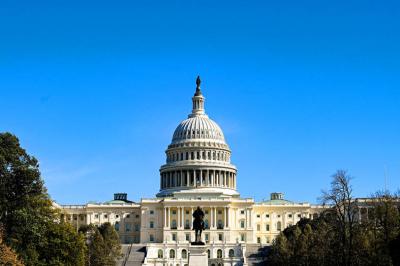
The US House of Representatives yesterday passed the PROTECT Taiwan Act, which stipulates that Washington would exclude China from participating in major global financial organizations if its actions directly threaten Taiwan’s security. The bill, proposed by Republican US Representative Frank Lucas, passed with 395 votes in favor and two against. It stipulates that if China’s actions pose any threat to Taiwan’s security, economic or social systems, the US would, “to the maximum extent practicable,” exclude China from international financial institutions, including the G20, the Bank for International Settlements and the Financial Stability Board. The bill makes it clear that China

‘T-DOME’: IBCS would increase Taiwan’s defense capabilities, enabling air defense units to use data from any sensor system and cut reaction time, a defense official said A defense official yesterday said that a purported new arms sale the US is assembling for Taiwan likely includes Integrated Battle Command Systems (IBCS). The anonymous official’s comments came hours after the Financial Times (FT) reported that Washington is preparing a US$20 billion arms sale encompassing “Patriot missiles and other weapons,” citing eight sources. The Taiwanese official said the IBCS is an advanced command and control system that would play a key role in President William Lai’s (賴清德) flagship defense program, the “T-Dome,” an integrated air defense network to counter ballistic missiles and other threats. The IBCS would increase Taiwan’s
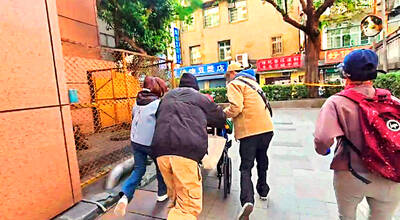
NOMINAL NEWLYWEDS: A man’s family and his wife — his long-term caregiver — are engaged in a legal dogfight over the propriety and validity of the recent union A centenarian’s marriage to his caregiver unbeknownst to his children has prompted legal action, as the caregiver accuses the man’s children of violating her personal liberty and damaging her reputation, while the children have sought a legal option to have the marriage annulled. According to sources, the 102-year-old man surnamed Wang (王) lives in Taipei’s Zhongshan District (中山) and previously worked as a land registration agent. Wang reportedly owns multiple properties and parcels of land worth several hundred million New Taiwan dollars and has ten children. His caregiver, a 69-year-old surnamed Lai (賴), has been caring for him since about 1999,


 RSS
RSS