


A “sensible cross-strait policy” is in the interest of both sides of the Taiwan Strait, while Chinese leaders will realize that change is inevitable, former US ambassador to Beijing Jon Huntsman said during a meeting with Democratic Progressive Party (DPP) Chairman Su Tseng-chang (蘇貞昌) in Taipei yesterday.
During the one-hour meeting, Huntsman, who is scheduled to leave Taiwan today after a three-day visit, exchanged views with Su on a number of China-related issues and reminisced about the time he spent in Taiwan in the 1980s.
The former Utah governor said he expects the Internet to drive change in China because Chinese bloggers and Internet users keep pushing the envelope, although he said he was not sure how this change “would play out and at what speed in China.”

Photo: Liu Hsin-de, Taipei Times
In terms of the incoming Chinese leadership, Huntsman said the fifth generation of Chinese Communist Party (CCP) leaders would understand that change is inevitable, but at the same time they would be concerned about instability.
Huntsman said Chinese Vice President Xi Jinping’s (習近平) likely designation as the next Chinese leader marked the end of a dynasty that started with former Chinese leader Deng Xiaoping (鄧小平), because Xi would be the first leader not to have been personally anointed by the late Deng.
Xi will face three new challenges, said Huntsman, who served as a Mormon missionary in Taiwan between 1979 and 1980 and returned to work and live in Taiwan from 1987 to 1988.
“Is China becoming more repressive domestically? Is China becoming more nationalistic economically? Is it becoming more assertive internationally in terms of its military affairs?” he asked.
In the latter half of the meeting, which was closed to the media, Su told Huntsman the DPP would re-establish a representative office in Washington to make sure Taiwan’s voice is heard, said Liu Shih-chung (劉世忠), director of the DPP’s Department of International Affairs.
The DPP would conduct a series of seminars and internal meetings before the 18th national party congress of the CCP to better understand China, Liu quoted Su as saying.
Su also said the DPP’s economic policy would encourage diverse foreign investment, a better investment environment, higher government efficiency and environmental protection, Liu said.

A preclearance service to facilitate entry for people traveling to select airports in Japan would be available from Thursday next week to Feb. 25 at Taiwan Taoyuan International Airport, Taoyuan International Airport Corp (TIAC) said on Tuesday. The service was first made available to Taiwanese travelers throughout the winter vacation of 2024 and during the Lunar New Year holiday. In addition to flights to the Japanese cities of Hakodate, Asahikawa, Akita, Sendai, Niigata, Okayama, Takamatsu, Kumamoto and Kagoshima, the service would be available to travelers to Kobe and Oita. The service can be accessed by passengers of 15 flight routes operated by
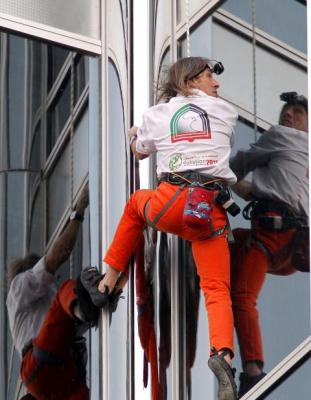
Alain Robert, known as the "French Spider-Man," praised Alex Honnold as exceptionally well-prepared after the US climber completed a free solo ascent of Taipei 101 yesterday. Robert said Honnold's ascent of the 508m-tall skyscraper in just more than one-and-a-half hours without using safety ropes or equipment was a remarkable achievement. "This is my life," he said in an interview conducted in French, adding that he liked the feeling of being "on the edge of danger." The 63-year-old Frenchman climbed Taipei 101 using ropes in December 2004, taking about four hours to reach the top. On a one-to-10 scale of difficulty, Robert said Taipei 101

Taiwanese and US defense groups are collaborating to introduce deployable, semi-autonomous manufacturing systems for drones and components in a boost to the nation’s supply chain resilience. Taiwan’s G-Tech Optroelectronics Corp subsidiary GTOC and the US’ Aerkomm Inc on Friday announced an agreement with fellow US-based Firestorm Lab to adopt the latter’s xCell, a technology featuring 3D printers fitted in 6.1m container units. The systems enable aerial platforms and parts to be produced in high volumes from dispersed nodes capable of rapid redeployment, to minimize the risk of enemy strikes and to meet field requirements, they said. Firestorm chief technology officer Ian Muceus said
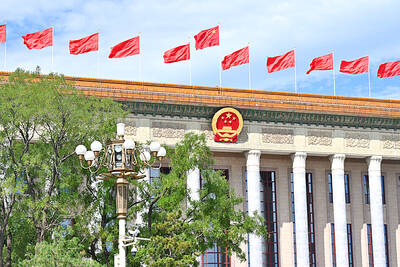
MORE FALL: An investigation into one of Xi’s key cronies, part of a broader ‘anti-corruption’ drive, indicates that he might have a deep distrust in the military, an expert said China’s latest military purge underscores systemic risks in its shift from collective leadership to sole rule under Chinese President Xi Jinping (習近平), and could disrupt its chain of command and military capabilities, a national security official said yesterday. If decisionmaking within the Chinese Communist Party has become “irrational” under one-man rule, the Taiwan Strait and the regional situation must be approached with extreme caution, given unforeseen risks, they added. The anonymous official made the remarks as China’s Central Military Commission Vice Chairman Zhang Youxia (張又俠) and Joint Staff Department Chief of Staff Liu Zhenli (劉振立) were reportedly being investigated for suspected “serious


 RSS
RSS