

Taiwan Solidarity Union Legislator Lin Shih-chia (林世嘉) yesterday said she would propose officially inviting Tibetan spiritual leader the Dalai Lama to deliver a speech at the Legislative Yuan.
“To show that we’re in solidarity with the Tibetans in their quest for freedom, I will make a proposal to formally invite the Dalai Lama to deliver a speech at our legislature,” Lin said during a question-and-answer session after the Tibetan government-in-exile’s Minister for Information and International Relations Dicki Chhoyang made a presentation at the Legislative Yuan on the exiled government, its policies and issues facing Tibetans inside and outside Tibet.
The event was co-hosted by Democratic Progressive Party Legislator Hsiao Bi-khim (蕭美琴) and the Tibetan Religious Foundation of His Holiness the Dalai Lama.
Lin’s proposal triggered a round of applause from the audience.
She said she would begin to collect signatures from fellow legislators and hopefully submit the proposal during a plenary session in the next legislative session.
Dicki Chhoyang is in Taiwan on her first stop of a tour to exiled Tibetan communities. Her tour will also include stops in South Korea and Japan.
In her speech, the Tibetan minister stressed that the government-in-exile would stand firmly behind the principles of non-violence and the middle-way approach in solving the Tibet issue.
Dicki Chhoyang also criticized the Chinese government for what she said was Beijing laying blame on the Dalai Lama and the government-in-exile for anti-Chinese sentiment and interethnic conflict in China.
“It [the conflicts] is often rooted in misguided, not well-structured, policies,” she said. “First, the patriotic re-education campaigns imposed on monasteries, resettlement of nomads and the language policy.”
Dicki Chhoyang said that in its propaganda campaigns, the Chinese government stations troops in monasteries and asks monks to denounce the Dalai Lama, while trying to destroy the centuries-old way of life of Tibetan nomads by forcing them to resettle in collective communities.
On language policy, the Chinese government has made Mandarin the medium of instruction in schools and only offers a few hours of Tibetan-language classes — taught in Chinese — per week, she added.
“A lot of Chinese in mainland [sic] China have no access to information other than what’s been given by the government,” Dicki Chhoyang said. “We really would like to request Chinese communities in free societies to deliver the accurate information.”
Hsiao said that while both Taiwan and Tibet are facing threats from China, “the suffering of Tibetans is much more serious than the Taiwanese.”
“It saddens me to see Tibetans trying to speak out through extreme actions, such as self-immolation, because they cannot take it anymore,” Hsiao said.
“We should all show more concern to human rights conditions in Tibet,” Hsiao said.
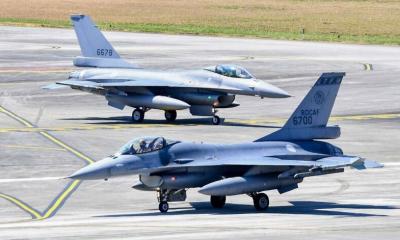
The first two F-16V Block 70 jets Taiwan purchased from the US were spotted unexpectedly turning back after departing from Hawaii yesterday, potentially further delaying delivery of the aircraft. Taiwan has purchased 66 of the F-16 C/D Block 70 jets to be deployed at Chihhang Air Base (志航基地) in Taitung County and operated by the air force's 7th Tactical Fighter Wing to defend Taiwan’s eastern region. Two single-seat jets, bearing serial No. 6727 and 6728, were spotted taking off from Hickam Field in Hawaii yesterday, observers said. Based on the precedent set during the delivery of Taiwan's older F-16 Block 20s, the new

Taiwan’s growing defense preparations might be sending a stronger signal to the US than to Beijing, highlighting the need for Taipei to tailor its deterrence efforts to different audiences, a US security academic said yesterday. Stanford University Freeman Spogli Institute for International Studies fellow Oriana Skylar Mastro made the comment during a Taipei Security Dialogue panel examining lessons Taiwan could draw from the wars in Ukraine and the Middle East. Mastro said she was impressed by Taiwan’s increased defense spending, emphasis on asymmetric capabilities and efforts to prepare society for conflict, but questioned whom those initiatives were influencing. She said when she asked
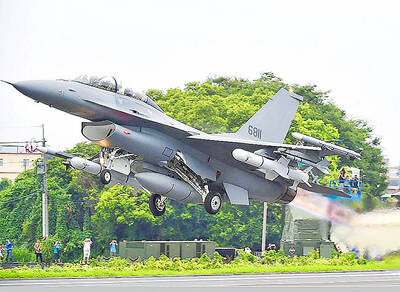
A sharp rise in compensation to be paid by air force officers who leave before completing their required service could indicate an increase in pilots leaving the military early, an analyst said on Friday, warning that the trend could worsen a shortage of experienced personnel. Chieh Chung (揭仲), a researcher at the Association for Strategic Foresight, issued the warning even though the number of volunteer military personnel is expected to increase next year. The planned headcount for volunteer military personnel, covering officers, noncommissioned officers (NCO) and enlisted soldiers, is 158,223 for next year, up 4,258 from 153,965 this year, Chieh said. The increase
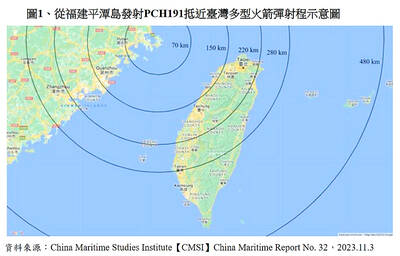
Potential improvements to munitions used by China’s long-range rocket-artillery units could extend their range to cover the entire Miyako Strait, which might give the Chinese People’s Liberation Army (PLA) the ability to secure the strategic waterway, the Mainland Affairs Council (MAC) said in a report. The PLA’s long-range rocket-artillery units deployed along the Taiwan Strait are concentrated along the coast of Fujian Province, including Changle, Pingtan and Shishi, the quarterly report on China said. The artillery brigades of the PLA’s 71st, 72nd and 73rd group armies have been deployed, with preparations for potential battlefield operations under way since August 2022, the report


 RSS
RSS