


Researchers in Taiwan recently unveiled a rose-scented lychee which is seen as having huge economic potential.
The new crop, the fruit of 21 years of botanical work, was cultivated by the Council of Agriculture’s Taiwan Agricultural Research Institute
The fragrant fruits can be stored in a refrigerator for longer than the regular variety.
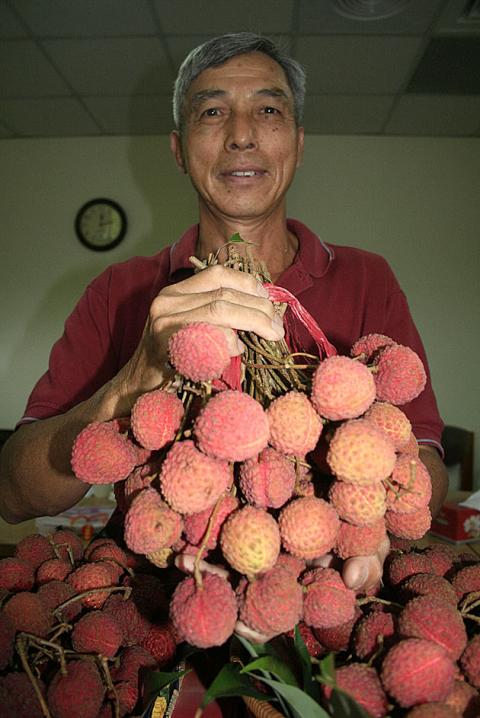
Photo: CNA
Development of the new crop began in 1986 when Chang Jer-way (張哲瑋), head of the horticulture department at the institute’s Chiayi branch, cross--fertilized two other types of lychees.
The principal attraction of the rose-flavored lychee is that the flesh is delicate and chewy, while the shell is a glamorous red color, Chang said.
The larger size of the lychee (weighing on average between 25g and 40g per fruit) combined with its smaller seeds, sweetness and easy-to-peel skin all contribute to the fruit’s unique qualities, Chang added.
The economic benefits of the fruit are high because, unlike other lychees, which grow from about May to mid-July, the rose-scented lychee can also be grown and harvested from mid-July into August.
As a result of these qualities, fruit farmers would be able to increase their income because theirs will be the only lychees on the -market -during that period, Chang said.
By comparison with other lychees such as the “hak ip” (black leaf) — which accounts for up 70 percent of the lychees on the market — and the “no mai tsz,” “guiwei” and longan, the rose-scented lychee’s extended storage period adds to its economic strength, Chiayi branch director Yang Hong-ren (楊宏仁) said.
While a normal lychee can only be stored for seven to 14 days, and the guiwei lychee can sit in refrigeration for up to 20 days, the rose-scented lychee can be held in a chilled atmosphere for as long as 30 days.
With its longevity the rose-scented lychee will be available not only during Ghost Festival, but also for the Mid-Autumn Festival said Director-General Hwang Jing-san (黃金山) from the Jhuci Township (竹崎) Government in Chiayi County.

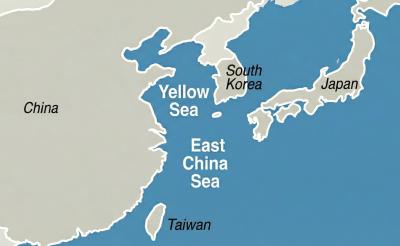
China has reserved offshore airspace in the Yellow Sea and East China Sea from March 27 to May 6, issuing alerts usually used to warn of military exercises, although no such exercises have been announced, the Wall Street Journal (WSJ) reported yesterday. Reserving such a large area for 40 days without explanation is an “unusual step,” as military exercises normally only last a few days, the paper said. These alerts, known as Notice to Air Missions (Notams), “are intended to inform pilots and aviation authorities of temporary airspace hazards or restrictions,” the article said. The airspace reserved in the alert is
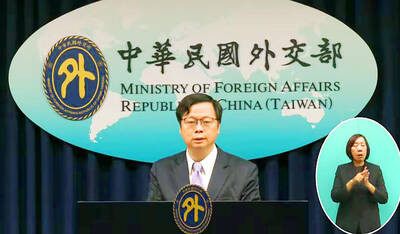
NAMING SPAT: The foreign ministry called on Denmark to propose an acceptable solution to the erroneous nationality used for Taiwanese on residence permits Taiwan has revoked some privileges for Danish diplomatic staff over a Danish permit that lists “Taiwan” as “China,” Eric Huang (黃鈞耀), head of the Ministry of Foreign Affairs’ Department of European Affairs, told a news conference in Taipei yesterday. Reporters asked Huang whether the Danish government had responded to the ministry’s request that it correct the nationality on Danish residence permits of Taiwanese, which has been listed as “China” since 2024. Taiwan’s representative office in Denmark continues to communicate with the Danish government, and the ministry has revoked some privileges previously granted to Danish representatives in Taiwan and would continue to review

More than 6,000 Taiwanese students have participated in exchange programs in China over the past two years, despite the Mainland Affairs Council’s (MAC) “orange light” travel advisory, government records showed. The MAC’s publicly available registry showed that Taiwanese college and university students who went on exchange programs across the Strait numbered 3,592 and 2,966 people respectively. The National Immigration Agency data revealed that 2,296 and 2,551 Chinese students visited Taiwan for study in the same two years. A review of the Web sites of publicly-run universities and colleges showed that Taiwanese higher education institutions continued to recruit students for Chinese educational programs without

A bipartisan group of US senators has introduced a bill to enhance cooperation with Taiwan on drone development and to reduce reliance on supply chains linked to China. The proposed Blue Skies for Taiwan Act of 2026 was introduced by Republican US senators Ted Cruz and John Curtis, and Democratic US senators Jeff Merkley and Andy Kim. The legislation seeks to ease constraints on Taiwan-US cooperation in uncrewed aerial systems (UAS), including dependence on China-sourced components, limited access to capital and regulatory barriers under US export controls, a news release issued by Cruz on Wednesday said. The bill would establish a "Blue UAS


 RSS
RSS