


Several universities had graduation ceremonies yesterday with political figures and leading businesspeople invited to address graduates and share their words of wisdom with the graduating classes.
Former premier Liu Chao-shiuan (劉兆玄), who graduated from National Taiwan University (NTU) in 1965, yesterday attended the university’s commencement ceremony and encouraged new graduates to be open to innovation and new ventures.
He drew an analogy between coconut trees — the most well--recognized symbol of the university, whose celebrated Coconut Grove Boulevard (椰林大道) stands in front of the campus — and students of the high-ranking university.

Photo: Wang Yi-sung, Taipei Times
“Walking through the front gate of NTU, what comes directly into view is the university road lined with coconut trees. However, the main characteristic of these trees is that they are preoccupied with upwards growth and reluctant to give umbrage,” he said.
In contrast, what epitomizes National Cheng Kung University in Greater Tainan is the many old banyan trees that are rooted in the ground, with luxuriant foliage that creates shade for the people, Liu said.
Liu said NTU was a time-honored institution that offered education in various fields of expertise and enjoyed ample resources, but its greatest pride is in the acclaimed qualities of its students, who are therefore shouldered with great responsibility.
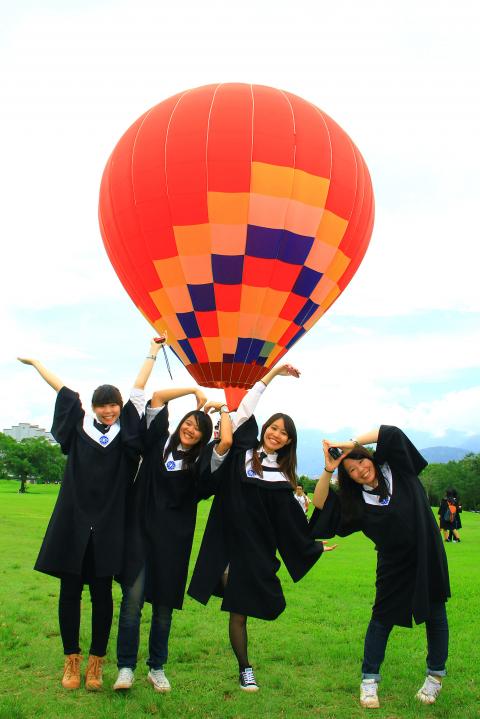
Photo: Tung Chen-kuo, Taipei Times
“The cultivation of an intellectual elite necessitates academic knowledge and general knowledge, as well as courage and insight and appreciation,” he said.
However, Liu said that while Taiwan has nurtured an abundance of doctorate holders, the country has only seen the creation of a handful of innovative companies.
“If even NTU graduates are in dread of innovating and taking chances, where will Taiwan’s [global] competitiveness come from in the future?” Liu asked.
NTU president Lee Si-chen (李嗣涔) said the university not only has coconut trees growing on campus, but dragon junipers alongside them, which provide shade, adding that the university is putting more weight on cooperation between students.
The National Taiwan University of Science and Technology in Taipei chose a venue simulating an air terminal to stage its commencement ceremony.
On entering the venue, graduates handed over a boarding pass written with their future aspirations to service staff dressed as flight attendants, while holding in their hands a mock passport with the sentence “[We are] graduating” printed on its cover — a ritual designed to represent graduates heading to their futures.
In central Taiwan, graduates of Tunghai University, Greater Taichung, passed a wooden knocker on to others during their graduation ceremony, as a kind of “torch-passing” ceremony.
In his speech to the graduates, Vice Premier Jiang Yi-hua (江宜樺) encouraged the young adults to develop enthusiasm, ideals, tolerance, respect and persistence.
In a ceremony at National Chiao Tung University in Hsinchu County, Phison Electronics Corp president Pan chien-cheng (潘健成), who is also an alumnus of the university, shared with graduates his life experience and ideals.
“Passion is the key to success, while sustainable success requires a sense of responsibility. This generation of young people does not lack capability, but an [appropriate] attitude,” Pan said.
President Ma Ying-jeou (馬英九) yesterday attended the commencement ceremony at National Taiwan University of Arts, during which he urged graduates to not only be creative, but to give thought to how to make use to it and to employ it to inpire their imagination.
Vice President Wu Den-yih (吳敦義) appeared at the graduation ceremonies of three universities in Greater Kaohsiung, including I-Shou University, Cheng Shiu University and National Kaohsiung Normal University.
Translated by Stacy Hsu, Staff Writer

LOUD AND PROUD Taiwan might have taken a drubbing against Australia and Japan, but you might not know it from the enthusiasm and numbers of the fans Taiwan might not be expected to win the World Baseball Classic (WBC) but their fans are making their presence felt in Tokyo, with tens of thousands decked out in the team’s blue, blowing horns and singing songs. Taiwanese fans have packed out the Tokyo Dome for all three of their games so far and even threatened to drown out home team supporters when their team played Japan on Friday. They blew trumpets, chanted for their favorite players and had their own cheerleading squad who dance on a stage during the game. The team struggled to match that exuberance on the field, with
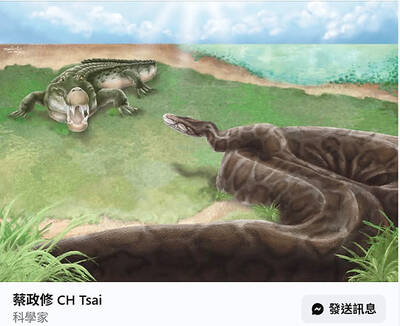
Taiwanese paleontologists have discovered fossil evidence that pythons up to 4m long inhabited Taiwan during the Pleistocene epoch, reporting their findings in the international scientific journal Historical Biology. National Taiwan University (NTU) Institute of Ecology and Evolutionary Biology associate professor Tsai Cheng-hsiu (蔡政修) led the team that discovered the largest snake fossil ever found in Taiwan. The single trunk vertebra was discovered in Tainan at the Chiting Formation, dated to between 400,000 and 800,000 years ago in the Middle Pleistocene, the paper said. The area also produced Taiwan’s first avian fossil, as well as crocodile, mammoth, saber-toothed cat and rhinoceros fossils, it said. Discoveries

Taiwanese paleontologists have discovered fossil evidence that pythons up to 4m long inhabited Taiwan during the Pleistocene epoch, reporting their findings in the international scientific journal Historical Biology. National Taiwan University (NTU) Institute of Ecology and Evolutionary Biology associate professor Tsai Cheng-hsiu (蔡政修) led the team that discovered the largest snake fossil ever found in Taiwan. A single trunk vertebra was discovered in Tainan at the Chiting Formation, dated to between 800,000 to 400,000 years ago in the Middle Pleistocene, the paper said. The area also produced Taiwan’s first avian fossil, as well as crocodile, mammoth, sabre-toothed cat and rhinoceros fossils, it said. Discoveries
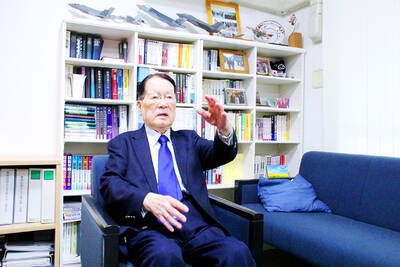
Whether Japan would help defend Taiwan in case of a cross-strait conflict would depend on the US and the extent to which Japan would be allowed to act under the US-Japan Security Treaty, former Japanese minister of defense Satoshi Morimoto said. As China has not given up on the idea of invading Taiwan by force, to what extent Japan could support US military action would hinge on Washington’s intention and its negotiation with Tokyo, Morimoto said in an interview with the Liberty Times (sister paper of the Taipei Times) yesterday. There has to be sufficient mutual recognition of how Japan could provide


 RSS
RSS