


Washington-based academics are warning US President Barack Obama not to sign the UN Arms Trade Treaty (ATT) because it could make it more difficult to sell weapons to Taiwan.
The treaty is to be negotiated next month in New York.
“The US is obligated by the 1979 Taiwan Relations Act [TRA] to make available the hardware and services necessary for Taiwan’s defense,” Heritage Foundation Research Fellows Ted Bromund and Dean Cheng (成斌) wrote.
In a paper published on Friday, Bromund and Cheng said that because Taiwan is not a UN member state — and is not recognized by a majority of UN members — the ATT would not recognize its right to buy or import arms.
“The ATT thus provides the basis for a Chinese argument that US sales of arms to Taiwan would circumvent the PRC’s [People’s Republic of China] import control system, violate China’s territorial integrity, and thus violate the treaty,” Bromund and Cheng wrote.
They said the ATT would “very likely” establish a series of criteria that treaty signatories are required to apply to proposed arms transfers. One of these criteria is likely to be that arms transfers should not seriously undermine peace and security or provoke, prolong or aggravate internal, regional, subregional or international instability.
“Since the Chinese Civil War has never been formally concluded, a state of war still exists between Taiwan and the PRC,” Bromund and Cheng said.
They said that this criteria offers the PRC a third argument that the US weapons sales or transfers to Taiwan would violate the terms of the ATT.
Bromund and Cheng said that the ATT poses three distinct threats to the legal obligation of the US to provide for the defense of Taiwan, or to the ability of Taiwan to provide for its own defense.
“A US administration that earnestly wished to fulfill its obligations under the TRA would likely do so, regardless of the ATT,” the academics said.
However, they said a US administration that believed US sales to Taiwan endangered US relations with the PRC, or did not want to sell arms to Taiwan for some other reason, would be able to cite the ATT as a reason not to proceed with those sales.
“Even if the US does not sign or ratify the ATT, US legal scholars who interpret it as customary international law could use it to argue that the US should not proceed with a proposed sale,” Bromund and Cheng said.
They conclude: “The ATT can only raise yet another hurdle to US arms sales to Taiwan.”
Arms sales, like international relations as a whole, are always a matter for judgement. In next month’s negotiations, the US should make it clear that it will not accept any treaty that would impinge on its ability to apply that judgement to its legal obligation to provide for the defense of Taiwan, they said.
“Elected officials have the broader responsibility to make it clear that they recognize the importance of the US commitment to Taiwan, and to stand by that commitment in word and deed,” Bromund and Cheng said.
In Taipei, Director-General of the Department of North American Affairs at the Ministry of Foreign Affairs Bruce Linghu (令狐榮達) said the ministry is aware of the proposed UN treaty and would keep abreast of any developments.
Issues related to the proposed UN treaty have not been placed on the agenda between Taiwan and the US, but the ministry will look into the matter, Linghu said.
Additional reporting by Shih Hsiu-chuan

NATIONAL SECURITY: Authorities are working to confirm the identities of the military personnel involved and investigating possible illegal conduct and regulatory violations Authorities are probing possible national security implications after Kinmen police and immigration officers on Sunday found a Chinese woman allegedly posing as a tourist while engaging in prostitution involving more than 10 military personnel. The woman, surnamed Chen (陳), has since been deported, authorities said, adding that investigators are still working to confirm the identities of those implicated, as the records only listed code names and aliases. The case stemmed from a report received by the Kinmen District Prosecutors’ Office on Friday last week from the Jinhu Precinct of the Kinmen County Police Bureau. On Sunday, police, along with the National Immigration

GLOBALGIVING: ‘ Caving to external pressure is not acceptable for an organization that has cultivated justice reform and human rights for 30 years,’ one NGO said A slew of non-government organizations (NGOs) have withdrawn from the GlobalGiving fundraising platform after it announced it would use “Chinese Taipei” instead of “Taiwan” from next month. The Taiwan Good Rice Association wrote on Facebook on Friday that it was informed on April 28 via a teleconference call of the change, which was made because the platform wanted to operate in China. Taiwan Good Rice is to terminate all cooperative relationships with GlobalGiving in response to the platform’s “unilateral and non-negotiable” decision to remove references to Taiwan, the NGO said. “Taiwan is in the official name of Taiwan Good Rice Association and the
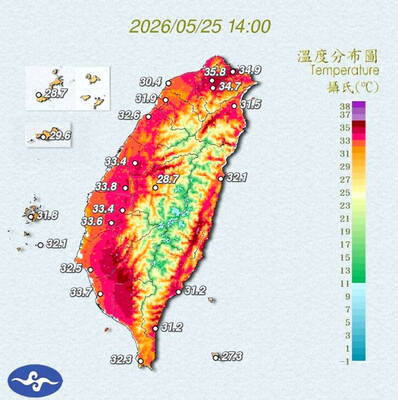
STAY COOL: The HPA recommended that people stay hydrated, use air-conditioning or fans while indoors, wear loose-fitting clothes and walk in the shade while outdoors Employers must implement measures such as installing cooling equipment, and providing drinking water and rest breaks for outdoor workers starting from Monday next week, the Taipei Department of Labor said on Sunday. Employers who fail to comply could face fines of NT$30,000 to NT$300,000 under the Occupational Safety and Health Act (職業安全衛生法), the department said. Businesses in Taipei employing fewer than 100 workers, as well as registered self-employed workers with labor insurance coverage, could receive on-site assessments and guidance from occupational safety consultants to help them apply for central government subsidies to implement or improve heat-protection measures, it said. Under the Ministry of

Chinese Nationalist Party (KMT) Chairwoman Cheng Li-wun (鄭麗文) yesterday briefed her party’s Central Standing Committee regarding her scheduled visit to the US between Monday next week and June 16, saying that her purpose would be to persuade the US that the Republic of China (ROC) Constitution was a “one China” constitution that would foster stable and peaceful cross-strait relations. The ROC Constitution is the most important defense for all Taiwanese citizens, as it upholds our democracy and has contributed to our robust economy, which aligns with international and US interests, she said. “We would not be troublemakers and drag the US under,”


 RSS
RSS