


The best place for a writer is to remain on the fringes of society so as to keep a clear head, maintain alertness and avoid becoming another victim of the political propaganda apparatus, exiled Chinese novelist and Nobel laureate Gao Xingjian (高行健) said yesterday at a talk at National Taiwan Normal University.
Dean of the university’s graduate institute of performing arts Jerry Hsia (夏學理) asked Gao how literature and politics could maintain an “aesthetic distance,” so that writers who entered politics could avoid being suborned by politics.
Hsia also asked Gao what suggestions he would offer to Minister of Culture Lung Ying-tai (龍應台), a renowned writer, if Lung was sitting in the audience.
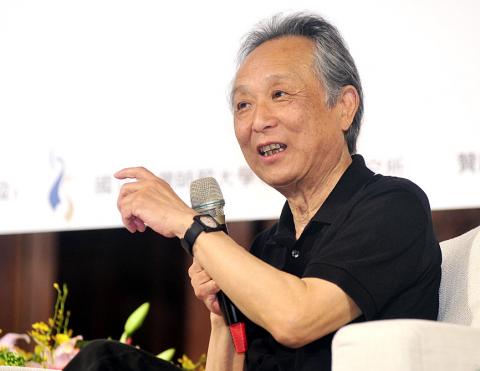
Photo: Pan Shao-tang, Taipei Times
While side-stepping the question of offering advice to Lung, Gao said politics is in essence a squabble for power, adding that politics drove people mad and made them lose the basic qualities that made them human.
Any political ideology serves politics, Gao said, adding that while it is impossible for writers to separate themselves entirely from society, they should avoid meddling in politics.
“Literature and arts in my mind should be a wakeful observation of the world and present the doubts one has about the world, not to negate it; literary authors should also not devote themselves to politics. Being like [Chinese novelist] Lu Xun (魯迅) and immersing oneself into the ardor of political service is not to be encouraged,” Gao said.
Gao said writers entering political life would inevitably be influenced by it, citing the example of Chinese writer Xia Yan (夏衍), who was the Chinese deputy minister of culture from 1955 until he was toppled in the Cultural Revolution.
Xia was a good writer and playwright, but he was unable to prevent the Nanjing City Government from burning 3,000 Chinese novels when he was in office, Gao said, adding that such was an example of the bitter fruit that a cultured individual is forced to consume while in government office.
However, Gao did not entirely deny the value of having a person from literary circles in government. He cited the example of Andre Malraux, who made a great contribution to culture and the humanities when he was French minister of cultural affairs.
Translated by Jake Chung, Staff Writer
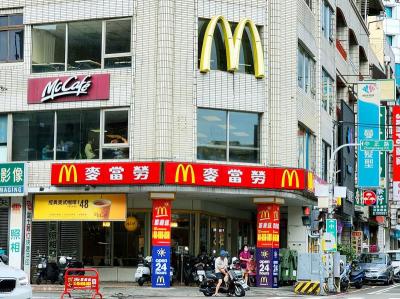
Fast food chain McDonald's is to raise prices by up to NT$5 on some products at its restaurants across Taiwan, starting on Wednesday next week, the company announced today. The prices of all extra value meals and sharing boxes are to increase by NT$5, while breakfast combos and creamy corn soup would go up by NT$3, the company said in a statement. The price of the main items of those meals, if ordered individually, would remain the same. Meanwhile, the price of a medium-sized lemon iced tea and hot cappuccino would rise by NT$3, extra dipping sauces for chicken nuggets would go up
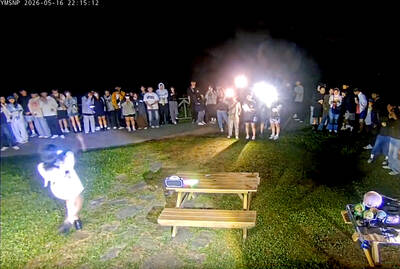
Yangmingshan National Park’s Qingtiangang (擎天崗) nature area has gone viral after a park livestream camera observed a couple in the throes of intimate congress, which was broadcast live on YouTube, drawing large late-night crowds and sparking a backlash over noise, bright lights and disruption to wildlife habitat. The area’s livestream footage appeared to show a couple engaging in sexual activity on a picnic table in the park on Friday last week, with the uncensored footage streamed publicly online. The footage quickly spread across social media, prompting a tide of visitors to travel to the site to “check in” and recreate the
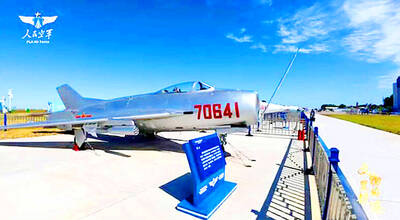
GROUNDED: A KMT lawmaker proposed eliminating drone development programs and freezing funding for counterdrone systems, despite China’s adoption of the technology China has deployed attack drones at air bases near the Taiwan Strait in a strategy aimed at overwhelming Taiwan’s air defense systems through saturation attacks, the Mainland Affairs Council (MAC) said. The council’s latest quarterly report on China said that satellite imagery and open-source intelligence indicate that the Chinese People’s Liberation Army (PLA) had converted retired J-6 fighter jets into J-6W drones, which the PLA has stationed at six air bases near Taiwan, five in China’s Fujian Province and one in Guangdong Province. The report cited J. Michael Dahm, a senior fellow at the US-based Mitchell Institute, as saying that China has

Carrefour Taiwan is to begin using a new name from the start of July, but it cannot divulge the name until then, the chairman of the supermarket chain's parent company said today. President Chain Store Co chairman Lo Chih-hsien (羅智先) was asked by reporters after a shareholders' meeting to confirm whether the company has settled on a new name for the supermarket brand. In March, the government-registered name of two Carrefour Taiwan branches was quietly changed to "Le Chia Kang" (樂家康) in Chinese, raising speculation that has been selected as the name. Lo said that because of local regulations and contractual obligations, the


 RSS
RSS