


Taiwan’s maturing democracy is an “amazing development” that will ultimately have a very significant influence on China, US academic Larry Diamond said on Monday.
“To walk the streets of Taiwan is to experience a very pluralistic, dynamic, liberal democracy,” Diamond said.
“It is a very appealing society,” he added.
A senior fellow at the Hoover Institution, Diamond was addressing a conference on “Taiwan’s Maturing Democracy” at the Brookings Institution in Washington.
He said that in the long run, Taiwan was sure to have a pro--democracy impact on China.
That impact, he said, was one reason that he had become a “passionate advocate” of cross-strait cultural and social exchanges.
Visits to the nation by Chinese tourists would “wind up as one of the most subversive factors for authoritarian Communist rule of China,” Diamond said.
Shelley Rigger, a professor of East-Asian politics at Davidson College, North Carolina, said Taiwan’s democracy was “still in the process” of maturing and that it was “very much a work in progress.”
“Things don’t fit together quite right yet,” she said.
Rigger said that Taiwan had not just a “critical citizenry,” it had a “cranky citizenry.”
This was not a good time to be a politician in Taiwan, she said, adding that no one was popular.
At least two factors helped to explain the feeling of “unsettledness and upheaval” in Taiwan and the inability of political actors to find positions that were “meaningful and desirable” to the electorate, she added.
One factor was the continuing evolution of the political parties within the democracy and the other was the problem of cross-strait relations hanging “like a cloud” over Taiwanese politics.
“It’s a cloud that people have tried to blow away, or get out from under, but it follows wherever they go,” she said. “The cloud brings pressure and uncertainty.”
According to Rigger, Taiwanese politics still lacked a clear “left” and “right” distinction.
Both major parties represented a range of interests across the economic spectrum that resulted in them being “paralyzed” on how far they could go on economic issues.
At the same time the question of “national identity” was becoming increasingly problematic for both parties, she said.
Especially among young Taiwanese, a strong Taiwanese identity was being accompanied by a “pro-engagement attitude” toward China, Rigger said.
However, even if people agreed ideologically, it did not mean they shared a view on how to reach shared goals.
“Taiwan is in an incredibly tight spot and it is getting tighter all the time,” she said. “Figuring out how to deliver continued economic prosperity and good relations with China without conceding much, if anything, in terms of Taiwan’s autonomy and sovereignty, is a very tall order.”
Among others speaking at the conference were Nigel Li (李念祖), adjunct professor at Soochow University; Liao Da-chi (廖達琪), professor at National Sun Yat-sen University; Yeh Jiunn-rong (葉俊榮), professor at National Taiwan University; CTiTV news anchor Erich Shi-wei Shih (史哲維); Eric Yu (俞振華), assistant professor at National Chengchi University (NCCU); Brookings Senior Fellow Richard Bush; and Ho Szu-yin (何思因), professor at NCCU.

Alain Robert, known as the "French Spider-Man," praised Alex Honnold as exceptionally well-prepared after the US climber completed a free solo ascent of Taipei 101 yesterday. Robert said Honnold's ascent of the 508m-tall skyscraper in just more than one-and-a-half hours without using safety ropes or equipment was a remarkable achievement. "This is my life," he said in an interview conducted in French, adding that he liked the feeling of being "on the edge of danger." The 63-year-old Frenchman climbed Taipei 101 using ropes in December 2004, taking about four hours to reach the top. On a one-to-10 scale of difficulty, Robert said Taipei 101

Taiwanese and US defense groups are collaborating to introduce deployable, semi-autonomous manufacturing systems for drones and components in a boost to the nation’s supply chain resilience. Taiwan’s G-Tech Optroelectronics Corp subsidiary GTOC and the US’ Aerkomm Inc on Friday announced an agreement with fellow US-based Firestorm Lab to adopt the latter’s xCell, a technology featuring 3D printers fitted in 6.1m container units. The systems enable aerial platforms and parts to be produced in high volumes from dispersed nodes capable of rapid redeployment, to minimize the risk of enemy strikes and to meet field requirements, they said. Firestorm chief technology officer Ian Muceus said
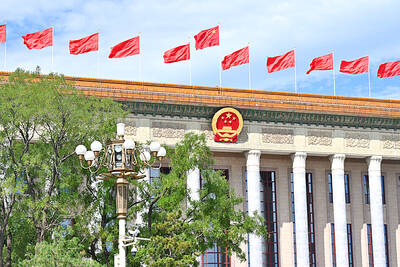
MORE FALL: An investigation into one of Xi’s key cronies, part of a broader ‘anti-corruption’ drive, indicates that he might have a deep distrust in the military, an expert said China’s latest military purge underscores systemic risks in its shift from collective leadership to sole rule under Chinese President Xi Jinping (習近平), and could disrupt its chain of command and military capabilities, a national security official said yesterday. If decisionmaking within the Chinese Communist Party has become “irrational” under one-man rule, the Taiwan Strait and the regional situation must be approached with extreme caution, given unforeseen risks, they added. The anonymous official made the remarks as China’s Central Military Commission Vice Chairman Zhang Youxia (張又俠) and Joint Staff Department Chief of Staff Liu Zhenli (劉振立) were reportedly being investigated for suspected “serious
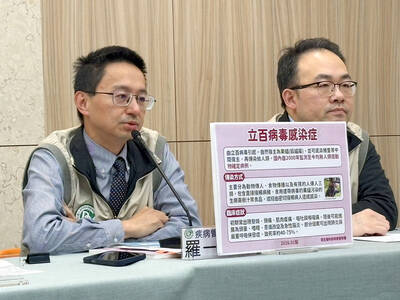
Nipah virus infection is to be officially listed as a category 5 notifiable infectious disease in Taiwan in March, while clinical treatment guidelines are being formulated, the Centers for Disease Control (CDC) said yesterday. With Nipah infections being reported in other countries and considering its relatively high fatality rate, the centers on Jan. 16 announced that it would be listed as a notifiable infectious disease to bolster the nation’s systematic early warning system and increase public awareness, the CDC said. Bangladesh reported four fatal cases last year in separate districts, with three linked to raw date palm sap consumption, CDC Epidemic Intelligence


 RSS
RSS