


Israeli scientist Dan Shechtman, last year’s winner of the Nobel Prize in Chemistry, shared his personal learning experiences yesterday with more than 1,500 high-school and college students at National Taipei University of Technology, encouraging them to be inquisitive about everything.
Shechtman received the prize for his discovery of quasicrystal, a new structure of crystal patterns that were once thought to be impossible. Shechtman had faced skepticism and mockery when he announced his discovery.
After speaking for more than an hour about his discovery to students and teachers, Shechtman, joined by another winner of the Nobel Prize in Chemistry, Lee Yuan-tseh (李遠哲), answered students’ questions about learning and becoming a scientist.

Photo: Liu Hsin-de, Taipei Times
Asked why Israel has had several Nobel Prize winners in recent years, Shechtman said Israel is only about half the size of Taiwan with a population of about 8 million people, and during the early years of the country, the people knew that they had to win in the face of enemies surrounding them because they had no where else to go, so Israelis have always encouraged constant innovation.
“To doubt everything, to ask questions about everything and an exquisite mind is [sic] essential to being creative,” he said.
While failure is often linked with shame in East Asia, people in Israel are given many chances to try again and to learn from each failure, Shechtman added.
Asked what features were needed to become an outstanding scientist, he said curiosity to observe the small details of everything around and trying to understand them is a main feature that many great scientists have.
Persistence is also another important feature, he said, encouraging the students to invest their time and energy into something and not to let what they discover go until it is fully understood.
Asking questions is essential and creativity is important, but young people have to be brave to be different and be creative, and confidence is essential to become different from others, Lee said, adding that confidence was accumulated knowledge and asking questions, as well as gradually developing the expertise to judge what is right.
Lee encouraged teachers to let students explore and develop their interests by not taking up all their time with schoolwork and exams.
“The Internet is a mixed blessing if you only use it for social purposes, which takes a lot of time, or to play games and watch movies, then it distracts you from doing something you really should do in scientific research,” Shechtman said in an answer to a question on how the Internet affects the quality of scientific research.
Shechtman said he did not feel frustrated when facing skepticism field because he trusted his profession and tested his results many times before publishing his work.

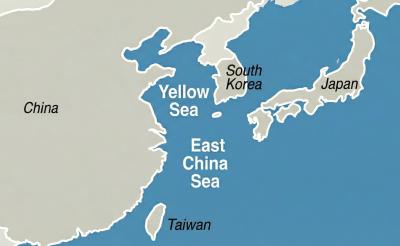
China has reserved offshore airspace in the Yellow Sea and East China Sea from March 27 to May 6, issuing alerts usually used to warn of military exercises, although no such exercises have been announced, the Wall Street Journal (WSJ) reported yesterday. Reserving such a large area for 40 days without explanation is an “unusual step,” as military exercises normally only last a few days, the paper said. These alerts, known as Notice to Air Missions (Notams), “are intended to inform pilots and aviation authorities of temporary airspace hazards or restrictions,” the article said. The airspace reserved in the alert is
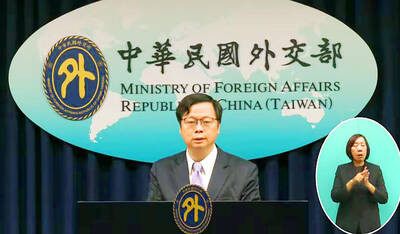
NAMING SPAT: The foreign ministry called on Denmark to propose an acceptable solution to the erroneous nationality used for Taiwanese on residence permits Taiwan has revoked some privileges for Danish diplomatic staff over a Danish permit that lists “Taiwan” as “China,” Eric Huang (黃鈞耀), head of the Ministry of Foreign Affairs’ Department of European Affairs, told a news conference in Taipei yesterday. Reporters asked Huang whether the Danish government had responded to the ministry’s request that it correct the nationality on Danish residence permits of Taiwanese, which has been listed as “China” since 2024. Taiwan’s representative office in Denmark continues to communicate with the Danish government, and the ministry has revoked some privileges previously granted to Danish representatives in Taiwan and would continue to review

More than 6,000 Taiwanese students have participated in exchange programs in China over the past two years, despite the Mainland Affairs Council’s (MAC) “orange light” travel advisory, government records showed. The MAC’s publicly available registry showed that Taiwanese college and university students who went on exchange programs across the Strait numbered 3,592 and 2,966 people respectively. The National Immigration Agency data revealed that 2,296 and 2,551 Chinese students visited Taiwan for study in the same two years. A review of the Web sites of publicly-run universities and colleges showed that Taiwanese higher education institutions continued to recruit students for Chinese educational programs without

A bipartisan group of US senators has introduced a bill to enhance cooperation with Taiwan on drone development and to reduce reliance on supply chains linked to China. The proposed Blue Skies for Taiwan Act of 2026 was introduced by Republican US senators Ted Cruz and John Curtis, and Democratic US senators Jeff Merkley and Andy Kim. The legislation seeks to ease constraints on Taiwan-US cooperation in uncrewed aerial systems (UAS), including dependence on China-sourced components, limited access to capital and regulatory barriers under US export controls, a news release issued by Cruz on Wednesday said. The bill would establish a "Blue UAS


 RSS
RSS