


President Ma Ying-jeou’s (馬英九) first human rights report, which he released yesterday, is full of empty boasts and obfuscations, opposition legislators said, while local advocacy groups said Ma was not sincere about making human rights improvement a priority.
Ma yesterday released a human rights report based on the International Covenant on Civil and Political Rights and the International Covenant on Economic, Social and Cultural Rights, which Taiwan ratified three years ago.
Commenting on the report, Democratic Progressive Party (DPP) spokesman Lin Chun-hsien (林俊憲) said that freedom of the press in Taiwan has been deteriorating during the Ma administration, with its world ranking falling from 32nd in 2008 to 48th last year.
It has also been more difficult for people to voice their discontent because the Ma administration has delineated a much larger restricted zone for Ma’s second-term inauguration ceremony, slated to be held on May 20, to keep a planned mass rally against Ma farther away from the Presidential Office, Lin said.
“Ma has chosen the way of ‘hear no protest, see no protest’ against the people’s voices,” Lin said.
It is disingenuous for Ma to say that he cares deeply about human rights conditions in China, he added.
Ma has refused to meet with Chinese dissidents, such as Wang Dan (王丹), since taking office in 2008, Lin said.
“Ma has not publicly criticized the Tiananmen Square Massacre since he was elected in 2008. He even praised Beijing for making progress on human rights issues. It’s simply incredible,” Lin said.
Human Rights Covenants Watch convener Kao Yung-cheng (高湧誠) told a press conference yesterday that in Ma’s report, “we only see the government dressing up human rights conditions in the country, instead of trying to touch the core of issues, and make profound changes.”
“The government is not facing some real human rights violations happening in this country,” he added.
Taiwan Indigenous Peoples’ Policies Association chairman Oto Micyang, an Amis, said that despite the mention of indigenous rights in the two international human rights covenants and Ma’s own promises, “Aborigines in Taiwan are far from getting autonomy, and I don’t see any concrete actions by the government to work toward that objective.”
Wellington Koo (顧立雄), an attorney who represented the Judicial Reform Foundation at the press conference, said that obtaining testimony through “inappropriate ways,” such as torture or threats, still occurs in Taiwan, and such illegally obtained testimony is still used in court.
Taiwan Alliance to End the Death Penalty executive director Lin Hsin-yi (林欣怡) criticized Ma’s “three policy directions” to abolish capital punishment.
“Ma said he would push to revise laws that provide the capital punishment as the only penalty — well, it’s something that was already done back in 2006,” Lin said. “Ma also said the Ministry of Justice would work to revise laws on the death penalty, but the ministry is only preparing to make changes to laws that are rarely used any more, such as the Civil Aviation Act (民用航空法) and the Criminal Code of the Armed Forces (陸海空軍刑法) — if Ma is really sincere about taking away the death penalty, he should push for changes to more commonly used laws.”
As for Ma’s third “policy direction” that the death penalty would only be used as a last resort, Lin said that on April 30, 2010, a prisoner on death row was executed while the Council of Grand Justices were still reviewing whether his sentencing was unconstitutional and that nine other people on death row were executed in 2010 and last year after they applied for amnesty from the president, but had not received any response.

NATIONAL SECURITY: Authorities are working to confirm the identities of the military personnel involved and investigating possible illegal conduct and regulatory violations Authorities are probing possible national security implications after Kinmen police and immigration officers on Sunday found a Chinese woman allegedly posing as a tourist while engaging in prostitution involving more than 10 military personnel. The woman, surnamed Chen (陳), has since been deported, authorities said, adding that investigators are still working to confirm the identities of those implicated, as the records only listed code names and aliases. The case stemmed from a report received by the Kinmen District Prosecutors’ Office on Friday last week from the Jinhu Precinct of the Kinmen County Police Bureau. On Sunday, police, along with the National Immigration

GLOBALGIVING: ‘ Caving to external pressure is not acceptable for an organization that has cultivated justice reform and human rights for 30 years,’ one NGO said A slew of non-government organizations (NGOs) have withdrawn from the GlobalGiving fundraising platform after it announced it would use “Chinese Taipei” instead of “Taiwan” from next month. The Taiwan Good Rice Association wrote on Facebook on Friday that it was informed on April 28 via a teleconference call of the change, which was made because the platform wanted to operate in China. Taiwan Good Rice is to terminate all cooperative relationships with GlobalGiving in response to the platform’s “unilateral and non-negotiable” decision to remove references to Taiwan, the NGO said. “Taiwan is in the official name of Taiwan Good Rice Association and the

HEAVY WEATHER: Typhoon Jangmi is due to crash straight into the Ryukyus as airlines look to shift flights to larger aircraft or cancel flights to Okinawa entirely Taiwan’s international air carriers announced flight adjustments over the weekend as Typhoon Jangmi is forecast to hit the Ryukyu Islands today and tomorrow. The Central Weather Administration (CWA) upgraded Jangmi from a tropical storm to a typhoon at 8am yesterday, with the eye located 580km south of Naha city. It was moving north at 19kph. Today, China Airlines’ CI-120, CI-121, CI-122 and CI-123 flights between Taoyuan and Naha, Okinawa, have been canceled as well as CI-132 and CI-133 between Kaohsiung and Naha. EVA Air’s BR-112, BR-113, BR-186 and BR-185 flights between Taoyuan and Naha are also canceled. Low-cost carrier Tigerair Taiwan canceled IT-230,
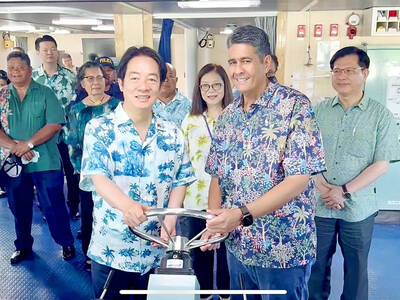
MULTIPRONGED APPROACH: China has sought to pressure Palau across a number of fronts, but the island nation has staunchly resisted overtures to ditch Taiwan Palau has been firm in backing Taiwan despite Chinese pressure that uses tourism economics, cyberattacks and criminal infiltration as tools to threaten the Pacific ally into renouncing its recognition of Taiwan as a sovereign state. The Presidential Office yesterday announced that Vice President Hsiao Bi-khim (蕭美琴) would visit Palau from Saturday to Wednesday next week at the invitation of Palauan President Surangel Whipps Jr. Whipps in April said in an interview that China had outspokenly asked Palau to “denounce Taiwan.” “And we have said: ‘We have no enemies, but nobody tells us who our friends are,’” he said. Whipps has told reporters multiple times


 RSS
RSS