


President Ma Ying-jeou (馬英九) yesterday said the government will complete negotiations on the cross-strait Economic Cooperation Framework Agreement (ECFA) with China in the next two years, as well as deepen economic and trade relations with other countries to raise the nation’s economic competitiveness.
The completion of the ECFA negotiations will prepare Taiwan for more economic and trade cooperation with other countries, Ma said in an interview with the Chinese-language United Evening News.
He said he expects the ECFA to help facilitate the country’s goal of signing free-trade agreements (FTA) with major trade partners and join the Trans-Pacific Partnership (TPP).
“Before the ECFA was signed, many countries were watching [China’s] attitude when negotiating FTAs with us, and now the problem is solved,” Ma said. “Once the ECFA negotiations are completed, our closer economic ties with [China] will help us attract more foreign investment and negotiate trade deals with other nations.”
Taiwan and China signed the cross-strait trade agreement in June 2010 and the pact took effect in September that year. The “early harvest” program for tariff reductions or exemptions took effect on Jan. 1 last year.
The two sides are expected to conclude tariff reduction or exemption talks for more than 5,000 further items that were not included on the “early harvest” list over the next two years.
Ma dismissed concerns about over-dependence on China following the signing of the ECFA and said the cross-strait economic pact would make Taiwan more qualified to sign FTAs or trade pacts with other countries and join the TPP.
“We are not depending on [China] to connect with the world as we have been negotiating with other nations at the same time,” he said. “We must open up our markets and start seeking mutual interests with [China] in the future.”
When asked to comment on vice president-elect Wu Den-yih’s (吳敦義) recent trip to the Boao Forum in China, Ma said Wu’s meeting with Chinese Vice Premier Li Keqiang (李克強) showed that cross-strait policies that promote peaceful relations across the Taiwan Strait are correct, and said the government will continue to develop such cross-strait mechanisms during his second term.
“As we continue with our cross-strait policies, the two sides will build mutual trust and promote peace … The mechanism works and should continue to work in spite of any transfer of power in [China],” Ma said.
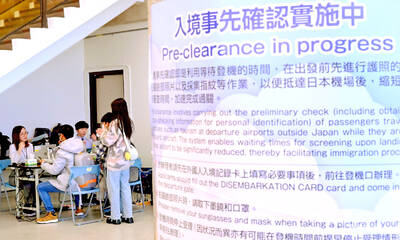
A preclearance service to facilitate entry for people traveling to select airports in Japan would be available from Thursday next week to Feb. 25 at Taiwan Taoyuan International Airport, Taoyuan International Airport Corp (TIAC) said on Tuesday. The service was first made available to Taiwanese travelers throughout the winter vacation of 2024 and during the Lunar New Year holiday. In addition to flights to the Japanese cities of Hakodate, Asahikawa, Akita, Sendai, Niigata, Okayama, Takamatsu, Kumamoto and Kagoshima, the service would be available to travelers to Kobe and Oita. The service can be accessed by passengers of 15 flight routes operated by
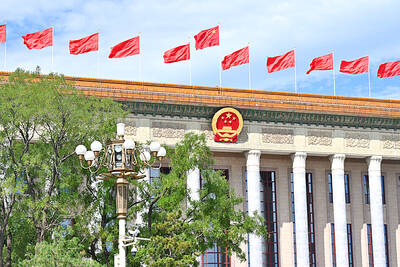
MORE FALL: An investigation into one of Xi’s key cronies, part of a broader ‘anti-corruption’ drive, indicates that he might have a deep distrust in the military, an expert said China’s latest military purge underscores systemic risks in its shift from collective leadership to sole rule under Chinese President Xi Jinping (習近平), and could disrupt its chain of command and military capabilities, a national security official said yesterday. If decisionmaking within the Chinese Communist Party has become “irrational” under one-man rule, the Taiwan Strait and the regional situation must be approached with extreme caution, given unforeseen risks, they added. The anonymous official made the remarks as China’s Central Military Commission Vice Chairman Zhang Youxia (張又俠) and Joint Staff Department Chief of Staff Liu Zhenli (劉振立) were reportedly being investigated for suspected “serious
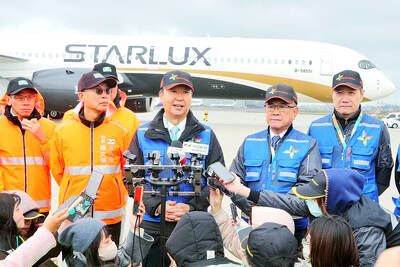
ENHANCING EFFICIENCY: The apron can accommodate 16 airplanes overnight at Taoyuan airport while work on the third runway continues, the transport minister said A new temporary overnight parking apron at Taiwan Taoyuan International Airport is to start operating on Friday next week to boost operational efficiency while the third runway is being constructed, the Ministry of Transportation and Communications said yesterday. The apron — one of the crucial projects in the construction of the third runway — can accommodate 16 aircraft overnight at the nation’s largest international airport, Minister of Transportation and Communications Chen Shih-kai (陳世凱) told reporters while inspecting the new facility yesterday morning. Aside from providing the airport operator with greater flexibility in aircraft parking during the third runway construction,
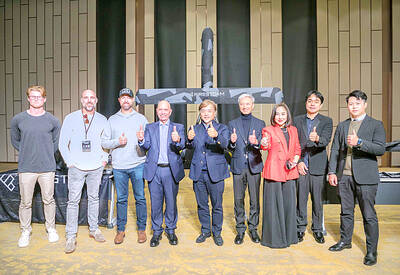
Taiwanese and US defense groups are collaborating to introduce deployable, semi-autonomous manufacturing systems for drones and components in a boost to the nation’s supply chain resilience. Taiwan’s G-Tech Optroelectronics Corp subsidiary GTOC and the US’ Aerkomm Inc on Friday announced an agreement with fellow US-based Firestorm Lab to adopt the latter’s xCell, a technology featuring 3D printers fitted in 6.1m container units. The systems enable aerial platforms and parts to be produced in high volumes from dispersed nodes capable of rapid redeployment, to minimize the risk of enemy strikes and to meet field requirements, they said. Firestorm chief technology officer Ian Muceus said


 RSS
RSS