


The nation’s tap water meets international drinking water standards, state-run Taiwan Water Corp (TWC) said yesterday, addressing concerns over reports of high levels of aluminum in the water at some treatment plants.
Media reports said that the levels of aluminum in the water at 18 of the country’s 59 treatment plants were recently found to be above 0.15 milligrams per liter, a safety standard -proposed by the WHO.
Most of the water treatment plants containing excessive levels of the metal are in southern Taiwan, the reports said, citing the results of tests commissioned by TWC and conducted by National Cheng Kung University (NCKU).
However, TWC said that except for the Nanyu plant in Greater Tainan, all of its treatment plants tested below the WTO-proposed level for aluminum and that the NCKU water quality report was released a year ago.
TWC president Chen Fu-tien (陳福田) said the company had also commissioned Chia Nan University of Pharmacy and Science to explore ways of improving the quality of drinking water nationwide.
That study is expected to be completed within two years, Chen said in a report to the legislature’s Economics Committee.
In a scene straight from the movie Erin Brockovich, Chinese Nationalist Party (KMT) Legislator Yang Chiung-ying (楊瓊瓔) asked Chen during the session to drink a glass of water to prove its safety.
Minister of Economic Affairs Shih Yen-shiang (施顏祥) also said the water quality in Taiwan met international safety standards and that the aluminum levels were below 0.9 milligrams per liter, the latest recommendation issued by the WHO last year.
Nonetheless, TWC would try to reduce the amount of aluminum used in its water treatment procedures, Shih said.
Most of the aluminum used for water treatment is removed at the plants before the water reaches consumers, TWC said.
At present, the Environmental Protection Administration has no regulations on the quality of drinking water.
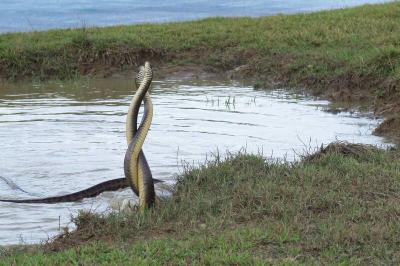
Kenting National Park service technician Yang Jien-fon (楊政峰) won a silver award in World Grand Prix Photography Awards Spring Season for his photograph of two male rat snakes intertwined in combat. Yang’s colleagues at Kenting National Park said he is a master of nature photography who has been held back by his job in civil service. The awards accept entries in all four seasons across six categories: architectural and urban photography, black-and-white and fine art photography, commercial and fashion photography, documentary and people photography, nature and experimental photography, and mobile photography. Awards are ranked according to scores and divided into platinum, gold and
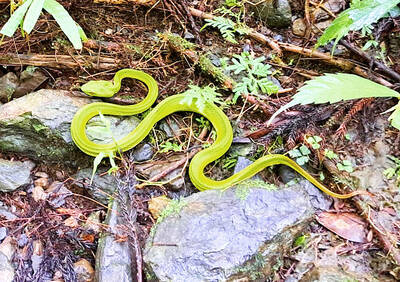
More than half of the bamboo vipers captured in Tainan in the past few years were found in the city’s Sinhua District (新化), while other districts had smaller catches or none at all. Every year, Tainan captures about 6,000 snakes which have made their way into people’s homes. Of the six major venomous snakes in Taiwan, the cobra, the many-banded krait, the brown-spotted pit viper and the bamboo viper are the most frequently captured. The high concentration of bamboo vipers captured in Sinhua District is puzzling. Tainan Agriculture Bureau Forestry and Nature Conservation Division head Chu Chien-ming (朱健明) earlier this week said that the

The Chinese Nationalist Party (KMT) caucus yesterday said it opposes the introduction of migrant workers from India until a mechanism is in place to prevent workers from absconding. Minister of Labor Hung Sun-han (洪申翰) on Thursday told the Legislative Yuan that the first group of migrant workers from India could be introduced as early as this year, as part of a government program. The caucus’ opposition to the policy is based on the assessment that “the risk is too high,” KMT caucus secretary-general Lin Pei-hsiang (林沛祥) said. Taiwan has a serious and long-standing problem of migrant workers absconding from their contracts, indicating that
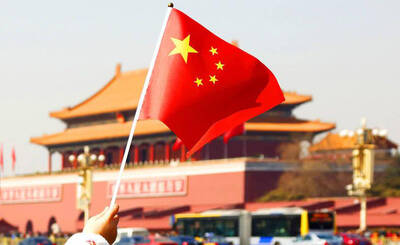
TRADE-OFF: Beijing seeks to trade a bowl of tempura for a Chinese delicacy, an official said, while another said its promises were attempts to interfere in the polls The government must carefully consider the national security implications of building a bridge connecting Kinmen County and Xiamen, China, the Public Construction Commission (PCC) said yesterday. PCC Commissioner Derek Chen (陳金德), who is also a minister without portfolio, made the remarks in a meeting of the legislature’s Transportation Committee, after Democratic Progressive Party Legislator Hsu Fu-kuei (徐富癸) asked about China’s proposal of new infrastructure projects to further connect Kinmen and Lienchiang (Matsu) counties with Xiamen. China unveiled the bridge plan, along with nine other policies for Taiwan, on Sunday, the last day of Chinese Nationalist Party (KMT) Chairwoman Cheng Li-wun’s (鄭麗文) visit


 RSS
RSS