


The director of the American Institute in Taiwan (AIT) denied yesterday that the US is bullying Taiwan on the issue of US beef imports.
AIT Director William Stanton made the remarks in the face of protests that Washington has been putting pressure on Taipei to allow imports of US beef containing residues of ractopamine, a leanness enhancer used by the US meat industry that is banned in many parts of the world, including Taiwan.
“America doesn’t bully,” Stanton said.
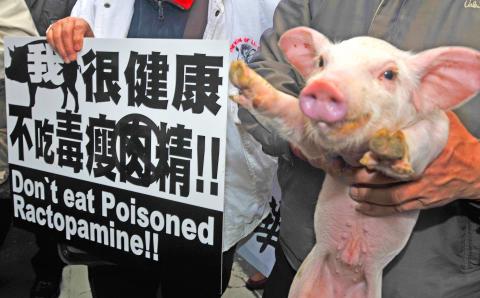
Photo: Mandy Cheng, AFP
In a 45-minute interview with local media, Stanton said more than once that the US considers ractopamine to be a safe feed additive and he urged the Taiwanese authorities to review the current ban based on scientific findings and rational discussion.
A considerable number of studies have been done to prove ractopamine is a safe feed additive, he said, noting that millions of people have eaten meat with residues of ractopamine without falling sick.
“I think the whole debate has been a bit eschewed, frankly. All we say is, bring it back to science,” Stanton said.
Proposing a look at the problem from a historical perspective, he produced a notification submitted in 2007 by then-president Chen Shui-bian’s (陳水扁) administration to the WTO, saying that his government was going to allow ractopamine use in pigs and cattle.
“What happened was that pig farmers ... protested and the government backed down,” he said. “You have to understand the history of the issue to understand some of the frustrations of the US trade negotiators.”
Stanton said fears over health concerns and a negative impact on the domestic meat market are unfounded and not scientific. Citing statistics showing that the US on average consumes 98 percent of the pork it produces, Stanton said his country has no motive to stir up a disturbance in the local pork market.
Taiwan’s beef market is relatively small for the US, he added. He said Japan imported US$900 million of US beef, while South Korea imports US$600 million.
“The highest amount of beef we sold here was in 2010 and that was valued at about US$220 million,” he said.
“I think Taiwan needs in the future to diversify its markets,” Stanton said, adding that Taiwan’s international trade relations with the US could be hindered if the beef dispute remains unsolved.
“This kind of issue will be a stumbling block, not only with the US, but with winning free-trade agreements with other countries. So it’s in Taiwan’s own interest to open up its markets more,” Stanton said.
The US’ frustration, for example, can be seen in the long-stalled bilateral talks under the Trade and Investment Framework Agreement (TIFA).
Talks were brought to a halt in 2007 after Taiwan imposed a strict ban on ractopamine in 2006 and returned batches of US beef containing residues of ractopamine.
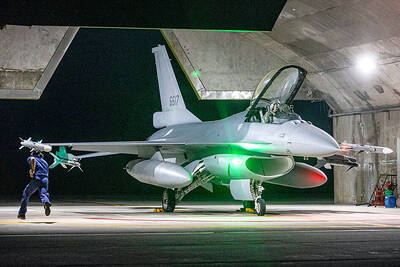
Taiwan has received more than US$70 million in royalties as of the end of last year from developing the F-16V jet as countries worldwide purchase or upgrade to this popular model, government and military officials said on Saturday. Taiwan funded the development of the F-16V jet and ended up the sole investor as other countries withdrew from the program. Now the F-16V is increasingly popular and countries must pay Taiwan a percentage in royalties when they purchase new F-16V aircraft or upgrade older F-16 models. The next five years are expected to be the peak for these royalties, with Taiwan potentially earning
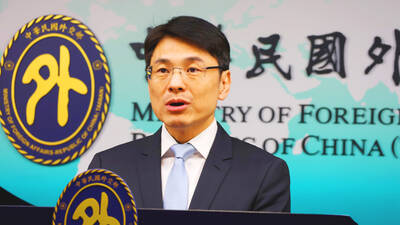
STAY IN YOUR LANE: As the US and Israel attack Iran, the ministry has warned China not to overstep by including Taiwanese citizens in its evacuation orders The Ministry of Foreign Affairs (MOFA) yesterday rebuked a statement by China’s embassy in Israel that it would evacuate Taiwanese holders of Chinese travel documents from Israel amid the latter’s escalating conflict with Iran. Tensions have risen across the Middle East in the wake of US and Israeli airstrikes on Iran beginning Saturday. China subsequently issued an evacuation notice for its citizens. In a news release, the Chinese embassy in Israel said holders of “Taiwan compatriot permits (台胞證)” issued to Taiwanese nationals by Chinese authorities for travel to China — could register for evacuation to Egypt. In Taipei, the ministry yesterday said Taiwan
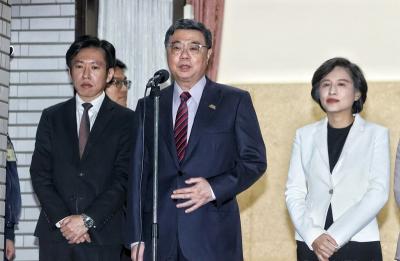
Taiwan is awaiting official notification from the US regarding the status of the Agreement on Reciprocal Trade (ART) after the US Supreme Court ruled US President Donald Trump's global tariffs unconstitutional. Speaking to reporters before a legislative hearing today, Premier Cho Jung-tai (卓榮泰) said that Taiwan's negotiation team remains focused on ensuring that the bilateral trade deal remains intact despite the legal challenge to Trump's tariff policy. "The US has pledged to notify its trade partners once the subsequent administrative and legal processes are finalized, and that certainly includes Taiwan," Cho said when asked about opposition parties’ doubts that the ART was
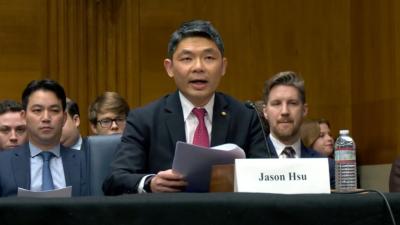
If China chose to invade Taiwan tomorrow, it would only have to sever three undersea fiber-optic cable clusters to cause a data blackout, Jason Hsu (許毓仁), a senior fellow at the Hudson Institute and former Chinese Nationalist Party (KMT) legislator, told a US security panel yesterday. In a Taiwan contingency, cable disruption would be one of the earliest preinvasion actions and the signal that escalation had begun, he said, adding that Taiwan’s current cable repair capabilities are insufficient. The US-China Economic and Security Review Commission (USCC) yesterday held a hearing on US-China Competition Under the Sea, with Hsu speaking on


 RSS
RSS