


President Ma Ying-jeou (馬英九) has already broken his campaign promises less than a month after winning re-election, taking a sharp turn on a wide range of policies, the Democratic Progressive Party (DPP) said yesterday.
Ma proposed implementing a social housing program and reiterated his opposition to lifting the import ban on US beef during his re-election campaign, but he and his administration are now making dramatic U-turns on those issues, DPP Legislator Chen Ting-fei (陳亭妃) told a press conference.
Minister of the Interior Lee Hong-yuan (李鴻源), who was sworn in on Monday, said yesterday that no more new social housing projects will be planned.
The Ma administration, which imposed a ban on US beef import in 2009, is now considering easing the ban on beef containing the controversial livestock feed additive ractopamine.
“Ma’s failure to keep his campaign promises is not new. A lot of his pledges in the 2008 presidential campaign were broken during the next four years,” Chen said.
The sudden change of policy on social housing and US beef are only “the tip of the iceberg” in terms of Ma’s broken promises, she said, adding that Ma had also “lied to Taiwanese” about the impact of the cross-strait Economic Cooperation Framework Agreement (ECFA).
Newly appointed Council of Economic Planning and Development Minister Yiin Chii-ming (尹啟銘) was quoted in an interview yesterday as saying that the first-year results of the ECFA had not been as good as expected.
The Ma administration estimated that Taiwanese businesses would save at least US$9 billion in tariffs after the ECFA was signed, she said. However, according to statistics from the Bureau of Foreign Trade, actual tariff cuts last year amounted to less than US$200 million.
Statistics also showed that Taiwanese exports to China grew by 8.1 percent last year and Chinese exports to Taiwan increased by 20.5 percent. While US$13.1 billion in Taiwanese investment went to China last year, Chinese investment in Taiwan was less than US$50 million.
“Ma lied to Taiwanese when he said Beijing ‘yielded benefits’ to Taiwan when signing the trade pact. In fact, China is the beneficiary,” DPP Legislator Huang Wei-cher (黃偉哲) said.
“These numbers show that Ma did not tell people the truth before the presidential election,” Huang said.
Not only Ma, but also officials in his administration have shown inconsistency in their policymaking, often sending out mixed and conflicting messages, Huang said.
For example, Lee’s decision cease planning any more social housing projects was a “slap in the face” to Ma and Deputy Premier Jiang Yi-huah (江宜樺), the former minister of the interior.
Intentionally or unintentionally, government officials often announce policies prematurely and then cancel them after public opposition and heated discussion, Huang said.

The military has spotted two Chinese warships operating in waters near Penghu County in the Taiwan Strait and sent its own naval and air forces to monitor the vessels, the Ministry of National Defense (MND) said. Beijing sends warships and warplanes into the waters and skies around Taiwan on an almost daily basis, drawing condemnation from Taipei. While the ministry offers daily updates on the locations of Chinese military aircraft, it only rarely gives details of where Chinese warships are operating, generally only when it detects aircraft carriers, as happened last week. A Chinese destroyer and a frigate entered waters to the southwest

A magnitude 6.1 earthquake struck off the coast of Yilan County at 8:39pm tonight, the Central Weather Administration (CWA) said, with no immediate reports of damage or injuries. The epicenter was 38.7km east-northeast of Yilan County Hall at a focal depth of 98.3km, the CWA’s Seismological Center said. The quake’s maximum intensity, which gauges the actual physical effect of a seismic event, was a level 4 on Taiwan’s 7-tier intensity scale, the center said. That intensity level was recorded in Yilan County’s Nanao Township (南澳), Hsinchu County’s Guansi Township (關西), Nantou County’s Hehuanshan (合歡山) and Hualien County’s Yanliao (鹽寮). An intensity of 3 was

Japanese Prime Minister Sanae Takaichi’s comment last year on Tokyo’s potential reaction to a Taiwan-China conflict has forced Beijing to rewrite its invasion plans, a retired Japanese general said. Takaichi told the Diet on Nov. 7 last year that a Chinese naval blockade or military attack on Taiwan could constitute a “survival-threatening situation” for Japan, potentially allowing Tokyo to exercise its right to collective self-defense. Former Japan Ground Self-Defense Force general Kiyofumi Ogawa said in a recent speech that the remark has been interpreted as meaning Japan could intervene in the early stages of a Taiwan Strait conflict, undermining China’s previous assumptions
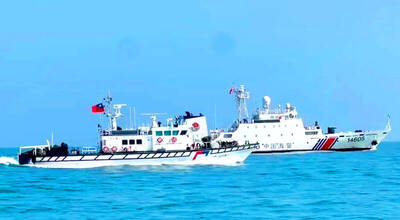
Instead of focusing solely on the threat of a full-scale military invasion, the US and its allies must prepare for a potential Chinese “quarantine” of Taiwan enforced through customs inspections, Stanford University Hoover fellow Eyck Freymann said in a Foreign Affairs article published on Wednesday. China could use various “gray zone” tactics in “reconfiguring the regional and ultimately the global economic order without a war,” said Freymann, who is also a nonresident research fellow at the US Naval War College. China might seize control of Taiwan’s links to the outside world by requiring all flights and ships entering or leaving Taiwan


 RSS
RSS