


Greater Kaohsiung, Chiayi — cities little known outside Taiwan, but in Saturday’s presidential election, they could hand victory to an opposition candidate expected to cool relations with China.
The cities are in the south, where Taiwanese are traditionally wary of China’s embrace and where many are pinning their hopes on Democratic Progressive Party (DPP) presidential candidate Tsai Ing-wen (蔡英文), who is aiming to become Taiwan’s first female head of state.
“Little Ing elected,” hundreds of people chanted on Sunday in Greater Tainan, affectionately using Tsai’s nickname as they caught a glimpse of her passing by in an open-top jeep.
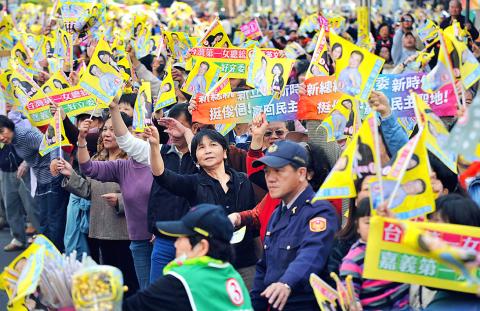
Photo: PATRICK LIN, AFP
Morale is high among Tsai’s followers, who believe she has a real chance of regaining power for the DPP, which lost to President Ma Ying-jeou (馬英九) four years ago.
Relations between China and Taiwan have improved since Ma took office on a Beijing-friendly platform, allowing in more Chinese tourists and signing an important trade pact.
Ma is running for a second and final term, arguing that he can maintain prosperity in Taiwan through stable cross-strait ties, although some voters appear unconvinced.
“I don’t like China as it often bullies Taiwan and looks down on us,” 22-year-old student Liu Chia-wen said as she took part in a major rally for Tsai in Greater Kaohsiung. “I think Ma is leaning too much toward China and he hasn’t done enough to uphold Taiwan’s sovereignty.”
Tsai has given few details about where she would take Taiwan’s China policy if elected and Beijing has been careful not to explicitly warn against her, fearing it could boost her support.
However, there is little doubt China would prefer four more years of Ma rather than a return of the DPP.
In a veiled reference to the DPP’s track record, a spokesman for Beijing’s Taiwan Affairs Office said last month that insisting on Taiwanese independence will “harm the peaceful development of relations.”
Southern voters are concerned Taiwan has become too reliant on Beijing during Ma’s term and dubious over the supposed benefits of closer ties.
“We southerners are rooting for a Tsai victory,” said Wu Jia-chi, a mother of two who runs a restaurant in Chiayi County.
“I don’t think we should open too much to China, which will want to have more control of Taiwan and eventually turn us into a second Hong Kong,” she said, referring to the territory where British rule ended in 1997.
Interviews with voters in the south lay bare the unease that remains to this day.
Huang Li-chin, a rice distributor from a farming family in Tainan, criticized Beijing for “trying to buy its way into Taiwan people’s hearts” while refusing to remove missiles targeting Taiwan.
“Taiwan may be small and weak and China may be rich and powerful, but we want to be our own masters and we don’t want to become a province of China,” she said.
Huang is among those dismayed by a 2008 incident when police prevented demonstrators from displaying Taiwan’s national flag during a visit by a top Chinese official.
“If we don’t have any dignity, it won’t matter how much more money we can make from trade deals with China,” she said.
Tsai has sought to ease fears that her victory would stir up tensions, vowing to seek peace and dialogue with Beijing.
Taiwan’s young democracy has traditionally been defined by China policy, but it is a less prominent factor in these elections because of voter apathy. National polls show Ma leading Tsai by as little as 3 percentage points.
However, a recent China Times survey showed Tsai’s support in the south was running at 48 percent in Tainan, Yunlin and Chiayi, against 32 percent for Ma, reflecting the strong feelings in the region.
Shen Feng-piao, a retired businessman, said he believes China is using trade as a foil to push for its ultimate political goal of taking over Taiwan, and that it will pile pressure on Ma if he is re-elected.
“I think Tsai won’t move so fast like Ma, but she won’t be too radical. She can uphold Taiwan’s sovereignty and maintain the ‘status quo,’” he said. “No matter how big and strong China is, I want to live in a democracy and I want to elect my president.”

The military has spotted two Chinese warships operating in waters near Penghu County in the Taiwan Strait and sent its own naval and air forces to monitor the vessels, the Ministry of National Defense (MND) said. Beijing sends warships and warplanes into the waters and skies around Taiwan on an almost daily basis, drawing condemnation from Taipei. While the ministry offers daily updates on the locations of Chinese military aircraft, it only rarely gives details of where Chinese warships are operating, generally only when it detects aircraft carriers, as happened last week. A Chinese destroyer and a frigate entered waters to the southwest
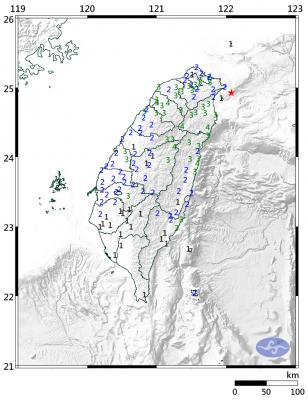
A magnitude 6.1 earthquake struck off the coast of Yilan County at 8:39pm tonight, the Central Weather Administration (CWA) said, with no immediate reports of damage or injuries. The epicenter was 38.7km east-northeast of Yilan County Hall at a focal depth of 98.3km, the CWA’s Seismological Center said. The quake’s maximum intensity, which gauges the actual physical effect of a seismic event, was a level 4 on Taiwan’s 7-tier intensity scale, the center said. That intensity level was recorded in Yilan County’s Nanao Township (南澳), Hsinchu County’s Guansi Township (關西), Nantou County’s Hehuanshan (合歡山) and Hualien County’s Yanliao (鹽寮). An intensity of 3 was

Japanese Prime Minister Sanae Takaichi’s comment last year on Tokyo’s potential reaction to a Taiwan-China conflict has forced Beijing to rewrite its invasion plans, a retired Japanese general said. Takaichi told the Diet on Nov. 7 last year that a Chinese naval blockade or military attack on Taiwan could constitute a “survival-threatening situation” for Japan, potentially allowing Tokyo to exercise its right to collective self-defense. Former Japan Ground Self-Defense Force general Kiyofumi Ogawa said in a recent speech that the remark has been interpreted as meaning Japan could intervene in the early stages of a Taiwan Strait conflict, undermining China’s previous assumptions
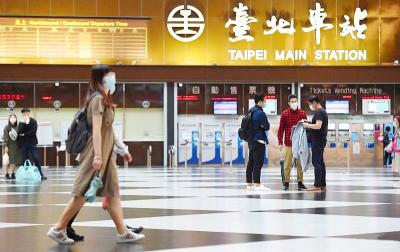
Taiwan Railways Corp (TRC) today announced that Shin Kong Mitsukoshi has been selected as the preferred bidder to operate the Taipei Railway Station shopping mall, replacing the current operator, Breeze Development Co Ltd. Among eight qualified firms that delivered presentations and were evaluated by a review committee, Shin Kong Mitsukoshi was ranked first, while Breeze was named the runner-up, the rail company said in a statement. Contract negotiations are to proceed in accordance with regulations, it said, adding that if negotiations with the top bidder fail, it could invite the second-ranked applicant to enter talks. Breeze in a statement today expressed doubts over


 RSS
RSS