


Taiwan has become the first country to make an international purchase of the Block III Longbow Fire Control Radar (FCR), a powerful target acquisition and prioritization system and a key component of the AH-64D Apache helicopter.
This was made official in a Lockheed Martin Corp press release on Wednesday, which stated that Longbow Limited Liability Co, a joint venture of Lockheed Martin and Northrop Grumman Corp, had received a US$181 million contract from the US Army for AH-64D Apache Block III Longbow systems.
According to the press release, the contract includes the first international purchase of the Block III Longbow Fire Control Radar (FCR), for a total of 15 Block III Longbow FCR systems.
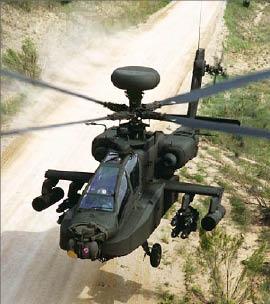
Photo: Boeing Web site
The Boeing Co-made Apaches are part of a US$6.4 billion arms package notified to US Congress in October 2008. The 30 attack helicopters will cost Taiwan an estimated US$2.5 billion and will supplement the AH-1W Super Cobra that has been used by the Taiwanese army since 1993. The notification also included 1,000 AGM-114L Longbow Hellfire missiles and 66 M299 Hellfire Longbow missile launchers.
Wednesday’s announcement represents the first batch of Longbow radar systems for Taiwan, with orders for the remaining 15 expected to be placed sometime in the future.
“The Longbow Apache is the world’s premier attack helicopter and the FCR is one of the key elements that make it that way,” Colonel Shane Openshaw, US Army project manager for the Apache helicopters, was quoted as saying.
The FCR provides all-terrain and all-weather detection, location, classification and prioritization of multiple air and ground targets, the Web site says. As it is mounted atop the helicopter’s main rotor, the FCR enhances the Apache’s ability to acquire and track targets without being detected. The Longbow FCR integrates with the Hellfire missile, enhancing the Apache’s lethality fourfold and increasing its survivability sevenfold, the release says.
The first Apache is scheduled for delivery in October. Taiwan’s acquisition of the world’s most advanced combat helicopter is part of a project codenamed Tian Ying, or “Sky Eagle.”
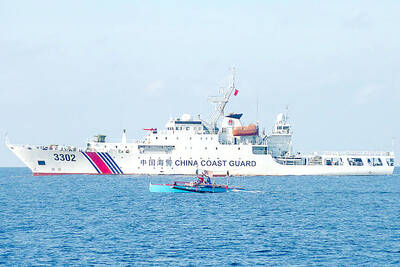
EXPANSIONIST: China deploys an average of 40 to 50 warships and coast guard vessels daily in the South China Sea, despite pledges not to militarize the region, an official said China is attempting to expand its influence across the First Island Chain and increase pressure on Japan by sending coast guard vessels into waters off of Taiwan under the pretext of maritime negotiations with Japan and the Philippines, a national security official said yesterday. China’s recent actions in the waters east of Taiwan and Japan and the Philippines’ exclusive economic zones (EEZ) are attempts to establish dominance in First Island Chain waters, said the official who declined to be named, adding that this is “expansion disguised as law enforcement.” Framing China’s actions solely as a cross-strait issue is a serious misjudgment that
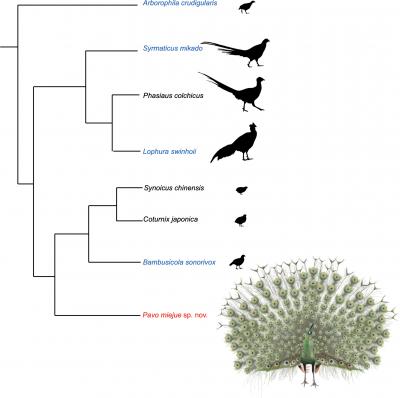
Through analyzing fossil evidence, a research team at National Taiwan University (NTU) discovered the largest endemic bird to have lived in Taiwan, naming it Pavo miejue, or extinct peafowl (滅絕孔雀). The Mikado pheasant, which is printed on the back of the NT$1,000 bank note, was previously believed to be the biggest endemic bird to Taiwan. The research team’s findings suggest that Pavo miejue lived during the Pleistocene epoch tens of thousands of years ago. It is the first endemic extinct bird species discovered and formally named in Taiwan. The study was coauthored by NTU Institute of Ecology and Evolutionary Biology professor Tsai Cheng-hsiu (蔡政修),
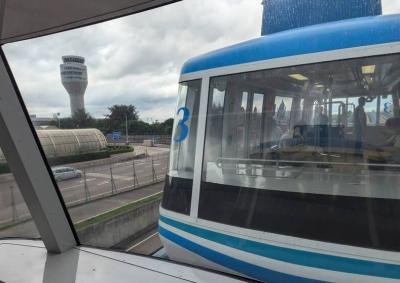
Taiwan Taoyuan International Airport is to suspend its automated Skytrain service connecting Terminal 1 and Terminal 2 starting on July 1 to facilitate connection works for the upcoming Terminal 3, the airport operator said today. Passengers and staff who need to travel between the two terminals after the suspension can instead use the Taoyuan MRT or the airport's 24-hour shuttle bus service, Taoyuan International Airport Corp said. The Taoyuan MRT Airport Line directly links the two terminals, while the shuttle buses are to operate around the clock, the company added. The Skytrain provides free transportation between the airport’s two terminals for travelers and
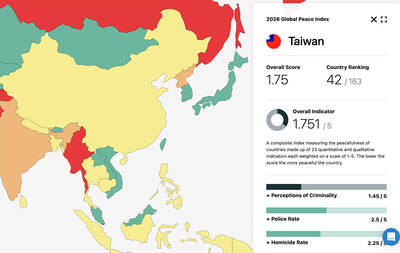
Taiwan ranked 42nd in terms of peacefulness among 163 countries, down five places from last year, according to this year’s Global Peace Index. With an overall score of 1.751, Taiwan dropped from 37th last year, the report published by the global Institute for Economics and Peace showed. The overall score measures a country’s level of peacefulness using 23 quantitative and qualitative indicators across three domains — ongoing domestic and international conflict, societal safety and security, and militarization. While Taiwan ranked 42nd worldwide, it was listed in ninth place among the 19 Asian-Pacific countries in the report, after New Zealand, Singapore, Japan, Malaysia,


 RSS
RSS