


The government will start fingerprinting foreigners next year as part of its efforts to strengthen border control, with workers from four Southeast Asian countries to be affected first.
At present, blue-collar migrant workers and Chinese spouses are required to process their fingerprint card at the National Immigration Agency (NIA) service center within the area of their residency within 15 days of entering Taiwan.
Starting in the first quarter of next year, nationals from Vietnam, Thailand, the Philippines and -Indonesia who apply for visas to stay in Taiwan for six months or more to work in blue-collar sectors or to marry a Taiwanese citizen will be fingerprinted when they apply for their visa in their home country, director--general of the Bureau of Consular Affairs Thomas Chen (陳經銓) told a news briefing.
Chen said the implementation date had yet to be decided
“[Those] countries do not have rigorous procedures for processing visas, which permits false applications or applications under false identities. National security is the main concern,” Chen said.
Some immigrant workers who are not allowed to work in Taiwan either because they have completed the maximum nine years or because they were deported have changed their names and applied for visas under different identities, Chen said.
Fake marriages are also a problem, Chen said, adding that between 15 percent and 30 percent of spouses from these countries were suspected of seeking a fake marriage and were denied visas.
Chen said the Ministry of Foreign Affairs had communicated with its counterparts and labor brokers in those countries to inform them of the policy and had not received any complaints.
Separately, NIA Deputy Director-General Ho Jung-chun (何榮村) said by telephone yesterday that the government planned to collect fingerprints for anyone who does not have registered permanent residence in Taiwan at ports of entry, where their identity would also be verified using facial recognition systems.
Article 91 of the Immigration Act (入出國及移民法), amended in 2009, authorizes the use of biometric systems to collect information on individuals and to keep a record of the information when foreigners, nationals without registered permanent residence, or residents of China, Hong Kong and Macau apply for residence or permanent residency, Ho said.
“The policy will apply to anyone without registered permanent residence regardless of their nationality or duration of stay,” Ho said.
Commenting on the policy, the Taiwan International Workers’ Association (TIWA) and TransAsia Sisters Association, Taiwan (TASAT) both voiced opposition.
“It’s a policy of racial discrimination because the ministry assumes that people from those [four Southeast Asian] countries are more likely to come to Taiwan under false pretenses,” TIWA secretary-general Chen Hsiu-lian (陳秀蓮) said.
TASAT director Wu Jia-zhen (吳佳臻) said it was a way to repress the disadvantaged under the pretext of national security.
The government originally included foreign spouses in its policy, but made an about-face late last night, saying the policy will not apply to people married to Taiwanese.

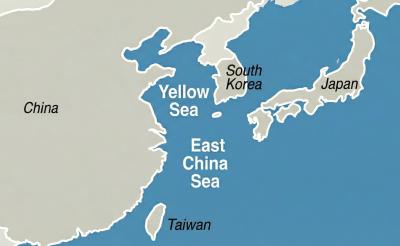
China has reserved offshore airspace in the Yellow Sea and East China Sea from March 27 to May 6, issuing alerts usually used to warn of military exercises, although no such exercises have been announced, the Wall Street Journal (WSJ) reported yesterday. Reserving such a large area for 40 days without explanation is an “unusual step,” as military exercises normally only last a few days, the paper said. These alerts, known as Notice to Air Missions (Notams), “are intended to inform pilots and aviation authorities of temporary airspace hazards or restrictions,” the article said. The airspace reserved in the alert is

South Korea is planning to revise its controversial electronic arrival card, a step Taiwanese officials said prompted them to hold off on planned retaliatory measures, a South Korean media report said yesterday. A Yonhap News Agency report said that the South Korean Ministry of Foreign Affairs is planning to remove the “previous departure place” and “next destination” fields from its e-arrival card system. The plan, reached after interagency consultations, is under review and aims to simplify entry procedures and align the electronic form with the paper version, a South Korean ministry official said. The fields — which appeared only on the electronic form

More than 6,000 Taiwanese students have participated in exchange programs in China over the past two years, despite the Mainland Affairs Council’s (MAC) “orange light” travel advisory, government records showed. The MAC’s publicly available registry showed that Taiwanese college and university students who went on exchange programs across the Strait numbered 3,592 and 2,966 people respectively. The National Immigration Agency data revealed that 2,296 and 2,551 Chinese students visited Taiwan for study in the same two years. A review of the Web sites of publicly-run universities and colleges showed that Taiwanese higher education institutions continued to recruit students for Chinese educational programs without

A bipartisan group of US senators has introduced a bill to enhance cooperation with Taiwan on drone development and to reduce reliance on supply chains linked to China. The proposed Blue Skies for Taiwan Act of 2026 was introduced by Republican US senators Ted Cruz and John Curtis, and Democratic US senators Jeff Merkley and Andy Kim. The legislation seeks to ease constraints on Taiwan-US cooperation in uncrewed aerial systems (UAS), including dependence on China-sourced components, limited access to capital and regulatory barriers under US export controls, a news release issued by Cruz on Wednesday said. The bill would establish a "Blue UAS


 RSS
RSS