


Non-governmental organizations (NGO) supervising the construction and operation of the Fourth Nuclear Power Plant said they would issue a statement of no-confidence in reaction to a safety report, to be submitted by Taiwan Power Corp (Taipower) today, which fails to tackle structural issues.
The Fourth Nuclear Power Plant Safety Oversight Committee is scheduled to hold a meeting today in Gongliao (貢寮), New Taipei City (新北市), where the plant is located. During the meeting, Taipower will brief the members on how it intends to resolve the safety problems at the plant.
Green Citizens’ Action Alliance secretary-general Tsui Shu-hsin (崔愫欣), who is also a member of the committee, said the group had received an advance copy of the report and determined that the state-run power company was not sincere in addressing safety issues.
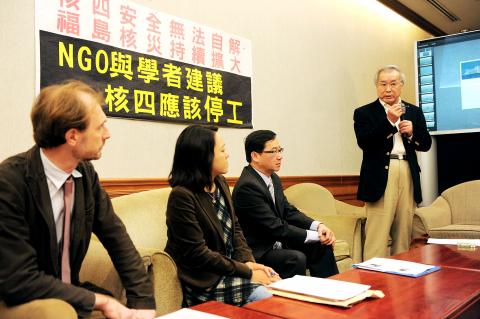
Photo: CNA
“If you look at the report, which has already listed 30 to 40 problems from the nuclear power plant, you really question the quality of the construction,” Tsui said. “They are just minor problems and Taipower is still avoiding addressing the structural flaws.”
Tsui said former committee member Lin Tsung-yao (林宗堯) had already identified flaws in the design, construction and the operating system at the plant.
Any proposed solutions would be rendered useless if Taipower fails to stop the construction and fix these flaws immediately, she said.
While it was reported in July that electrical cables at the plant’s control room needed to be reinstalled after technicians failed to properly follow the design, Tsui said the Taipower report said nothing about why such an error had occurred.
While Taipower claimed it would hire foreign specialists to inspect the plant, Tsui said it was an excuse to avoid dealing with the fundamental problems.
She said there were 300 reports about the plant, all written in Chinese. It would take at least six months to translate those documents, and that time would not even guarantee that the translations were error-free, Tsui said.
“Taipower expects the members of the Oversight Committee to endorse the contents of the 130-page report and guarantee that the power plant is safe. We will say that we do not recognize the report and have no confidence in it,” Tsui said.
Democratic Progressive Party (DPP) Legislator Tien Chiu-chin (田秋堇) said the committee passed a resolution in August that said construction of the Fourth Nuclear Power Plant should be suspended if safety problems could not be resolved
Tien added that President Ma Ying-jeou (馬英九) should tell the public how much more money the nation needs to spend on the plant if the nation decides to continue construction.
She said Ma promised to invite officials from the US Nuclear Regulatory Commission to inspect the plant, but they would not sign anything while they were visiting.
She said the nation would not be able to hold the officials responsible if anything happened at the plant.
Tien said Taipower had evaluated in 2000 that suspending construction would cost about NT$80 billion (US$2.63 billion).
Now it will cost more than NT$270 billion to construct the plant and make sure it is safe to run, she said.
Even though it is not yet operational, the plant had already been declared by the World Nuclear Association as one of the most dangerous in the world, she added.
A former head of the Environmental Protection Administration, Lin Jun-yi (林俊義), as well as Taipei Office of the French Center for Research on Contemporary China director Paul Jobin, said the Japanese public did not trust the statistics presented by Tokyo pertaining to the radioactive contamination following the crisis at the Fukushima Dai-ichi nuclear power power plant, which leaked radiation following the March earthquake and tsunami.
“Based on the report from Taipower, we will conduct a stress test on the Fourth Nuclear Power Plant using a model set in Germany,” Lin said.

The Ministry of Finance this afternoon announced the winning numbers for the March-April uniform invoice lottery. The winning number for the NT$10 million (US$318,060) special prize is 19531471, and the winning number for the NT$2 million grand prize is 85941329. Three numbers were drawn for the NT$200,000 first prize: 07225810, 20231230 and 83518781. Those with receipts matching the last seven digits of any of the first-prize numbers will win the NT$40,000 second prize, while those matching the last six digits will win the NT$10,000 third prize. Those whose receipts match the last five digits of the first-prize numbers can claim the NT$4,000 fourth prize,
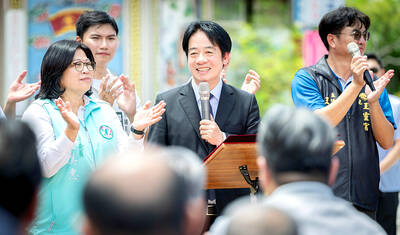
SIX SUBSIDIES: The monthly allowance for older farmers is to increase to NT$10,000, and NT$5,000 is to be given to homemakers under the national pension system, Lai said The government is to implement major welfare policies for disadvantaged groups, including raising the monthly allowance for older farmers to NT$10,000 and providing homemakers with NT$5,000 per month, President William Lai (賴清德) said yesterday. Lai made the remarks during a visit to Wangling Temple in Chiayi County, saying that the planned increases were being introduced amid economic growth and an increase in tax revenue. Touting a policy, in which the government plans to provide a monthly allowance of NT$5,000 for every child under the age of 18 in a bid to address Taiwan’s low birthrate, Lai said that if received for the
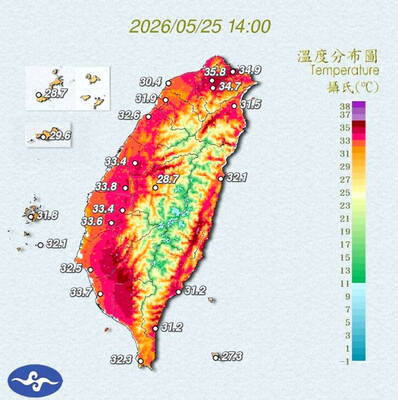
STAY COOL: The HPA recommended that people stay hydrated, use air-conditioning or fans while indoors, wear loose-fitting clothes and walk in the shade while outdoors Employers must implement measures such as installing cooling equipment, and providing drinking water and rest breaks for outdoor workers starting from Monday next week, the Taipei Department of Labor said on Sunday. Employers who fail to comply could face fines of NT$30,000 to NT$300,000 under the Occupational Safety and Health Act (職業安全衛生法), the department said. Businesses in Taipei employing fewer than 100 workers, as well as registered self-employed workers with labor insurance coverage, could receive on-site assessments and guidance from occupational safety consultants to help them apply for central government subsidies to implement or improve heat-protection measures, it said. Under the Ministry of

NATIONAL SECURITY: Authorities are working to confirm the identities of the military personnel involved and investigating possible illegal conduct and regulatory violations Authorities are probing possible national security implications after Kinmen police and immigration officers on Sunday found a Chinese woman allegedly posing as a tourist while engaging in prostitution involving more than 10 military personnel. The woman, surnamed Chen (陳), has since been deported, authorities said, adding that investigators are still working to confirm the identities of those implicated, as the records only listed code names and aliases. The case stemmed from a report received by the Kinmen District Prosecutors’ Office on Friday last week from the Jinhu Precinct of the Kinmen County Police Bureau. On Sunday, police, along with the National Immigration


 RSS
RSS