


The legislature yesterday enacted the Family Proceedings Act (家事事件處理法) to accelerate the pace of trials in family-related cases and protect disadvantaged women and children.
Chinese Nationalist Party (KMT) Legislator Pan Wei-kang (潘維剛) said the act was more progressive than similar acts in countries like Japan and Germany, mainly because it allowed for consolidation of trials of related offenses.
As an example, in line with the principle of consolidated trials, in proceedings for divorce, related cases such as child-rearing expenses and child custody may be jointly tried, to save the parties involved time and energy.
At present, trials in family--related cases are governed under the Civil Procedure Code (民事訴訟法) and Non-Contentious Case Act (非訟事件法).
Under the current system, a parent who rears a child after divorce must file a civil lawsuit for any child support that the defendant has failed to pay and must have a family proceedings court decision to force the defendant to pay maintenance.
Democratic Progressive Party (DPP) Legislator Huang Sue-ying (黃淑英) said the act was designed to protect the rights and interests of those who are disadvantaged in a marriage.
The act stipulates that proceedings in family courts be held in private and the decisions not be made public, except with the informed consent of all parties involved, Huang said.
Juveniles appearing in courts shall be accompanied by social workers and family courts shall conduct gender equality awareness programs for judges and staff to avoid gender-biased decisions, the act said.
The legislature also approved an amendment to the Consumer Debt Clearance Act (消費者債務清理條例) to ease restrictions on credit card debtors’ ability to negotiate debt settlement with lenders, which could affect about 850,000 credit card debtors who are trying to clear their debts.
Since the act was passed three years ago, only 24 percent of applications for debt repayment negotiations were approved, and only 10 percent of debtors were declared exempt from repaying their debts, DPP Legislator Chen Chieh-ju (陳節如) said.
“The act was not effective to facilitate debt settlements,” Chen said.
In Japan, 82 percent of debt repayment negotiations are approved, and the debt exemption rate for debtors is about 95 percent, Chen said.
KMT Legislator Hsieh Kuo--liang (謝國樑) said that under the amended act, courts shall rule in favor of debtors against banks as long as the debtors have regular incomes and are willing to repay the debts to the best of their abilities.

FUKUOKA SITUATION: Japanese media reported that the pathogen is expected to be identified by the summer, while the CDC downplayed the idea that it was hMPV A “mysterious cold-like illness” reported in Japan’s Fukuoka Prefecture does not seem to be a new disease, but Japanese authorities have been asked about the situation, the Centers for Disease Control (CDC) said yesterday. The Fukuoka Prefectural Medical Association on Wednesday told a news conference that a “mystery cold” that has become a hot topic on social media is “highly likely to be caused by some kind of viral infection,” Japan’s KBC News reported. “Many people are experiencing symptoms starting with a sore throat, followed by a runny nose, phlegm and a severe cough,” KBC News reported, citing association officials. Health authorities are

Nvidia Corp CEO Jensen Huang (黃仁勳) arrived in Taiwan yesterday ahead of upcoming AI and technology events, saying he plans to meet with clients and Taiwan Semiconductor Manufacturing Co Chairman C.C. Wei (魏哲家) during his visit. After landing at Taipei Songshan Airport, Huang posed for photos with fans and handed out Yakult drinks to reporters and supporters waiting at the scene, saying he has “a lot to do” during the trip. Asked about reports that Nvidia’s planned headquarters site in Taipei’s Beitou Shilin Technology Park could break ground on May 27, Huang said that if the company holds an event, he would

The Ministry of Finance this afternoon announced the winning numbers for the March-April uniform invoice lottery. The winning number for the NT$10 million (US$318,060) special prize is 19531471, and the winning number for the NT$2 million grand prize is 85941329. Three numbers were drawn for the NT$200,000 first prize: 07225810, 20231230 and 83518781. Those with receipts matching the last seven digits of any of the first-prize numbers will win the NT$40,000 second prize, while those matching the last six digits will win the NT$10,000 third prize. Those whose receipts match the last five digits of the first-prize numbers can claim the NT$4,000 fourth prize,
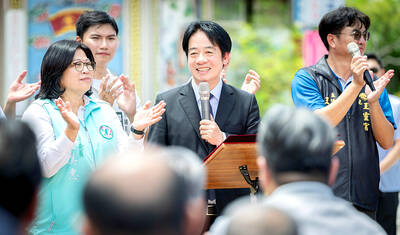
SIX SUBSIDIES: The monthly allowance for older farmers is to increase to NT$10,000, and NT$5,000 is to be given to homemakers under the national pension system, Lai said The government is to implement major welfare policies for disadvantaged groups, including raising the monthly allowance for older farmers to NT$10,000 and providing homemakers with NT$5,000 per month, President William Lai (賴清德) said yesterday. Lai made the remarks during a visit to Wangling Temple in Chiayi County, saying that the planned increases were being introduced amid economic growth and an increase in tax revenue. Touting a policy, in which the government plans to provide a monthly allowance of NT$5,000 for every child under the age of 18 in a bid to address Taiwan’s low birthrate, Lai said that if received for the


 RSS
RSS